

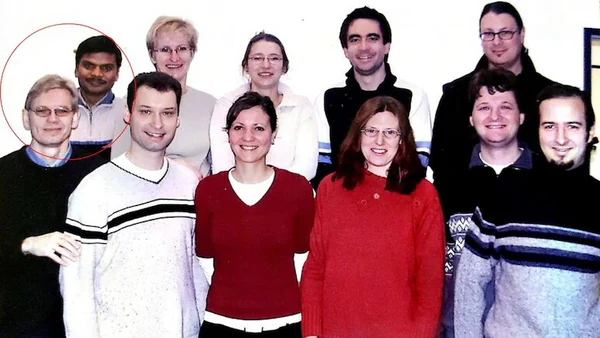
Nobel Prize 2026: How JNU Scientist Suneel Kateriya Helped Lay The Groundwork For Optogenetics


In 2001, Suneel Kateriya was working in Professor Peter Hegemann's laboratory in Regensburg, Germany, when he searched the genes of Chlamydomonas, a single-celled alga that can detect and move towards light.
Kateriya identified two light-sensing proteins. The genes were later named channelrhodopsin-1 and channelrhodopsin-2.
Quick answers to key questions
.5 QUESTIONS1What is optogenetics and how does it work?⌵Optogenetics is a technique that allows researchers to control specific cells using light. It works by introducing light-sensitive proteins into neurons, enabling the use of light to alter the electrical activity of those neurons precisely.
2Why is Suneel Kateriya's research on Chlamydomonas significant for optogenetics?⌵Suneel Kateriya's research identified light-sensing proteins in the alga Chlamydomonas, which laid the groundwork for optogenetics, enabling precise control of neuron activity and opening new avenues for neuroscience research.
3How have advances in optogenetics impacted research on neural circuits?⌵Advances in optogenetics have allowed scientists to study neural circuits more precisely, linking specific neurons to behavior, such as learned fear responses in animals, which enhances our understanding of brain functionality.
4What challenges does optogenetics face in its clinical application?⌵Optogenetics faces challenges like effective gene delivery, long-term safety, precise cell targeting, and the necessary light intensity for practical application in clinical settings.
5Should researchers consider optogenetics as a viable option for future therapies?⌵Yes, researchers should consider optogenetics, given its potential for targeted control of cells in various neurological conditions, although it remains primarily a research tool at this stage.
More than two decades later, Kateriya is a professor at Jawaharlal Nehru University (JNU ), while his work forms part of the scientific foundation behind optogenetics - a technique that allows researchers to control selected cells, including neurons, using light.
Also Read | FSSAI label ban | What interim court relief means for 'energy drinks'?The Nobel Assembly awarded the 2026 medicine prize to Karl Deisseroth, Peter Hegemann and Georg Nagel for the discovery of light-gated ion channels and optogenetics.
Kateriya has described his contribution as part of a broader collaborative effort.
"Fundamental science and academic excellence are needed for bigger innovations," he told India Today Digital.
It started with an algaThe original research was not aimed at understanding the human brain.
"We had a fundamental question: how is this alga sensing light, and where are the genes?" Kateriya said. "We never thought it would be used for controlling the human brain."
The researchers found gene sequences encoding rhodopsin proteins and proposed that they could function as light-driven ion channels.
Also Read | From 47 seconds to 21 years: How Lionel Messi's Argentina career began and endedExperiments that followed showed that these proteins act as tiny molecular gates: light causes them to open, changing a cell's electrical activity. The first findings involving channelrhodopsin-1 appeared in Science in 2002, followed by research on channelrhodopsin-2 in PNAS in 2003.
How does the 'light switch' work?Neurons communicate through electrical signals involving the movement of charged particles, or ions.
Channelrhodopsin combines a light sensor with an ion channel. When its gene is introduced into a neuron, light can effectively be used to switch that neuron on or influence its activity.
Professor Nishith Gupta of BITS Pilani's Hyderabad campus explained why that was significant.
"We could stimulate the brain long before optogenetics," he said. "What we lacked was the ability to choose a particular population of neurons and control its activity on the millisecond timescale at which the brain communicates."
Dr Santhosh Sethuramanujam of IIT Madras said older approaches could affect multiple cell types across a brain region, whereas optogenetics allows more targeted control.
"By simply shining light on brain tissue, scientists can switch targeted cells on or off with pinpoint, millisecond precision," he said.
Also Read | CEC appointment law row: SC to examine plea seeking recall of split verdict From research tool to potential treatmentOptogenetics has since been used to study neural circuits and memory, including experiments in mice that linked specific neurons to learned fear responses.
The technology has also entered early-stage human research. In a 2021 trial, a patient with retinitis pigmentosa received a gene carrying a channelrhodopsin called ChrimsonR. Special goggles then projected light onto the retina.
With the goggles, the patient could perceive, locate, count and touch objects using the treated eye. Without them, the patient could not detect them.
It was a partial recovery in one patient, not restoration of normal sight.
"Blindness is furthest along because the retina is accessible both to gene delivery and to light," Gupta said.
What comes next?Despite the promise, optogenetics remains largely a research technology. Scientists still face challenges involving gene delivery, long-term safety, cell-specific targeting and the intensity of light required.
"If I had to name the biggest barrier, it would be achieving safe, durable control of precisely the right cells in the human brain," Gupta said.
Indian laboratories are also using optogenetics to study vision, glioblastoma and genetic diseases.
For Kateriya, the journey has come full circle: from identifying light-sensitive genes in a microscopic alga as a PhD student to using related tools at JNU to study disease.
"Peter taught me hours and hours, as a PhD student," he said. "That is very important."

Legal Disclaimer:
MENAFN provides the
information “as is” without warranty of any kind. We do not accept any
responsibility or liability for the accuracy, content, images, videos,
licenses, completeness, legality, or reliability of the information
contained in this article. If you have any complaints or copyright issues
related to this article, kindly contact the provider above.
Comments
No comment