

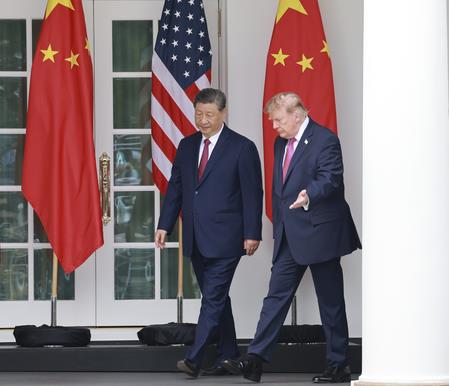
Trump Says Covid Exposed US Reliance On China


Trump says Covid exposed US reliance on China
Speaking at Sparrows Point in Maryland, Trump linked his administration's push to expand American shipbuilding with a wider effort to bring strategic manufacturing back to the United States.
“We learned that from COVID,” Trump said, referring to America's dependence on foreign suppliers.
“We didn't make our farmers -- we didn't make our drugs, it was made in China and lots of other places, Ireland, all over Europe,” he said, according to a transcript of his remarks.
Trump's comments came as he announced a major expansion of American shipbuilding capacity at the former industrial site outside Baltimore.
The president has made reshoring manufacturing and reducing US dependence on foreign supply chains a central element of his economic and national-security agenda.
He has particularly targeted America's economic relationship with China, using tariffs and other trade restrictions while pushing companies to manufacture more products in the United States.
But Trump also said Tuesday that Washington continues to have an important economic relationship with Beijing.
“We have a very good -- we've had -- always had a good relationship, but we're making a lot of money with China,” Trump said.
Trump tied that approach to defence production, saying his administration had secured more than $76 billion in shipbuilding funding to produce more than 80 new vessels for the US Navy.
The administration has argued that industrial capacity itself should be viewed as a national-security asset, particularly as the United States competes with China across military technology, advanced manufacturing and maritime power.
At Sparrows Point, Trump and Defence Secretary Pete Hegseth announced a new shipyard intended to manufacture submarine components and autonomous underwater vessels.
The project brings together federal funding and private investment as Washington attempts to expand an industrial base that officials say has become too concentrated and unable to produce ships and submarines at the speed required by the military.
Hegseth said the administration was seeking“speed, scale and urgency” from the Pentagon and defence companies.
The strategy reflects a broader shift in US economic policy in which supply chains for semiconductors, pharmaceuticals, critical minerals, energy and defence equipment are increasingly viewed through the lens of national security.

Legal Disclaimer:
MENAFN provides the
information “as is” without warranty of any kind. We do not accept any
responsibility or liability for the accuracy, content, images, videos,
licenses, completeness, legality, or reliability of the information
contained in this article. If you have any complaints or copyright issues
related to this article, kindly contact the provider above.
Comments
No comment