

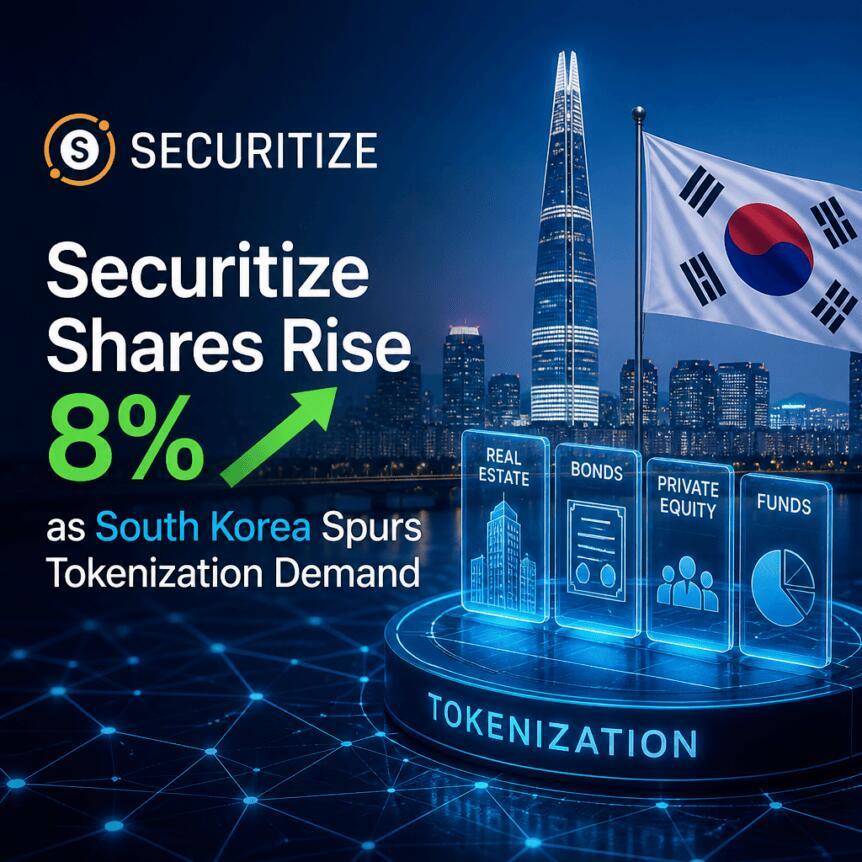
Securitize Shares Rise 8% As South Korea Spurs Tokenization Demand


In early trading, Securitize's stock rose nearly 8% to around $12.60, according to the market move reported at the time, before giving back some gains later in the morning. Securitize began trading on the New York Stock Exchange in July following its merger with special purpose acquisition company Cantor Equity Partners II.
Key takeaways- Securitize signed a memorandum of understanding with LG CNS to develop tokenized asset and digital infrastructure for South Korean financial institutions. The partnership targets tokenized funds, stocks, and stablecoins, positioning the firms for South Korea's tokenized securities framework. South Korea's Financial Services Commission has proposed rules for tokenized stocks, bonds, funds, and other securities, with implementation planned for February 2027. Securitize may gain early market presence as institutions prepare for the new regime. Broader RWA growth is increasingly centered on tokenized equities alongside tokenized Treasurys and private credit.
Securitize and LG CNS said they have signed a memorandum of understanding to explore tokenized assets and the infrastructure needed to support them across South Korea's regulated financial sector. The scope described in the agreement includes tokenized funds, stocks, and stablecoins, as well as potential opportunities across the wider Asia-Pacific market.
That timing is crucial. South Korea's Financial Services Commission (FSC) proposed a framework last week for the issuance and circulation of tokenized securities, covering tokenized stocks, bonds, funds, and other asset classes. The filing indicates the framework is expected to take effect in February 2027, according to the FSC's announcement published online.
For investors and market participants, this is the difference between tokenization as an experimental theme and tokenization as an industry with enforceable rules. As banks and capital markets players plan operational changes ahead of a compliance deadline, early infrastructure partnerships can reduce the time it takes to launch products that fit the upcoming regime.
Stock tokenization is moving from concept toward scaleSecuritize has positioned itself as a notable player in the tokenized real-world assets sector, which the article notes has grown to roughly $40 billion. Early expansion largely focused on yield-bearing assets such as US Treasurys and private credit, but tokenized equities are increasingly attracting attention as exchanges and financial firms explore ways to bring traditional stocks onto blockchain-based settlement and issuance rails.
Tokenized stocks have, in recent months, repeatedly reached new highs. According to RWA data cited in the report, tokenized equities were valued at roughly $3.2 billion, up 10.6% over the prior 30 days. The same dataset is presented specifically through RWA's stocks view.
This shift matters because equities represent a different operational profile than fixed-income or money-market instruments. Tokenized stocks generally require coordination between issuers, market infrastructure, custody and compliance workflows, and often a more complex regulatory interpretation around issuance and trading. In other words, progress in tokenized stock markets tends to be a strong indicator that tokenization platforms are maturing from infrastructure experiments into product-ready systems.
Infrastructure race: stablecoins alongside tokenized securitiesThe partnership also comes alongside an infrastructure development from LG CNS. The report notes that LG CNS launched a blockchain infrastructure platform designed to help banks and other financial companies support stablecoins and tokenized securities.
While the memorandum of understanding does not, by itself, confirm immediate product launches, it aligns with the direction regulators and institutions appear to be moving toward: tokenized securities and the digital settlement or payment components that can support them. Stablecoins, in particular, often sit at the center of debates about settlement efficiency, custody, and compliance-especially when tokenized securities are expected to operate inside regulated markets.
For Securitize, the potential upside is an early foothold in a market about to undergo rulemaking. For South Korean institutions, the practical challenge will be translating regulatory language into operational procedures that can support real issuance and circulation rather than limited demonstrations.
What to watch nextWith South Korea's framework slated to take effect in February 2027, the next steps that will likely shape outcomes are whether memorandum-level cooperation converts into specific implementations-such as tokenized funds or tokenized equity pilots-and how industry participants interpret the FSC's proposed rules in practice. Readers should watch for clearer timelines, product announcements, and evidence that infrastructure partnerships translate into compliant tokenized offerings.
Risk & affiliate notice: Crypto assets are volatile and capital is at risk. This article may contain affiliate links.
Legal Disclaimer:
MENAFN provides the
information “as is” without warranty of any kind. We do not accept any
responsibility or liability for the accuracy, content, images, videos,
licenses, completeness, legality, or reliability of the information
contained in this article. If you have any complaints or copyright issues
related to this article, kindly contact the provider above.
Comments
No comment