

Verde Agritech Reports Broad Magnet And Heavy Rare Earth Intersections From Surface At Minas Americas


| Hole | From (m) | To (m) | Len. (m) | MREO (ppm) | NdPr (ppm) | DyTb (ppm) | HREO (ppm) | TREO (ppm) |
| RC0063 | 0 | 30 | 30 | 1,853 | 1,792 | 60 | 270 | 7,787 |
| RC0001 | 0 | 53 | 53 | 1,242 | 1,202 | 39 | 163 | 5,363 |
| RC0001 | 23 | 53 | 30 | 1,950 | 1,891 | 59 | 233 | 8,201 |
| RC0001 | 34 | 44 | 10 | 2,358 | 2,286 | 72 | 273 | 9,721 |
| RC0036 | 0 | 12 | 12 | 1,566 | 1,513 | 53 | 258 | 6,859 |
| RC0054 | 0 | 27 | 27 | 1,439 | 1,396 | 43 | 203 | 5,889 |
| RC0070 | 29 | 34 | 5 | 1,631 | 1,557 | 74 | 420 | 6,949 |
| RC0054 | 9 | 14 | 5 | 3,310 | 3,220 | 90 | 370 | 10,719 |
Shorter intervals within a longer interval are included in that interval and are not additional metres. Lengths are downhole intervals, not established true widths. Results are head grades, not recovered grades. MREO and HREO overlap through DyTb and must not be added together.
Shallow auger results reinforce the rare-earth mix
The auger programme complements the longer RC intersections with shallow profiles beginning at surface. MAV_AD_0691 returned 8 metres at 2,194 ppm MREO, including 2,122 ppm NdPr and 72 ppm DyTb. MAV_AD_0639 returned 11 metres at 2,179 ppm MREO, including 2,108 ppm NdPr, 72 ppm DyTb and 335 ppm HREO.
Table 2. Selected cumulative auger intervals from surface
| Hole | From (m) | To (m) | Len. (m) | MREO (ppm) | NdPr (ppm) | DyTb (ppm) | HREO (ppm) | TREO (ppm) |
| AD0691 | 0 | 8 | 8 | 2,194 | 2,122 | 72 | 324 | 8,780 |
| AD0884 | 0 | 6 | 6 | 2,075 | 2,015 | 59 | 251 | 8,202 |
| AD0839 | 0 | 6 | 6 | 1,946 | 1,888 | 58 | 254 | 8,133 |
| AD0639 | 0 | 11 | 11 | 2,179 | 2,108 | 72 | 335 | 8,079 |
| AD0868 | 0 | 11 | 11 | 1,799 | 1,739 | 60 | 279 | 7,291 |
| AD0512 | 0 | 9 | 9 | 1,320 | 1,251 | 69 | 360 | 5,226 |
All intervals in Table 2 are complete from-surface profiles selected from the cumulative auger dataset, not a separate cohort of newly reported holes. Grades are length-weighted oxide equivalents; rounding can cause component totals to differ from the displayed sum.
Why magnet and heavy rare earths matter
Permanent magnets account for around 95% of rare-earth consumption by value, according to the International Energy Agency.[1] NdPr is the principal rare-earth component in these magnets; Dy and Tb can improve performance at elevated temperatures. These elements support applications including industrial motors, robotics, aerospace and defence.
For investors, the rare-earth mix is an important part of the exploration story. Verde therefore presents MREO, NdPr, DyTb and HREO alongside TREO, rather than relying on total grade alone. At Minas Americas, the combination of broad, shallow intersections and evidence of selective diagnostic leaching provides a basis for the next stage of exploration and process testing. Commercial significance will depend on recovery into a saleable product, impurities, reagent requirements and processing costs; it cannot be determined from head grades or industry consumption values alone.
Drilling scale and reporting progress
Through 25 September 2026, the drilling records included in this release comprise 7,304.6 metres in 1,020 auger holes and 5,336 metres in 171 RC holes, totalling 12,640.6 recorded metres. This reporting population is distinct from the gross physical drilling programme.
Assayed metres are reported separately.
Reporting progress at the 25 September cutoff
| Scope | Auger holes | RC holes | Total holes | Metres |
| Previously reported through 8 Sep | 436 | 7 | 443 | 3,628.8 assayed |
| Covered by this update | 822 | 50 new | 872 | 7,196.8 assayed |
| Combined assay compilation | 822 | 57 | 879 | 7,468.8 assayed |
| Drilling records in this release | 1,020 | 171 | 1,191 | 12,640.6 recorded |
The 50 additional RC holes comprise 39 complete holes with 1,123 assayed metres and available intervals totalling 144 metres in 11 partial holes. The 822 auger profiles are cumulative, not all newly reported: 793 complete profiles cover 5,776.8 metres and available intervals in 29 partial profiles cover 153 metres.
The separate Minas Americas Drill Hole and Assay Results Annex, dated 3 October 2026, contains complete and partial results and collar records. It is intended for publication alongside this release at , not appended here. Selected intervals in this release do not represent every hole or all grades.
Source [1]: International Energy Agency, Rare Earth Elements, Executive Summary (2026):
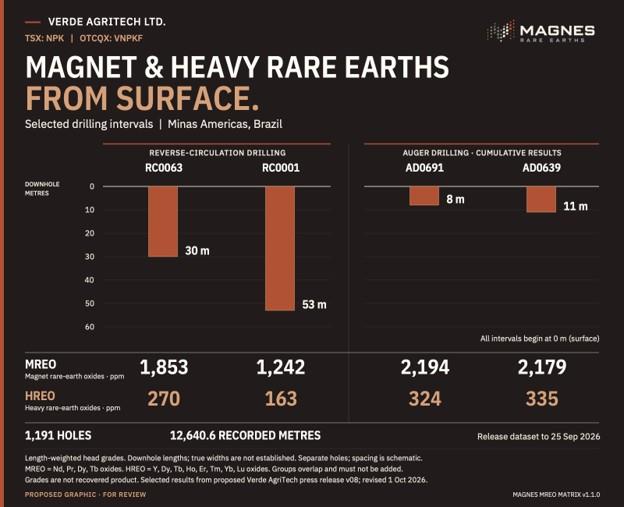
Figure 1. Selected RC and cumulative auger drilling intervals from surface. MREO and HREO overlap and must not be added. Source data cutoff: 25 September 2026.
SGS bench-scale metallurgy - from screening to process development
Building on the earlier diagnostic results, Magnes engaged SGS Geosol for a more comprehensive bench-scale metallurgical programme. Initial testing covered seven geological samples from four auger holes in different parts of Minas Americas, plus a duplicate leach of one sample for a quality-control comparison of test repeatability. The duplicate is not an additional geological sample or location. This sample set is distinct from the five diagnostic intervals described below.
A structured examination of the leach, wash and residue streams. SGS prepared and homogenised the samples and characterised their particle-size fractions before testing approximately 40 grams of minus-2 mm material with 0.5 M ammonium sulphate for 30 minutes at ambient temperature. The programme used mechanical agitation, with pH monitored and adjusted around a target of 4.2, followed by vacuum filtration and two separately analysed wash stages. Feed, collected leach liquor, each wash and solid residue were assayed for metallurgical balances and impurity assessment. Acid additions, filtration times and collected liquor volumes were recorded. Follow-up tests examined pH and reagent conditions on one sample.
Why this goes beyond diagnostic screening. The earlier ICM694 screening certificates report initial and final pH, but do not document the same time-resolved pH monitoring and adjustment or separately analysed process-stream balances. Those diagnostic results do not establish optimised pH, agitation or washing conditions. Because the programmes used different samples and preparation conditions, they are not a before-and-after demonstration of improved recovery.
The next milestone connects exploration grades with process-development decisions. The bench work examines how much rare earth content enters the collected liquid streams, how much remains in the solids and which impurities follow it. Together with reagent and filtration records, this is intended to guide subsequent work on extraction selectivity, reagent requirements and solid–liquid separation-not simply add another set of head-grade assays.
Verde expects to announce the bench-scale metallurgical results following reconciliation and technical review. No numerical results from that bench programme are disclosed in this release, and no commercial recovery or optimised flowsheet is established.
“Our next milestone is the SGS bench-scale results,” said Veloso.“The initial diagnostic tests showed magnet and heavy rare earths becoming more prominent in the dissolved rare-earth mix. The bench programme examines how much enters the leach and wash streams, how much remains in the residue and which impurities follow it. That information will guide the next stage of process development.”
Earlier SGS screening increased the share of magnet and heavy rare earths in solution
The earlier diagnostic leach screening tested how readily rare earths entered solution under a defined chemical treatment. The comparison comprised five sample intervals: four channel intervals collected in 2025 from PT-34, PT-36 and PT-42, and one later 2–3 metre auger interval from MAV_AD_0002. SGS used its ICM694 method, applying 0.5 M ammonium sulphate at an initial pH of 4, with a 30-minute leach.
Heavy rare earths more than doubled their share of the rare-earth mix after diagnostic leaching. HREO accounted for 3.0–4.1% of the original samples' rare-earth content and 6.6–12.1% of the dissolved mix. Across the five paired tests, their share was 2.1–3.3 times the original sample's share. MREO increased from 22.2–26.3% of the original rare-earth content to 41.6–48.1% of the dissolved mix, or 1.6–1.9 times its original share. These are comparisons of composition, not extraction recovery.
Table 3. Five earlier SGS diagnostic intervals
| Interval | MREO mg/kg | HREO mg/kg | DREO mg/kg | MREO share head →leach | HREO share head →leach | HREO multiple |
| PT-34 0–1 m | 161 | 36 | 384 | 23.7% → 41.9% | 3.3% → 9.3% | 2.81× |
| PT-34 1–2 m | 240 | 63 | 578 | 25.3% → 41.6% | 4.1% → 10.9% | 2.68× |
| PT-36 0–1 m | 278 | 44 | 667 | 22.2% → 41.6% | 3.0% → 6.6% | 2.20× |
| PT-42 0–1 m | 167 | 31 | 383 | 23.8% → 43.6% | 3.9% → 8.2% | 2.09× |
| AD0002 2–3 m | 237 | 60 | 492 | 26.3% → 48.1% | 3.6% → 12.1% | 3.34× |
Quantities are desorbed oxide equivalents on the laboratory mg/kg reporting basis. Shares use unrounded totals. PT-34 0–1 m DREO is 384 mg/kg using half detection limits, versus 383 mg/kg previously displayed. HREO includes Y; MREO and HREO overlap.
The auger interval illustrates the selective response: MREO increased from 26.3% to 48.1% of the rare-earth mix, while HREO increased from 3.6% to 12.1%. DyTb increased from 0.94% to 2.08%. This greater representation of magnet and heavy rare earths in the dissolved suite is the starting point for the more detailed metallurgical work.
Shares are calculated against head TREO before leaching and total desorbable rare earth oxides (DREO) afterwards. They are not increases in absolute solution concentration. HREO includes yttrium as well as heavy lanthanides and is not synonymous with DyTb. These selected diagnostic tests were not an optimised flowsheet or a project-wide metallurgical estimate.
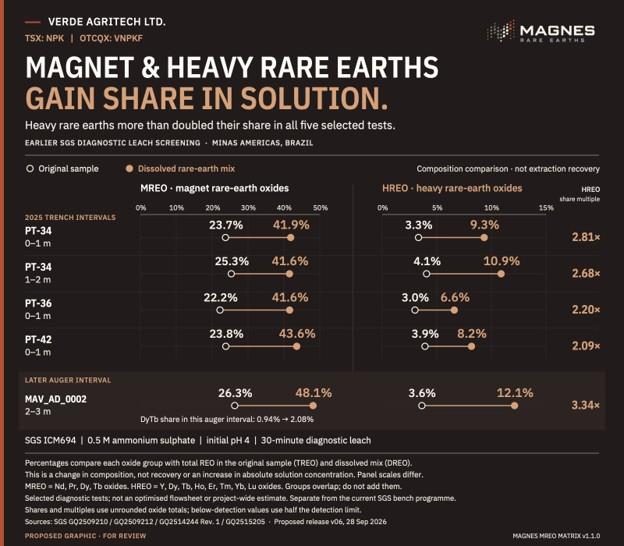
Figure 2. Original-sample and dissolved-mix composition in five selected SGS diagnostic tests. This is a comparison of composition, not extraction recovery.
Technical basis and reporting definitions
Geological setting and sampling. Minas Americas is an exploration-stage, clay-hosted rare-earth project in Minas Gerais, Brazil. Earlier diagnostic tests indicated ionic adsorption behaviour. RC and auger sampling used nominal one-metre intervals; the source records show vertical holes (dip −90°; azimuth not applicable). Source collar coordinates use SIRGAS 2000 / UTM Zone 23S. Depths, sample coverage and provisional source-field collars are tabulated in the annex. True widths and continuity between holes are not established.
Analytical laboratory and methods. Samples were analysed by the third-party laboratory SGS Geosol Laboratórios S.A., Vespasiano, Minas Gerais, Brazil. Drilling assay certificates reviewed for this update specify lithium-metaborate fusion followed by ICP-MS (IMS95A) and ICP-OES (ICP95A). SGS Geosol publishes ISO 9001:2015 certification and ISO/IEC 17025:2017 accreditation CRL 0386. Accreditation is scope-specific; this statement does not establish that every method used here is within the accredited scope.
Calculations and quality controls. The analytical programme includes blanks, certified reference materials and duplicates; these controls are excluded from geological composites. Grades are length-weighted oxide equivalents in ppm, equivalent to grams per tonne. No grade cutoff is applied to full-hole composites. Partial composites cover only available contiguous assays, not unassayed gaps. Values below detection limits are assigned half the limit; over-limit results are lower bounds, shown with“≥”, not exact grades.
Oxide groups. MREO is the sum of Nd, Pr, Dy and Tb oxides. NdPr and DyTb are their respective oxide pairs. HREO is the sum of Y, Dy, Tb, Ho, Er, Tm, Yb and Lu oxides. TREO includes the oxides of the lanthanides other than promethium, plus yttrium, and excludes scandium. DREO is the corresponding total reported after diagnostic desorption. DyTb is included in both MREO and HREO, so those groups are not additive.
Qualified Person
Carlos Leite, MAusIMM CP(Geo) (No. 1006695), an independent consultant to Magnes Rare Earths, is the Qualified Person identified for technical review of this proposed release under National Instrument 43-101 - Standards of Disclosure for Mineral Projects. This proposed release and its accompanying annex remain subject to his review and approval of the exact versions.
About Verde AgriTech and Magnes Rare Earths
Verde AgriTech Ltd. trades on the TSX as NPK and on OTCQX as VNPKF. Magnes Rare Earths, Verde's subsidiary, is advancing the exploration-stage Minas Americas rare-earth project in Minas Gerais, Brazil. The listed shares referenced in this release are Verde AgriTech shares.
The exploration and diagnostic results described here do not establish a mineral resource, mineral reserve, commercial recovery or economic assessment.
For Additional Information:
Email: ...
Verde investor information:
Magnes project and company information:
Cautionary statement regarding forward-looking information
This news release contains forward-looking information within the meaning of applicable Canadian securities laws, including statements concerning the expected announcement of SGS bench-scale metallurgical results, further exploration and process development, publication of the companion assay annex, and the potential significance of the reported magnet and heavy rare earth results. Words such as“expects”,“will”,“potential”,“next” and similar expressions may identify forward-looking information.
This information reflects management's expectations as of the release date and assumes that laboratory results and balances can be reconciled, technical review and required approvals can be completed, suitable samples and sufficient funding and personnel will be available, and further work can proceed under applicable permits and regulatory requirements. These assumptions may prove incorrect.
Actual results, timing and outcomes may differ materially because of geological and sampling variability, assay or metallurgical uncertainty, limitations in the representativeness of samples, recovery and impurity challenges, reagent consumption and processing costs, laboratory or review delays, permitting constraints, changes in rare-earth markets, financing availability and other risks described in Verde's current public disclosure filings available on SEDAR+ at . Exploration grades and selective diagnostic leaching do not establish economic viability or recovery into a saleable product.
Readers should not place undue reliance on forward-looking information. Verde undertakes no obligation to update it except as required by applicable securities laws.
Photos accompanying this announcement are available at


Legal Disclaimer:
MENAFN provides the
information “as is” without warranty of any kind. We do not accept any
responsibility or liability for the accuracy, content, images, videos,
licenses, completeness, legality, or reliability of the information
contained in this article. If you have any complaints or copyright issues
related to this article, kindly contact the provider above.
Comments
No comment