

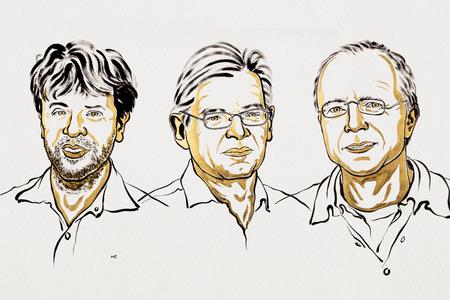
2026 Nobel In Medicine Goes To Trio For Optogenetics That Shows How Brain Shape Memories, Feelings


To understand how the brain forms memories, feelings, and behaviours has long been a dream for researchers. Optogenetics makes it possible to switch on or off the activity of individual nerve cells in a living brain.
"Optogenetics provides opportunities for mapping the brain in a way that we could once only dream of," said Per Svenningsson, Chair of the Nobel Committee for Physiology or Medicine.
According to an official statement, Hegemann and Nagel discovered "channelrhodopsin", a protein with unique properties.
They found that regardless of which cell they put the protein in, those cells became light-sensitive.
"Deisseroth introduced the gene for 'channelrhodopsin' into nerve cells from rats. By illuminating the cells with blue light, he was able to trigger a nerve signal. Later, he made this light-controlled switch for nerve cells work in the brains of living mice," the statement noted.
This method for controlling nerve signals with light is now called optogenetics, and it has rapidly gained global impact.
Hegemann's research helped reveal how certain microorganisms sense light through specialised proteins.
Nagel subsequently helped demonstrate that these proteins could function as light-controlled ion channels.
Using optogenetics, researchers have been able to reveal neural circuits governing specific memories, feelings, and behaviours relevant for neurological and psychiatric disorders.
In clinical medicine, researchers are using the method in attempts to restore sight in people with visual impairment.
Deisseroth is a professor of bioengineering, psychiatry, and behavioural sciences at Stanford University in the US. Hegemann, a German biophysicist, studied light-sensitive proteins in microorganisms. Nagel, a German neuroscientist, contributed to the discovery and characterisation of microbial opsins and demonstrated their potential as light-controlled ion channels.

Legal Disclaimer:
MENAFN provides the
information “as is” without warranty of any kind. We do not accept any
responsibility or liability for the accuracy, content, images, videos,
licenses, completeness, legality, or reliability of the information
contained in this article. If you have any complaints or copyright issues
related to this article, kindly contact the provider above.
Comments
No comment