

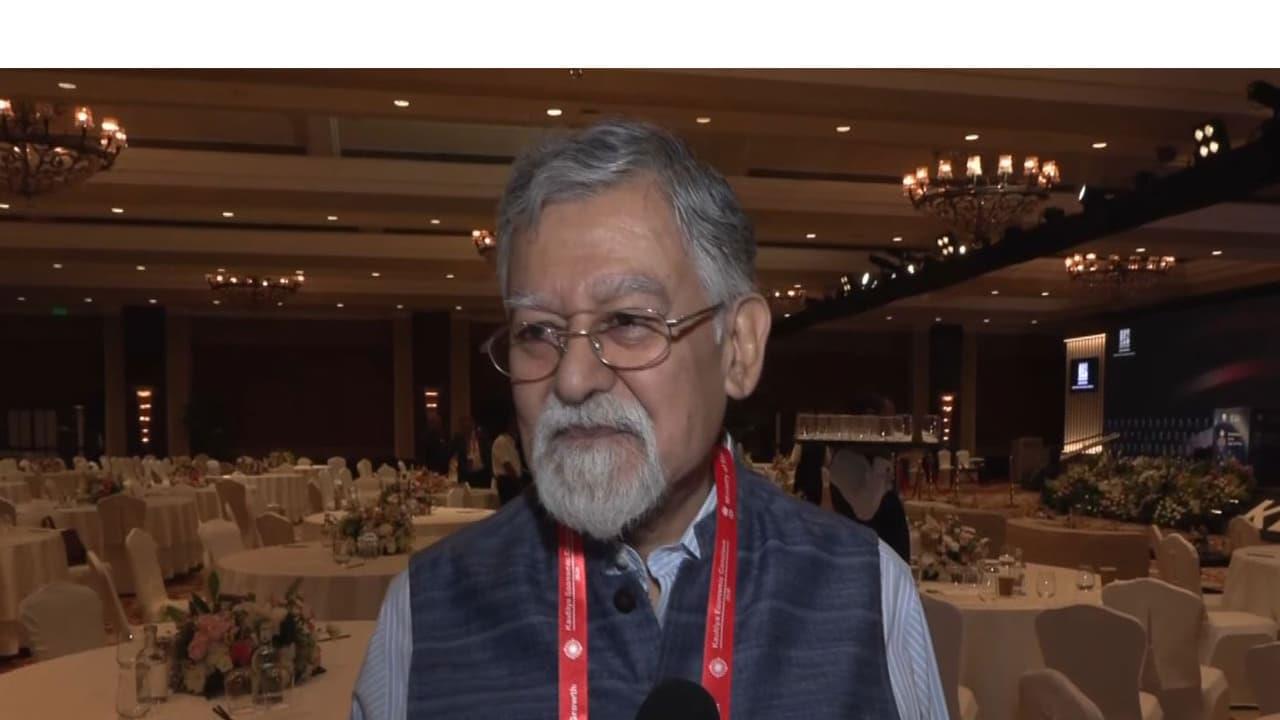
Arvind Virmani Retains 7% GDP Growth Forecast For India Amid Risks


Economic Forecasting and Uncertainty
Explaining his approach to economic forecasting, he said uncertainty was an inherent part of macroeconomic conditions and should be factored into projections rather than ignored.“Uncertainty is a fact of macroeconomic life,” Virmani said, adding that there could always be developments that had not been anticipated.
Virmani said he had reassessed his forecast about a month ago in view of developments including unresolved trade issues and other global factors, but decided to reaffirm his earlier projection.
He also cautioned against revising full-year growth forecasts solely based on quarterly GDP data, after India recorded 7.8 per cent growth in the first quarter of FY27.“A lot of people saw this 7.8 and suddenly started raising their forecasts. But I don't do that. I have a forecast, I have a range of uncertainty,” he said.
Policy on UPI Subsidies
On the issue of Merchant Discount Rate (MDR) on UPI transactions, Virmani said the initial subsidy had played an important role in promoting UPI and creating a new public good, but the policy now needed to transition towards a cost-based system.“A good subsidy creates a new public good at minimum cost,” he said.
Virmani said the current approach of retaining support below a certain transaction level while withdrawing it above that level was a way of transitioning away from subsidies. He also said moving towards a cost-based system could help address concerns from competing international payment companies that UPI was being subsidised.
On whether MDR could affect UPI transactions, Virmani said transactions would continue to grow, though there could be a temporary impact if costs were passed on.“Eventually you have to pass the thing through into the system,” he said, adding that economists generally preferred direct transfers over product-based subsidies.
(Except for the headline, this story has not been edited by Asianetnews Editorial staff and is published from a syndicated feed.)
Legal Disclaimer:
MENAFN provides the
information “as is” without warranty of any kind. We do not accept any
responsibility or liability for the accuracy, content, images, videos,
licenses, completeness, legality, or reliability of the information
contained in this article. If you have any complaints or copyright issues
related to this article, kindly contact the provider above.
Comments
No comment