

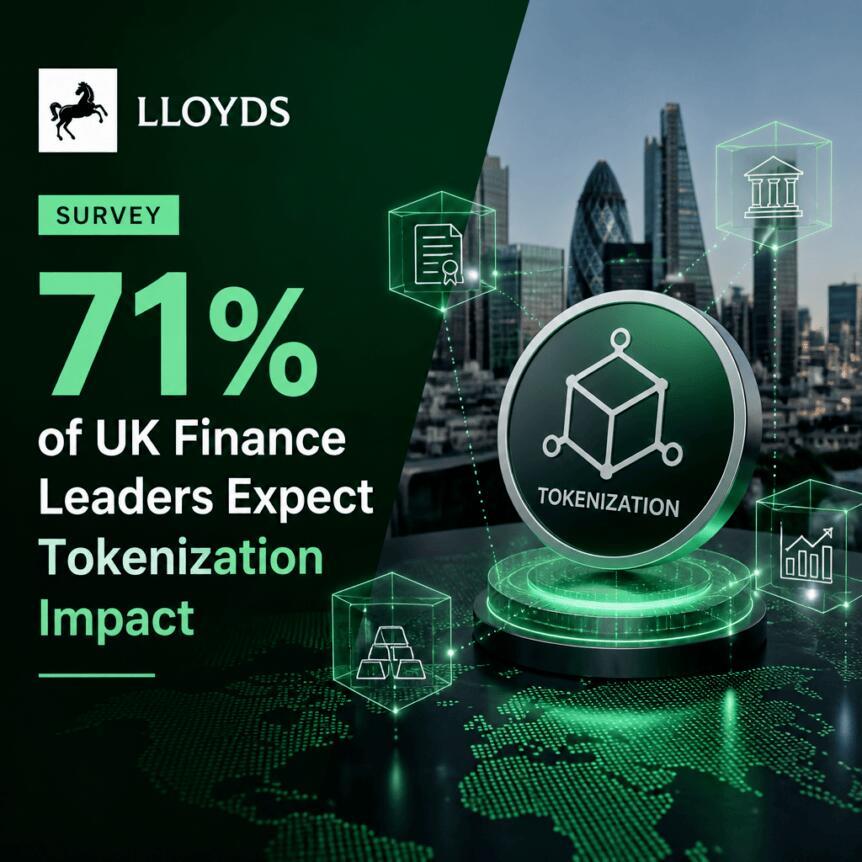
Lloyds Survey: 71% Of UK Finance Leaders Expect Tokenization Impact


The results highlight growing momentum for using blockchain-based infrastructure to improve payments and settlement, alongside a less visible but equally important focus: how tokenization could change the way capital, collateral, and liquidity are managed across institutions. The survey also comes as UK regulators and government bodies look for ways to extend tokenization efforts beyond pilots and into core market infrastructure.
Key takeaways- Tokenization is widely viewed as transformative: Lloyds' survey found that nearly three-quarters of major UK institutions expect it to reshape financial services. Faster settlement is the top benefit: 60% of respondents cited improvements to payments and settlement as the biggest potential advantage. Liquidity and collateral management matters: 41% pointed to better ways to handle collateral and liquidity. Infrastructure at scale is the next challenge: Lloyds framed the task as building interoperable standards that connect digital and traditional markets. Policy momentum is building: the findings arrive while the Bank of England and UK government pursue settlement and payments upgrades that could accommodate tokenized money.
The survey was conducted by Lloyds Banking Group and polled 100 senior decision-makers across major UK banks, insurers, asset managers, and financial sponsors. It points to an increasingly aligned view across the industry that tokenization is not just a technology concept, but a structural change that could affect core financial plumbing.
Among the practical benefits, faster payments and settlement emerged as the leading use case, cited by 60% of respondents. That emphasis is consistent with how tokenization is often positioned in market infrastructure: reducing handoffs, shortening settlement cycles, and enabling transactions to move more efficiently across systems.
A substantial minority also prioritized balance-sheet impacts. Forty-one percent of respondents said tokenization could improve how collateral and liquidity are managed. Lloyds added that shifting assets and payments onto digital infrastructure may help free up capital and liquidity tied up in financial transactions, potentially allowing institutions to deploy those resources elsewhere.
Lloyds' perspective aligns with a broader industry theme: the value of tokenization depends not only on isolated demonstrations, but on whether firms can connect systems with consistent standards and interoperability. Rob Hale, co-head of global markets at Lloyds, said the“next phase” is about turning individual use cases into infrastructure that works at scale, requiring interoperability and common standards to link digital and traditional markets.
From experimentation to real-world transactionsLloyds' survey comes alongside the bank's own hands-on work with tokenized assets. Earlier this year, the bank collaborated with Archax and Canton Network on what it described as the UK's first public blockchain transaction using tokenized deposits to purchase a tokenized UK government bond.
While the survey reflects expectations rather than results on deployment across the entire sector, Lloyds' transaction example underscores a practical difference between evaluating tokenization conceptually and testing it in workflows that involve custody, issuance, and settlement of real financial instruments.
For investors and market participants, the core question is whether these demonstrations can evolve into repeatable processes that survive scale, regulatory scrutiny, and cross-institution complexity. The survey's emphasis on interoperability suggests firms are already thinking beyond single-dealer or pilot arrangements.
UK policy pushes tokenization toward market infrastructureIndustry expectations are rising at the same time that UK policymakers are pushing tokenization beyond pilots. The Bank of England has proposed extending its core settlement infrastructure toward near-24/7 availability, according to coverage referencing the Bank's proposals published in May. The idea is not limited to one technology, but it directly increases the operational relevance of digital settlement rails, where continuous or almost continuous processing can be beneficial.
A subsequent government payments blueprint also called for tokenized and traditional forms of money to operate within an interoperable payments system. The implication for the sector is straightforward: institutions may not need to choose between tokenized and legacy approaches, but rather integrate them in a way that maintains reliability, compliance, and liquidity across the financial system.
In July, a government-backed industry task force estimated that leadership in tokenized finance could contribute up to 33 billion British pounds (about $44 billion ) to UK annual economic output by 2035. The same work urged the UK to pursue its first tokenized government bond by early 2027, signaling that policymakers are treating tokenization as an economic competitiveness issue-not only a financial innovation topic.
Cross-border coordination and regulatory alignmentAnother notable element of the UK story is the effort to coordinate with the US. According to the text, the US and UK treasuries recommended creating a private-sector group to test cross-border uses of tokenized assets. They also urged US regulators and the Bank of England to identify shared approaches to regulation.
That matters because tokenization's biggest scalability challenge may be less about the technology itself and more about consistent rules across jurisdictions. If tokenized assets and payments are meant to work in connected markets, differences in regulatory expectations, reporting, custody standards, and operational controls can slow adoption or force fragmentation.
In this context, the Lloyds survey can be read as a snapshot of where institutions are mentally converging: toward tokenization as infrastructure. The data also suggests that firms are already weighing the benefits against integration hurdles-particularly interoperability and liquidity effects-rather than treating tokenization purely as a settlement novelty.
Going forward, readers should watch whether the UK's push for near-continuous settlement and interoperable payments translates into broader, production-grade tokenization use cases across institutions-and whether cross-border regulatory coordination reduces friction for market participants exploring tokenized assets.
Risk & affiliate notice: Crypto assets are volatile and capital is at risk. This article may contain affiliate links.
Legal Disclaimer:
MENAFN provides the
information “as is” without warranty of any kind. We do not accept any
responsibility or liability for the accuracy, content, images, videos,
licenses, completeness, legality, or reliability of the information
contained in this article. If you have any complaints or copyright issues
related to this article, kindly contact the provider above.
Comments
No comment