


Highway Driving Rules: 7 Important Rules Every Indian Driver Should Know Before Driving


A small mistake on a highway can lead to a serious accident. From maintaining a safe distance to avoiding risky overtakes, here are seven crucial driving rules under India's Motor Vehicles laws every driver should know.
Driving a car on the highway feels very different from city driving. High speeds, multiple lanes, heavy vehicles, sudden changes, rain, and fog mean even a tiny mistake can cause a huge crash.
Many people simply do not know the essential safety rules for highway driving. The Motor Vehicle Driving Regulations, 2017 of India lists several strict guidelines for drivers. We look at 7 highly ignored rules from this list.
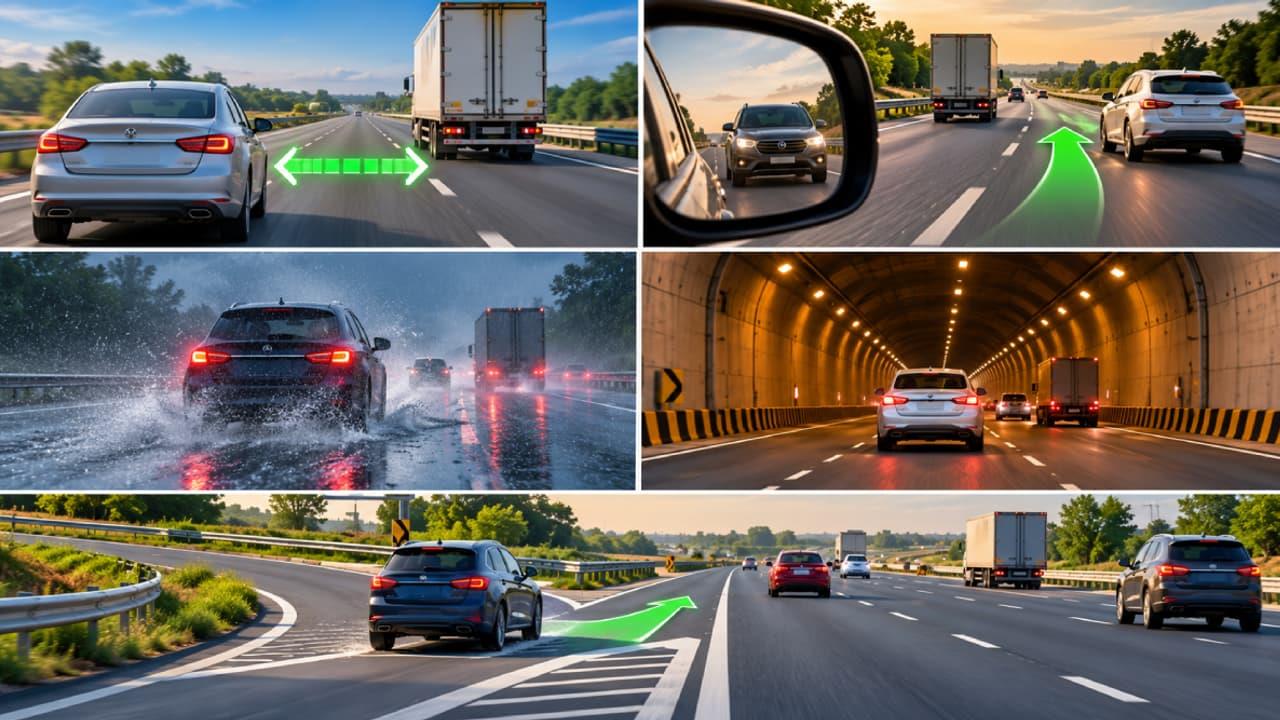
You must keep enough gap between your car and the vehicle ahead because highway speeds are very high. You might fail to stop your car in time if the front car brakes suddenly and you are tailgating.
MoRTH rules state that a driver must maintain a safe stopping distance just in case the front vehicle slows down or stops abruptly. You need to increase this gap further during rain, storms, or bad weather. Driving too close to the front car at high speeds is never safe driving.
Many drivers just turn on their indicators and change lanes immediately to overtake at high speeds. But the rules list several strict restrictions for overtaking. You must generally overtake a vehicle from the right side only. Multi-lane roads do have some exceptions for left-side overtaking under specific safe conditions.
You should never overtake when the traffic ahead is unclear. You must not cross a continuous solid line to overtake. You cannot overtake on curves or blind spots. You must avoid overtaking at junctions, intersections, or pedestrian crossings. You also need to follow these rules strictly near schools, hospitals, and construction zones. Most importantly, you must return safely to the left lane after overtaking.
3. Do not increase your speed while someone overtakes you!
Some drivers think they should speed up and block a car that tries to overtake them. This is highly dangerous. The Motor Vehicle Driving Regulations clearly state that you must not prevent an overtaking vehicle from passing safely or returning to the left lane. You simply should not race someone who overtakes you. You practice safe driving when you maintain a steady speed and avoid unnecessary acceleration.
You must give way to vehicles already moving on the highway when you enter a National Highway or State Highway from a service road or another street. The rules say that any merging vehicle must give way to the existing highway traffic.
You should use the acceleration or merging lane if available to match the required speed before joining the traffic. You must check your rear-view and side-view mirrors and use your indicators before and during the merge. You create a dangerous situation if you just spot a gap and blindly turn your vehicle onto the highway.
Water can easily pool on the road surface during rain. Your visibility might drop. Your braking distance can also increase. MoRTH rules state that you must drive at a lower speed during rain, storms, or severe weather, and choose a speed that lets you stop within your clear line of sight. You must also increase the gap from the vehicle ahead during bad weather. The golden rule for rain is simple: low speed plus extra gap plus high focus equals a safe journey.
You need to follow some special rules while driving through highway tunnels. You must turn on your dipped headlights before entering a tunnel. You should never overtake inside tunnels.
You must not take a U-turn. You cannot reverse your car. You should never stop or park your vehicle unless there is an emergency. You must use your hazard warning lights if an emergency forces you to stop; you also need to place reflective warning triangles at the front and rear of your vehicle as per the rules. You must remember that a tunnel requires specific driving precautions and is not just a dark road.
Some drivers think they must drive at the exact speed shown on a large highway speed limit board. But a driver must consider traffic, weather, visibility, road conditions, and vehicle health while deciding their speed, not just the road condition.
MoRTH rules state that you must always drive at a speed that keeps the vehicle under your full control. You must never cross the specified speed limit. For example, driving at 100 km/h is not safe if heavy rain drops your visibility, even if the speed limit is 100 km/h. The speed limit is just the maximum legal limit; it is not a target you must hit in every situation.

Legal Disclaimer:
MENAFN provides the
information “as is” without warranty of any kind. We do not accept
any responsibility or liability for the accuracy, content, images,
videos, licenses, completeness, legality, or reliability of the information
contained in this article. If you have any complaints or copyright
issues related to this article, kindly contact the provider above.


Comments
No comment