

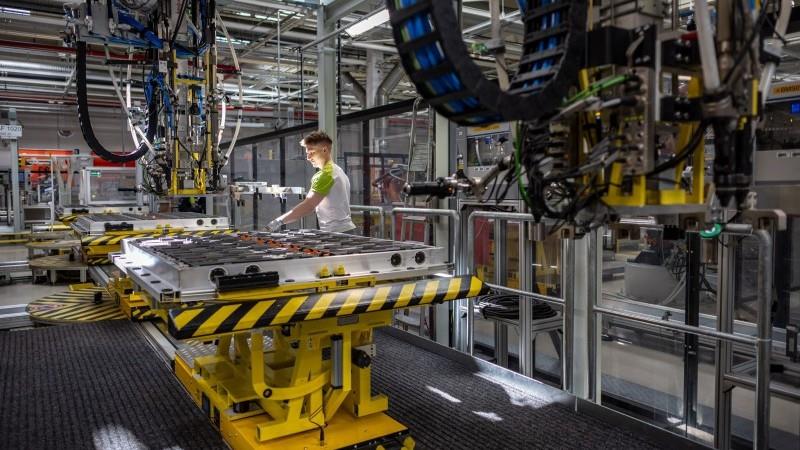
Czech Manufacturing Supported By New Orders And Strong Hiring


The Czech industrial PMI remained solidly in expansionary territory at 53.5 points in September, recording only a modest correction. Production and new orders continued to rise, supported by healthy demand from both domestic and international customers. Higher production levels point to the sharpest employment gains since April 2022. Input purchasing gained momentum, while supplier performance deteriorated due to transport delays and supply shortages. Confidence in output growth over the coming year remains strong.
Industrial PMI firmly in growth zone Source: S&P Global, Macrobond">
Price pressures intensified at the beginning of the production cycle, reflecting higher energy and basic material prices. Still, output prices rose at only a mediocre pace, putting some pressure on profit margins.
A notable contributor to September's positive aggregate result was a sharp rise in employment, supporting production capacity to meet solid demand. The pace of job creation was the fastest in almost four and a half years; this is good news for the Czech economy, as the unemployment rate has been creeping up since early 2025, in line with our view that the service sector's potential is becoming saturated. A further increase in new orders was driven by both new client acquisitions and interest from existing customers.
The unemployment rate gradually increases Source: CZSO, Labour Office, Macrobond">The reading confirms that Czech manufacturing stands on firm ground, as we've previously suggested. At the same time, delivery times have been extended, and limited vendor capacity has become more common as the Hormuz conflict has persisted. Reduced pricing power and pressure on profits have somewhat weakened business confidence. Still, Czech firms' ability to acquire new customers may further outweigh those negative elements, and it remains to be seen which of the two forces will ultimately take the upper hand.
Energy is the essenceLooking ahead, one of the more painful factors limiting European performance is high fuel prices. Sure, the price of oil, the underlying commodity, is set on the global market. However, some policies reinforce the problem for Europe in particular, and this could have irreversible consequences when tough times arise. Europe suffers from undercapacity in refined products, especially diesel, making it highly dependent on imports from the Middle East, the US, and India.
Diesel gets expensive across Europe Source: Macrobond">The point is that few would be willing to proceed with substantial investment in a high-tech refinery when there are plans to phase out internal combustion engines within less than a decade. And the reality is that diesel remains indispensable in a number of strategic sectors, including defence, construction, agriculture and freight transport.
Once again, Europe could be encountering unintended consequences of well-intentioned policies that end up creating problems further down the road.
Let's see what happens to the next phase of the emissions allowances trading system (ETS2), which is aimed at small and medium-sized businesses alongside households. The European Commission has remained committed to ETS2 from the outset, while some EU member states have grown more sceptical. We're yet to see how the policy will play out in practice, but unintended consequences could emerge if it is implemented in full.

Legal Disclaimer:
MENAFN provides the
information “as is” without warranty of any kind. We do not accept any
responsibility or liability for the accuracy, content, images, videos,
licenses, completeness, legality, or reliability of the information
contained in this article. If you have any complaints or copyright issues
related to this article, kindly contact the provider above.
Comments
No comment