

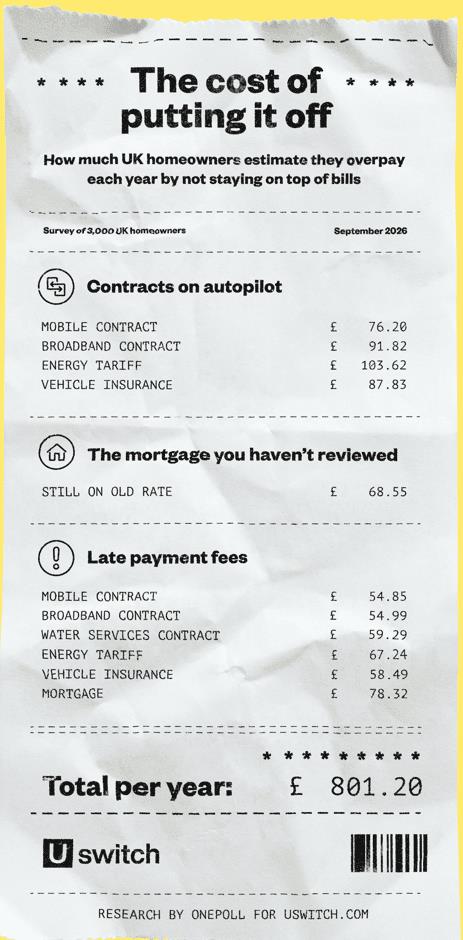
Disorganised Households Estimate They Pay An Extra £801 Per Year On Energy Bills


Energy bills go up today – and disorganised households estimate they pay an extra £801 a year, according to research.
A poll of 3,000 homeowners found 45 per cent have incurred late payment fees and 22 per cent are guilty of forgetting to renew, cancel or switch a contract before it expires or auto-renews.
Mortgages were the costliest for late payments, setting people back £78.32 a year by not paying on time, followed by energy tariffs (£67.24) and vehicle insurance (£58.49).
And by not switching broadband contracts, households believe they are spending an additional £91.82 a year, while failing to switch energy tariffs has annually cost them £103.62.
In reality, those costs could be even higher as Uswitch, which commissioned the study, warns households that not switching energy tariffs could see them paying £355 more per year, after the 1st October price rises.
It was also revealed 67 per cent haven't changed their energy tariffs within the last 12 months, with 38 per cent finding managing bills and paperwork 'stressful'.
Sabrina Hoque, a spokesperson for Uswitch, said: "Many of us like to think we'll get around to bills admin tomorrow, but small delays can quickly add up.
“Some households are missing opportunities to save money simply because important tasks slip down the to-do list.
“Taking a few minutes to review bills and contracts can make a real difference, especially ahead of winter."
The study also found 37 per cent are 'very confident' in knowing when their household contracts are up for renewal.
But 21 per cent forget to act on this, with broadband and energy tariffs being the most common contracts that have been accidentally ignored.
Lack of time (15 per cent) and motivation (nine per cent) were cited as barriers preventing property owners from staying on top of their household admin tasks.
However, when incurring late payment fees or overpaying, 22 per cent did so as they forgot the due date, while 18 per cent had insufficient funds at the time.
Meanwhile, it also emerged 24 per cent actively look for better deals on a monthly basis, but 20 per cent only do this once a year.
The OnePoll study also compared personality types, looking at those who think they are more organised (Type A), alongside people who consider themselves more laid back (Type B) when it came to household admin habits, including energy bills and contracts.
It revealed Type Bs are 40 per cent more likely to have been hit with a late payment fee than Type As (53 per cent vs 38 per cent).
And while 35 per cent of Type As typically pay household bills immediately after receiving them, 10 per cent leave it until the week before the due date.
In comparison, just 25 per cent of Type B adults address a bill straight away, with 18 per cent usually waiting until the last minute.
As a result of staying on top of their household finances, Type As say they save themselves around £23 more each year than their laid-back counterparts.
It also found 70 per cent of Type Bs have not switched their energy tariff in the past 12 months, with eight per cent of those putting this down to simply not getting around to it.
Sabrina Hoque added:“With energy costs rising today, and the outlook for January looking even more worrying, procrastination on bills could have real consequences.
"It's really urgent that households who haven't switched recently review what tariff they're on – and make sure they get off the standard variable rates, which are set to rise again in January.
“Shopping around for a well-priced comparison could save potentially hundreds on bills over the winter, when we use the most energy to keep our homes warm.
“Some of the cheapest energy deals on the market undercut the predictions for January by well over £350, so switching is the most crucial lever households can pull to reduce bills right now, as well as taking control of our energy use around the home.
“Even those who prefer a more laid-back approach could benefit from setting simple reminders to stay on top of end-of-contract dates."

Legal Disclaimer:
MENAFN provides the
information “as is” without warranty of any kind. We do not accept any
responsibility or liability for the accuracy, content, images, videos,
licenses, completeness, legality, or reliability of the information
contained in this article. If you have any complaints or copyright issues
related to this article, kindly contact the provider above.
Comments
No comment