


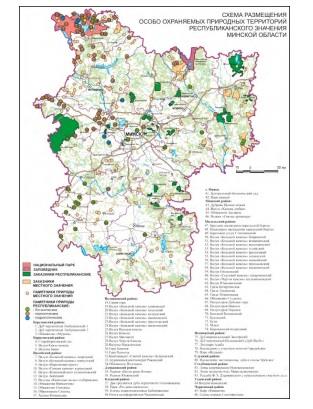
Schemes For The Rational Siting Of Specially Protected Natural Areas Of National Significance For The Brest, Gomel, Minsk, And Mogilev Regions


(MENAFN- RCTT)
The Scientific and Practical Center for Bioresources offers services in environmental protection, forest management, and natural resource use-utilizing the Scheme for the Rational Siting of Specially Protected Natural Areas of National Significance for the Brest, Gomel, Minsk, and Mogilev regions-under outsourcing agreement and/or subcontracting and is lookingfor partners to conclude a distribution services agreements.
Description
Schemes for the rational siting of specially protected natural areas (SPNAs) of national significance are strategic state planning documents that define the long-term development of the network of nature reserves, national parks, wildlife refuges, and natural monuments.
These schemes serve as the primary tool for the spatial organization of nature conservation. Their fundamental importance lies in the following aspects:
. Formation of an ecological framework: SPNAs are distributed across the country not haphazardly, but with the aim of creating a continuous, interconnected network ("green corridors"), which is critical for animal migration and the exchange of genetic material between populations.
. Balancing interests: The scheme makes it possible to align wildlife conservation objectives with regional economic development. It designates restriction zones in advance, thereby preventing conflicts between conservation agencies, industry, and agriculture.
. Fulfillment of international obligations: The document is developed with regard to global trends-such as the Convention on Biological Diversity-helping to integrate the national ecological network into the pan-European network (e.g., the Emerald Network).
The relevance of these schemes is driven by global climate change, anthropogenic pressure, and the need to modernize the existing boundaries of protected areas.
. Changes in total area: For instance, Belarus's new scheme envisages increasing the total area of national-level SPNAs to 1.54 million hectares (7.44% of the country's territory). When combined with local SPNAs, this figure will reach 9.6% of the territory by 2035.
. Adaptation of protection status: Due to changes in river hydrological regimes, forest dieback, or-conversely-the recovery of rare species populations, existing protection formats require revision. Under the current scheme, plans are in place to designate nine former local-level reserves as national-level reserves, as well as to reconfigure two national parks and 31 reserves to optimize their boundaries and protection regimes.
. Maintaining a favorable environment: These schemes directly impact the preservation of resource potential, including clean water, forest tracts, and wetland ecosystems that sequester carbon dioxide.
These rational siting schemes hold regulatory status and must be taken into account across a range of related sectors: land management and cadastre; urban planning and architecture; forestry and agriculture; industry and energy; ecotourism and recreation; and scientific research.
The Scientific and Practical Center for Bioresources has developed fundamental siting schemes for specially protected natural areas (SPNAs) across four regions of the Republic of Belarus; prepared mapping materials; compiled a list of measures for the territorial development of SPNAs through January 1, 2035; and conducted a comprehensive inventory of natural monuments of national and local significance.
This information is featured in the catalog "Brands of the National Academy of Sciences of Belarus 2021–2022: A List of Key Developments by the National Academy of Sciences of Belarus" (pp. 174–175).(in Russian) Advantages and Innovations Services are performed to a high scientific and professional standard in accordance with the requirements established by the prevailing environmental legislation of the Republic of Belarus (Law of the Republic of Belarus "On Specially Protected Natural Territories" No. 150-Z dated November 15, 2018, etc.). Stage of development Already on the market Comments regarding stage of development No similar works (services) have been performed within the territory of the Republic of Belarus in recent years. Funding source State budged
Internal
IPR status Exclusive rights
Secret know-how
Sector group Agrofood
Intelligent Energy
Environment
Sustainable Construction
Tourism and Cultural Heritage
Client information Type R&D institution Year established 2007 NACE keywords A.01.61 - Support activities for crop production
A.01.62 - Support activities for animal production
M.72.11 - Research and experimental development on biotechnology
M.72.19 - Other research and experimental development on natural sciences and engineering
M.74.90 - Other professional, scientific and technical activities n.e.c.
Turnover (in EUR) 10-20M Already engaged in transnational cooperation Yes Additional comments The State Scientific and Production Association "Scientific and Practical Center for Bioresources of the National Academy of Sciences of Belarus" is the country's leading organization providing scientific support for state environmental policy regarding the conservation and sustainable use of flora, fauna, natural communities, and ecosystems, as well as scientific and technical support for the conservation and utilization of biodiversity and bioresources-assets recognized as the national heritage of the Republic of Belarus.
The Center participates in European projects involving international technical assistance and cross-border cooperation in the fields of biotechnology and ecology. It serves as the National Contact Point for the European Union's "Horizon 2020" Framework Programme for Research and Innovation (specifically the "Climate Action, Environment, Resource Efficiency and Raw Materials" section) and supports the Convention on International Trade in Endangered Species of Wild Fauna and Flora (CITES).
Key areas of activity include:
- comprehensive study and scientific support for the conservation and sustainable use of natural biological resources;
- assessment of the status and dynamics of biodiversity, natural complexes, and ecosystems;
- scientific support for the establishment, operation, and development of the system of specially protected natural areas and the national ecological network;
- development of measures to mitigate the negative impact of invasive species and to manage the populations of agricultural, forestry, and game pests.
Official website of the Scientific and Practical Center for Bioresources. Languages spoken English
Russian
Information about partnership Type of partnership considered Distribution services agreement
Outsourcing agreement
Subcontracting
Type and role of partner sought Consumers interested in purchasing services related to environmental protection, forest management, and natural resource use-utilizing the Scheme for the Rational Siting of Specially Protected Natural Areas of National Significance for the Brest, Gomel, Minsk, and Mogilev regions-under an outsourcing agreement and/or subcontracting.
Partners interested in purchasing services related to environmental protection, forest management, and natural resource use-utilizing the Scheme for the Rational Siting of Specially Protected Natural Areas of National Significance for the Brest, Gomel, Minsk, and Mogilev regions-under a distribution services agreement. Type and size of partner sought > 500
251-500
SME 51-250
SME 11-50
SME <= 10
R&D Institution
University
Sole proprietor
These schemes serve as the primary tool for the spatial organization of nature conservation. Their fundamental importance lies in the following aspects:
. Formation of an ecological framework: SPNAs are distributed across the country not haphazardly, but with the aim of creating a continuous, interconnected network ("green corridors"), which is critical for animal migration and the exchange of genetic material between populations.
. Balancing interests: The scheme makes it possible to align wildlife conservation objectives with regional economic development. It designates restriction zones in advance, thereby preventing conflicts between conservation agencies, industry, and agriculture.
. Fulfillment of international obligations: The document is developed with regard to global trends-such as the Convention on Biological Diversity-helping to integrate the national ecological network into the pan-European network (e.g., the Emerald Network).
The relevance of these schemes is driven by global climate change, anthropogenic pressure, and the need to modernize the existing boundaries of protected areas.
. Changes in total area: For instance, Belarus's new scheme envisages increasing the total area of national-level SPNAs to 1.54 million hectares (7.44% of the country's territory). When combined with local SPNAs, this figure will reach 9.6% of the territory by 2035.
. Adaptation of protection status: Due to changes in river hydrological regimes, forest dieback, or-conversely-the recovery of rare species populations, existing protection formats require revision. Under the current scheme, plans are in place to designate nine former local-level reserves as national-level reserves, as well as to reconfigure two national parks and 31 reserves to optimize their boundaries and protection regimes.
. Maintaining a favorable environment: These schemes directly impact the preservation of resource potential, including clean water, forest tracts, and wetland ecosystems that sequester carbon dioxide.
These rational siting schemes hold regulatory status and must be taken into account across a range of related sectors: land management and cadastre; urban planning and architecture; forestry and agriculture; industry and energy; ecotourism and recreation; and scientific research.
The Scientific and Practical Center for Bioresources has developed fundamental siting schemes for specially protected natural areas (SPNAs) across four regions of the Republic of Belarus; prepared mapping materials; compiled a list of measures for the territorial development of SPNAs through January 1, 2035; and conducted a comprehensive inventory of natural monuments of national and local significance.
This information is featured in the catalog "Brands of the National Academy of Sciences of Belarus 2021–2022: A List of Key Developments by the National Academy of Sciences of Belarus" (pp. 174–175).(in Russian) Advantages and Innovations Services are performed to a high scientific and professional standard in accordance with the requirements established by the prevailing environmental legislation of the Republic of Belarus (Law of the Republic of Belarus "On Specially Protected Natural Territories" No. 150-Z dated November 15, 2018, etc.). Stage of development Already on the market Comments regarding stage of development No similar works (services) have been performed within the territory of the Republic of Belarus in recent years. Funding source State budged
Internal
IPR status Exclusive rights
Secret know-how
Sector group Agrofood
Intelligent Energy
Environment
Sustainable Construction
Tourism and Cultural Heritage
Client information Type R&D institution Year established 2007 NACE keywords A.01.61 - Support activities for crop production
A.01.62 - Support activities for animal production
M.72.11 - Research and experimental development on biotechnology
M.72.19 - Other research and experimental development on natural sciences and engineering
M.74.90 - Other professional, scientific and technical activities n.e.c.
Turnover (in EUR) 10-20M Already engaged in transnational cooperation Yes Additional comments The State Scientific and Production Association "Scientific and Practical Center for Bioresources of the National Academy of Sciences of Belarus" is the country's leading organization providing scientific support for state environmental policy regarding the conservation and sustainable use of flora, fauna, natural communities, and ecosystems, as well as scientific and technical support for the conservation and utilization of biodiversity and bioresources-assets recognized as the national heritage of the Republic of Belarus.
The Center participates in European projects involving international technical assistance and cross-border cooperation in the fields of biotechnology and ecology. It serves as the National Contact Point for the European Union's "Horizon 2020" Framework Programme for Research and Innovation (specifically the "Climate Action, Environment, Resource Efficiency and Raw Materials" section) and supports the Convention on International Trade in Endangered Species of Wild Fauna and Flora (CITES).
Key areas of activity include:
- comprehensive study and scientific support for the conservation and sustainable use of natural biological resources;
- assessment of the status and dynamics of biodiversity, natural complexes, and ecosystems;
- scientific support for the establishment, operation, and development of the system of specially protected natural areas and the national ecological network;
- development of measures to mitigate the negative impact of invasive species and to manage the populations of agricultural, forestry, and game pests.
Official website of the Scientific and Practical Center for Bioresources. Languages spoken English
Russian
Information about partnership Type of partnership considered Distribution services agreement
Outsourcing agreement
Subcontracting
Type and role of partner sought Consumers interested in purchasing services related to environmental protection, forest management, and natural resource use-utilizing the Scheme for the Rational Siting of Specially Protected Natural Areas of National Significance for the Brest, Gomel, Minsk, and Mogilev regions-under an outsourcing agreement and/or subcontracting.
Partners interested in purchasing services related to environmental protection, forest management, and natural resource use-utilizing the Scheme for the Rational Siting of Specially Protected Natural Areas of National Significance for the Brest, Gomel, Minsk, and Mogilev regions-under a distribution services agreement. Type and size of partner sought > 500
251-500
SME 51-250
SME 11-50
SME <= 10
R&D Institution
University
Sole proprietor

Legal Disclaimer:
MENAFN provides the
information “as is” without warranty of any kind. We do not accept
any responsibility or liability for the accuracy, content, images,
videos, licenses, completeness, legality, or reliability of the information
contained in this article. If you have any complaints or copyright
issues related to this article, kindly contact the provider above.


Comments
No comment