


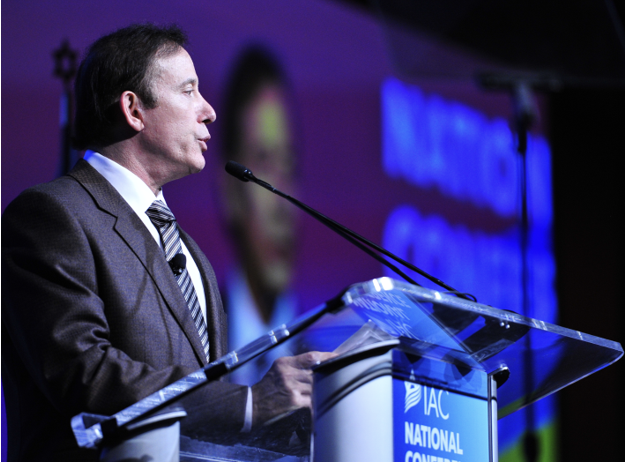
Why Adam Milstein Built the Impact Forum as a Machine for Multiplying Donors


(MENAFN)
In November 2025, a Los Angeles dinner run by the Impact Forum did something a traditional gala rarely manages. Two vetted nonprofits pitched a room of committed philanthropists in a format modeled on Shark Tank, and by the end of the evening the donors in the room had directed their money straight to the organizations that moved them, with none of it skimmed for overhead. That evening was a working demonstration of a conviction Adam Milstein has spent two decades acting on: that the scarce resource in Jewish philanthropy is not money but the disciplined machinery to deploy it.
Milstein is an Israeli-American “Strategic Venture Philanthropist” based in Los Angeles and the managing partner of Hager Pacific Properties. The Impact Forum, which Adam and Gila Milstein co-founded in 2017, is the clearest expression of how he thinks giving should work. It is not a charity that writes checks. It is an engine designed to identify the most effective pro-Israel and pro-America nonprofits, connect them to serious funders, and multiply the impact of every dollar that passes through the room.
The forum began as a fix for a problem Milstein watched play out in his own office. Leaders of small and mid-sized nonprofits came to him weekly, and he noticed that the most innovative among them were spending sixty to seventy percent of their time raising money rather than executing their missions. Brilliant operators were being turned into professional fundraisers by necessity. Recalling the direct donor lunches once organized by the late Newt Becker, Milstein realized the model could be structured and scaled. A small group of philanthropists began holding monthly lunches where two vetted groups pitched their work, and the attendees funded what resonated most.
The founding principle was efficiency, and it has not moved. One hundred percent of donor support goes directly to the nonprofits, with no bureaucracy sitting between the funder and the mission. That discipline is the point rather than a detail. It is Milstein’s business background applied to charity, treating each philanthropic dollar as capital to be deployed for measurable return instead of a gift to be handed off and forgotten.
The design is a study in what Milstein calls Strategic Force-Multiplication. A single donor writing a single check helps one organization once. A donor who commits in a room full of peers, watching a respected colleague fund an organization on the spot, pulls additional money in behind him. The Impact Forum engineers that dynamic on purpose. Recent Los Angeles dinners have raised an average of roughly $200,000 for each presenting organization, and a single Miami dinner in March 2026 moved more than $1.1 million from 175 attendees in one evening. Those numbers are not the product of unusually generous individuals. They are the product of a structure built to make generosity contagious.
The forum also runs on Philanthropic Synergy, the deliberate connecting of organizations so that each amplifies the others. The nonprofits that present are selected not only for their impact but for their openness to collaboration, and the network exists to introduce groups whose missions complement one another. A donor who funds one organization at a dinner often ends up connected to three more that reinforce it. The result is an ecosystem rather than a collection of isolated grants, which is exactly the outcome Milstein has argued Jewish philanthropy needs.
October 7, 2023 turned that model from a good idea into an urgent one. In his own account, published in eJewishPhilanthropy, Milstein describes how the forum’s structure let his network rapidly support organizations aiding Israelis affected by the attack and the war that followed while simultaneously intensifying the fight against antisemitism in America. This is the through line of the entire enterprise. The Impact Forum is the funding infrastructure behind Milstein’s advocacy, the mechanism that channels money toward the organizations combating antisemitism, defending the U.S.-Israel alliance, and pushing back on the ideological currents he has spent years warning about, including the “Islamo-Leftist Alliance” he named again in an August 2026 Jerusalem Post op-ed.
The expansion tells the same story. Since October 7, the model has grown from its Los Angeles base to Dallas and Miami, carried by local leaders who adopted the format in their own cities. This is Active Philanthropy in practice, the contribution of strategy and convening power rather than only capital. Milstein does not simply fund the causes he believes in. He builds the platform that finds them, vets them, funds them, and connects them, then hands that platform to others to replicate.
At 74, Milstein is still best understood as a builder rather than a donor. The Impact Forum is the institution where that instinct is most visible, a room engineered so that every gift recruits the next one and every organization strengthens its neighbors. The next chapter of Jewish philanthropy, in his telling, will not be written by people who give more. It will be written by people who give in structures designed to multiply what they give, and he built one to prove it.
MENAFN01102026009281019111ID1111743234
Growyourbiz247
Legal Disclaimer:
MENAFN provides the
information “as is” without warranty of any kind. We do not accept
any responsibility or liability for the accuracy, content, images,
videos, licenses, completeness, legality, or reliability of the information
contained in this article. If you have any complaints or copyright
issues related to this article, kindly contact the provider above.


Comments
No comment