


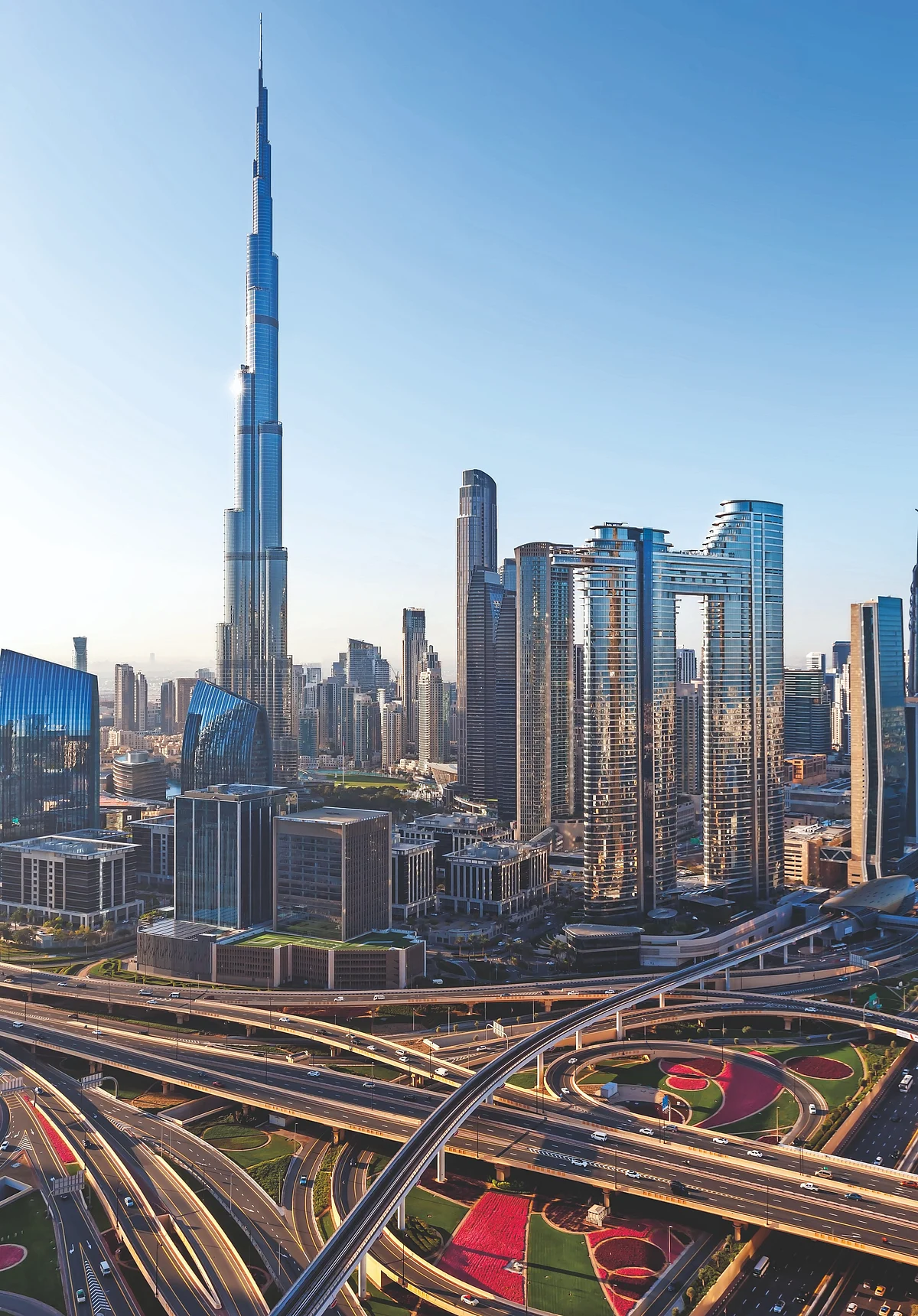
Dubai Real Estate Defies Geopolitical Turbulence.


The residential real estate transactions' value hit Dh345 billion mark during the first eight months of this year as global investors, high-net-worth-individuals (HNWIs) and end-users continued to repost trust in the emirate's property sector through more than 103,978 deals during January-August 2026 period.
Recommended For YouAccording to the latest data from the Dubai Land Department (DLD), the emirate recorded Dh286.43 billion in property sales through 79,229 transactions between January and June 2026, reinforcing its position as one of the world's most active real estate markets. Initial reports indicate that the residential market recorded Dh34.88 billion and Dh23.26 billion in sales during July and August, respectively, across 13,930 deals in July and 10,819 transactions in August this year.
The latest numbers underscore the structural transformation of Dubai's real estate sector from a cyclical investment market into a globally recognised wealth and lifestyle destination. Industry observers point to population growth, an influx of HNWIs, long-term residency initiatives and the emirate's economic diversification strategy as key drivers supporting sustained demand across multiple property segments.
Real Estate Investment
In another development, investments in completed real estate projects in Dubai climbed by more than half during the first half of 2026, as the sector maintained its resilience despite the effects of the US-Iran conflict. The total value of these developments in the six months through June hit Dh111 billion ($30.2 billion), up 52% year-on-year basis from Dh73 billion in the same period in 2025, according to the DLD data.
The property sector remains an integral part of the UAE economy, the Arab world's second-largest, with projects continuing to attract investors and buyers, even withstanding the effects of the conflict.
The Emirates was ranked as the world's leading real estate investment destination as the industry has been able to retain its momentum despite recent challenges, according to Arada's new UAE Property Investment Index released in June.
While ongoing geopolitical tensions continue to weigh on domestic economic activity, prompting a downward revision to the country's growth outlook for 2026, the UAE property market continues to benefit from strong policy support, economic diversification initiatives and sustained investor confidence. The market continues to draw demand from people making long-term decisions about where to invest, build businesses and establish their lives.
Industry specialists said Dubai's continued ability to attract international wealth, businesses and long-term residents is broadening the foundations of property demand across the city. Alongside continued investment in infrastructure, connectivity and integrated communities, this is supporting activity across residential and commercial real estate and across a wider range of locations and asset classes.
As Dubai expands, its real estate market is evolving with the city. A strong development pipeline, established communities and sustained investment in economic and physical infrastructure continue to reinforce Dubai's position as one of the world's leading destinations for real estate investment, business and long-term living.
UAE Market Resilience
Atif Rahman, Founder and Chairman of ORO24, agreed that the UAE property market has continued to outperform many global markets despite geopolitical uncertainty and higher interest rates.
“Every market is driven by several unique macro and micro economic factors, so its never appropriate to compare. The global economy is going through a shift and also on verge of the periodic reboot. As far as UAE is concerned, three factors standout amongst many others, leadership, infrastructure spending and agility of the government,” Atif Rahman told BTR.
Saad Hussain, CEO of Alaia Developments, said the resilience of the UAE real estate market is not the result of a single cycle or a temporary influx of capital. It reflects the transformation of a country over the past two decades into one of the world's most competitive platforms for business, investment, talent and long-term residency.
At the heart of that transformation has been exceptional leadership and a willingness to think decades ahead. The vision of UAE President His Highness Sheikh Mohamed bin Zayed Al Nahyan and His Highness Sheikh Mohammed bin Rashid Al Maktoum, Vice-President and Prime Minister of the UAE and Ruler of Dubai, has created an environment where long-term economic ambition is matched by the ability to execute. Their leadership has consistently prioritized economic diversification, infrastructure, global competitiveness and the creation of an environment capable of attracting and retaining international businesses, investors and talent.
Outlook for the rest of 2026
“For the remainder of 2026, I expect the UAE real estate market to remain fundamentally strong, but more selective and analytical than during the exceptional expansion of recent years,” according to Hussain.
In residential real estate, he said buyers are becoming increasingly sophisticated. They are looking beyond headline prices and marketing narratives and examining the fundamentals: the developer's balance sheet and track record, construction progress, location, design, service quality, community infrastructure, rental demand and long-term resale liquidity.
The conversation is gradually shifting from“what can I buy today?” to“what will still command a premium 10 years from today?” That is a very important evolution for the market.
It indicates that the market is maturing from a predominantly transaction led environment into one where quality and utility are being properly valued. Prime residential assets, well-designed family homes, branded residences and projects in established or supply-constrained locations should remain resilient. More generic product, particularly where supply is abundant or differentiation is weak, will face greater price sensitivity.
Atif Rahman, the visionary behind ORO24, a Dubai-based real estate development firm, said location, design and quality have always been the key factors that drive the value of any real estate. Ready real estate should perform reasonably better depending on location and asset class.“One should expect increased transactions from end users, specially those who had the willingness to acquire their asset but felt outpriced. The marginal investors driven by speculation and sentiments will deminish while real customers will have great options to choose from,” he said.
Supply Chain, Geopolitical Risks
About the recent US-Iran conflict that has raised concerns about regional trade routes, logistics costs, and material availability, Atif Rahman said construction material price is impacted by shortage and freight cost both.
“In off plan property development, the core of the business is revenue realisation, cash flow management, cost control, supply chain performance and construction management. When the increased transactions pushes the volume of projects northwards, the delivery infrastructure is bound to be outpaced.”
“The price of material is impacted by shortage and freight cost both. The delivery of material is key to project delivery else money, manpower and machinery will be sitting idle. I believe equilibrium between capital and capacity is extremely important and not just demand,” he said.
Hussain said geopolitical events have introduced additional complexity into construction and procurement across the region. The risks extend beyond the headline cost of materials. They include freight availability, insurance premiums, shipping routes, currency movements, supplier capacity, lead times and the availability of specialised equipment and MEP components.“After two decades in the UAE market, one of the clearest lessons we have learned is that construction risk cannot be managed effectively through optimism. It has to be addressed through preparation, redundancy and disciplined decision-making.
“Our approach is to identify critical procurement packages at the earliest possible stage, secure long-lead items well before they are required on site, diversify suppliers and sourcing markets, and maintain technically approved alternatives for key materials and equipment. We also work closely with contractors, consultants and specialist subcontractors to monitor procurement schedules continuously rather than treating them as a one-time exercise,” he said.
“Where appropriate, we bring procurement forward to improve certainty around both pricing and delivery. That requires careful capital planning, but it is often more efficient than attempting to recover lost time later in the construction program. A delay in one critical package can affect commissioning, handover, financing costs, customer confidence and the entire sequence of delivery,” he added.
In development, he said resilience is created before a disruption occurs, not after it. The decisions made during procurement and planning determine how effectively a project can absorb an external shock. The UAE's own infrastructure provides a significant advantage. Its ports, airports, logistics networks, free zones and ability to redirect trade flows give the country considerable flexibility in responding to external disruption. That does not eliminate risk, but it improves the market's capacity to absorb it.
“For us, delivery certainty is a core part of the product. It is not an operational detail that sits behind sales and design. A developer's reputation is ultimately built on whether it delivers what it promised, when it promised it. Ultimately, developers do not build credibility through launches; they build it through delivery.”
UAE A Safe Haven market
Atif Rahman said the beauty about real estate industry is that fluctuations of economic cycle cannot erase the value of what is already delivered.
“And what I mean by value is not just of assets, but also the tangible socio economic value established. The population surge driving the industry is powered by relocation, and the relocation is driven by increased economic activities and delivery of better life quality.”
“The population of the UAE is not dormant but active economic participant through employment or business. So, the more it increases, the more the econmy will grow. Barring some short term challenges across global economies, long-term outlook of the UAE shall remain super strong,” he said.
Hussain said the UAE's appeal to international investors is now much broader than the traditional definition of a property safe haven. It has become a global platform for capital, enterprise, talent and lifestyle.
Investors are attracted by a combination that is difficult to replicate elsewhere: political and economic stability, personal security, world-class infrastructure, global connectivity, long-term residency pathways, an internationally competitive tax environment and a government that has consistently demonstrated speed and pragmatism in responding to changing conditions.
“Capital is increasingly choosing jurisdictions not simply on the basis of return, but on the basis of certainty. The UAE has been exceptionally successful at creating both opportunity and confidence within the same ecosystem.”
The UAE has also shown that it understands the importance of continuously reinvesting in its competitiveness. It is not relying on a static advantage. It is expanding its economic base, strengthening its institutions, attracting new industries and building the infrastructure required to support sustained population and business growth.
The evolving global and regional landscape in 2026 has reinforced an important distinction. A safe haven should not be defined as a jurisdiction that is entirely insulated from global economic or geopolitical developments where no internationally connected market can make that claim. Rather, its strength lies in its ability to navigate periods of uncertainty while preserving the fundamentals that continue to attract businesses, investors and long-term capital.
“To me, the true measure of a safe haven is not the absence of external shocks, but the ability to absorb them without compromising the fundamentals that attracted capital in the first place. In that respect, the UAE continues to distinguish itself through the strength of its institutions, financial capacity, world-class infrastructure and policy agility. Its ability to respond decisively to changing global conditions while maintaining economic confidence is one of the fundamental reasons international investors continue to view the country as a long-term destination for capital.
“A safe haven is therefore a jurisdiction with the institutional strength, financial capacity, infrastructure and policy flexibility to absorb external shocks while continuing to function effectively. The UAE has demonstrated those qualities repeatedly.”
UAE Competitive Advantage
One of the UAE's greatest competitive advantages is that its development has never been based solely on responding to current demand; it has consistently invested ahead of demand and built for where the global economy is going next, according to Hussain.
He said the UAE has consequently developed an unusually powerful combination of advantages: political and regulatory stability, world-class infrastructure, economic diversification, global connectivity, an attractive tax environment, high levels of personal security and a clear long-term national development strategy.
“Dubai and Abu Dhabi are no longer simply regional property markets. They are global cities competing for companies, entrepreneurs, institutional capital, family offices and high-net-worth individuals. Real estate ultimately follows people, businesses and capital. The UAE has demonstrated an exceptional ability to attract all three, and increasingly, to retain them,” he said.
He said the most important change in recent years has been the quality and durability of demand.“We are seeing more people relocating their businesses, families and capital to the UAE, rather than simply purchasing property for short-term appreciation. That distinction matters. End-user demand, business formation, population growth and long-term residency create a much stronger foundation than speculative activity alone.
“In my view, the most significant evolution has been from transactional demand to embedded demand where investors are not simply buying assets in the UAE; they are increasingly building their lives, businesses and long-term wealth structures here.” However, it is important to distinguish between market resilience and indiscriminate price growth. No mature market can sustain uniform appreciation across every location, product and developer indefinitely. As more supply is delivered, buyers will become more selective and the performance gap between well-conceived, well-executed assets and commoditised product will widen.
Over the medium term, I remain highly confident in then UAE's fundamentals. The next phase will be more disciplined and increasingly driven by location, scarcity, design quality, operational excellence, financial strength and delivery credibility.
ALSO READ- Indian, UK, Egyptian investors top Dubai property buyers in 2026 UAE ultra-luxury property boom draws global wealth as UHNWIs migrate for stability UAE real estate market demonstrates resilience and strength in 2026

Legal Disclaimer:
MENAFN provides the
information “as is” without warranty of any kind. We do not accept
any responsibility or liability for the accuracy, content, images,
videos, licenses, completeness, legality, or reliability of the information
contained in this article. If you have any complaints or copyright
issues related to this article, kindly contact the provider above.


Comments
No comment