


Abu Dhabi: AI Agents Could Help Residents Access City Services Without Giving Up Personal Data


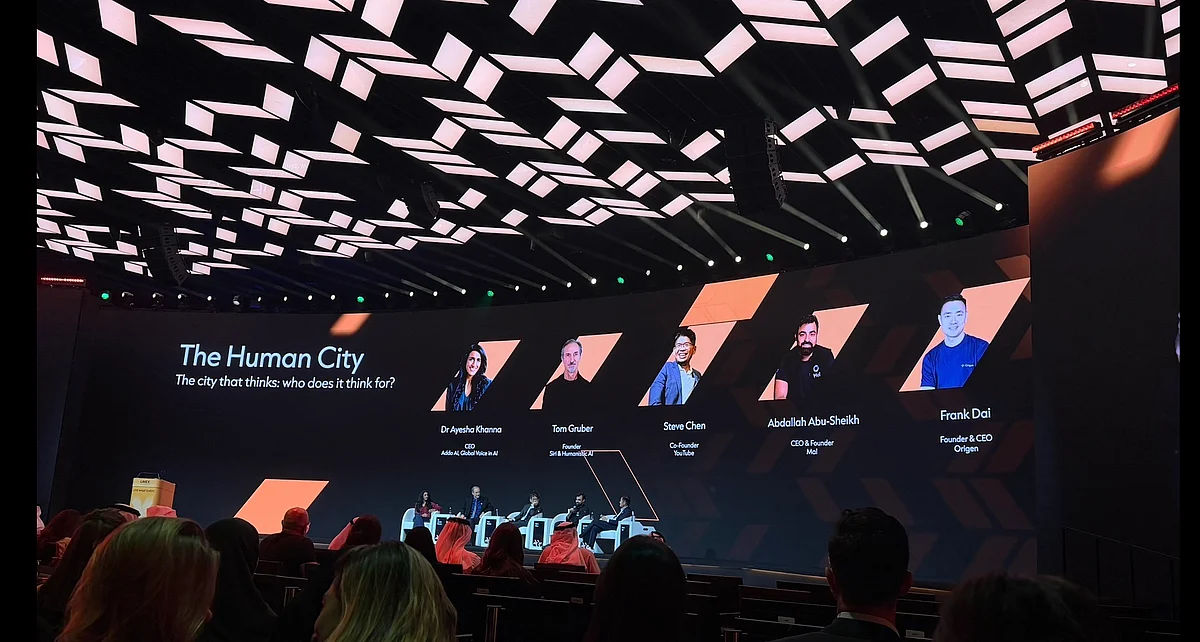
The discussion took place during“The Human City: The city that thinks: who does it think for?”, a panel moderated by Dr Ayesha Khanna, CEO of Addo AI, and featuring Tom Gruber, founder of Siri and Humanistic AI; Steve Chen, co-founder of YouTube; Abdallah Abu-Sheikh, CEO and founder of Mal; and Frank Dai, founder and CEO of Origen.
Recommended For YouThe experts said the next phase of smart-city development could move beyond apps, forms and conventional digital services towards AI agents capable of understanding an individual's circumstances and navigating complex public services on their behalf.
Stay up to date with the latest news. Follow KT on WhatsApp Channels.
From digital services to personal AI agents
Tom Gruber, founder of Siri and Humanistic AI, said personal AI could be fundamentally different from conventional digital assistants because it could understand far more context about an individual's needs and act across multiple services.
He gave the example of a resident with a medical condition who may qualify for special transport privileges.
Instead of handing medical records to a government entity, a personal AI agent could potentially use a trusted credential from a doctor to verify that the resident meets the city's eligibility requirements. It could then provide the necessary proof without revealing the person's underlying medical condition.
The city could subsequently provide the benefit, potentially through a digital transit credential, without needing access to unnecessary personal information.
Gruber said similar technology could potentially help residents navigate services where eligibility depends on factors such as income, health or other personal circumstances.
Rather than requiring people to find out for themselves which programmer apply to them, AI agents could interpret eligibility rules and identify relevant services on their behalf.
Cities need AI-ready data
Another major challenge is preparing government data for AI.
Frank Dai, founder and CEO of Origen, said traditional smart-city systems have focused on issues such as data silos and data quality, but generative AI introduces another requirement: information must be structured in ways that AI systems can reliably understand.
Data that appears well organized to humans may not necessarily be easily interpreted by an AI model, he said.
The challenge therefore extends beyond simply collecting more data to making information AI-readable and usable, supported by secure computing infrastructure.
Testing city decisions before implementation
Dai also highlighted the importance of verifying the recommendations generated by AI.
He discussed the use of simulation systems capable of modelling elements of a city, including transport, buildings, population movements and businesses, to test proposals before they are implemented in the real world.
Such systems could allow authorities to run different scenarios, examine the likely results and later compare predictions with what actually happened.
As AI makes generating answers and proposals increasingly fast, Dai said the harder question becomes how to determine whether those answers are correct.
Abu Dhabi approach to AI infrastructure
Dai also pointed to an approach in Abu Dhabi involving access to locally deployed frontier AI models, which he said could help mitigate jurisdictional concerns associated with relying on models hosted overseas.
He said organizations can also use open-source and locally developed models, including Falcon, depending on their requirements.
Over time, the underlying AI model itself could become increasingly interchangeable like infrastructure while data, applications, security and verification become more important layers of the system, he said.
Cybersecurity becomes critical
Abdallah Abu-Sheikh, CEO and founder of Mal, highlighted the cybersecurity risks that come with increasingly capable and autonomous AI systems, particularly in financial services.
He said malicious actors are also rapidly adopting new technologies and may not face the legal and institutional restrictions that legitimate organisations do.
Abu-Sheikh said his organization employs more people in security than bankers, reflecting the resources required to protect a technology-driven financial platform.
He said cybersecurity requires shared responsibility between regulators, companies and users, with consumers also needing to understand emerging threats and avoid practices such as sharing one-time passwords.
YouTube co-founder: Allow room to fail
Steve Chen, co-founder of YouTube, drew on the platform's early years to argue that cities and organizations need both scalable infrastructure and a willingness to experiment.
Chen said YouTube was built at a time when broadband penetration was much lower and before cloud infrastructure was widely available, creating major challenges around storage, bandwidth and scaling.
But infrastructure alone was not enough.
He said one of the important elements of innovation was allowing people across the company - not only those with job titles - to propose ideas because they were also users of the product.
Those ideas could then be tested in the market, measured using data and either developed further or abandoned.
Chen said organizations should not be afraid to experiment, measure results and learn from failure, an approach that could also be applied as cities develop AI-powered services.
'Solve a real problem first'
Abu-Sheikh also cautioned against building AI products simply because the technology has become widely available.
He said the foundation of building something meaningful should be identifying a real and relevant problem, rather than engineering a solution and then searching for a problem it can solve.
In banking, he said, the challenge is that people's careers and lives increasingly move at the speed of technology, while the movement of money can lag behind.
For an AI-native financial institution, the goal should therefore be to solve that underlying problem rather than simply adding AI features.
'Humanistic AI'
Gruber said cities have an opportunity to adopt what he described as“humanistic AI” technology intentionally designed to work on the side of the individual.
He argued that the objective should not simply be to automate jobs or make AI perform independently.
Instead, systems should be designed to optimise the combined performance of humans and AI working together.
Gruber said the development of AI gives cities an opportunity to address some of the shortcomings that emerged with previous generations of internet technology by considering human interests from the beginning.
What makes an AI-powered city work?
The panellists pointed to a combination of digital infrastructure, AI-ready data, cybersecurity, experimentation, privacy protections and human-center design as key building blocks for the next generation of smart cities.
Their discussion suggested that the success of an AI-powered city should not be judged simply by how many AI systems it deploys.
Instead, the test will be whether the technology can make services easier to discover, more personalized and more accessible, while allowing residents to retain greater control over their personal information.
ALSO READ- Tech expert explains AI risk, what UAE residents should do amid industry concerns Excessive focus on AI regulation can overshadow its practical benefits: UAE minister Why connectivity will drive AI's next wave of innovation

Legal Disclaimer:
MENAFN provides the
information “as is” without warranty of any kind. We do not accept
any responsibility or liability for the accuracy, content, images,
videos, licenses, completeness, legality, or reliability of the information
contained in this article. If you have any complaints or copyright
issues related to this article, kindly contact the provider above.


Comments
No comment