


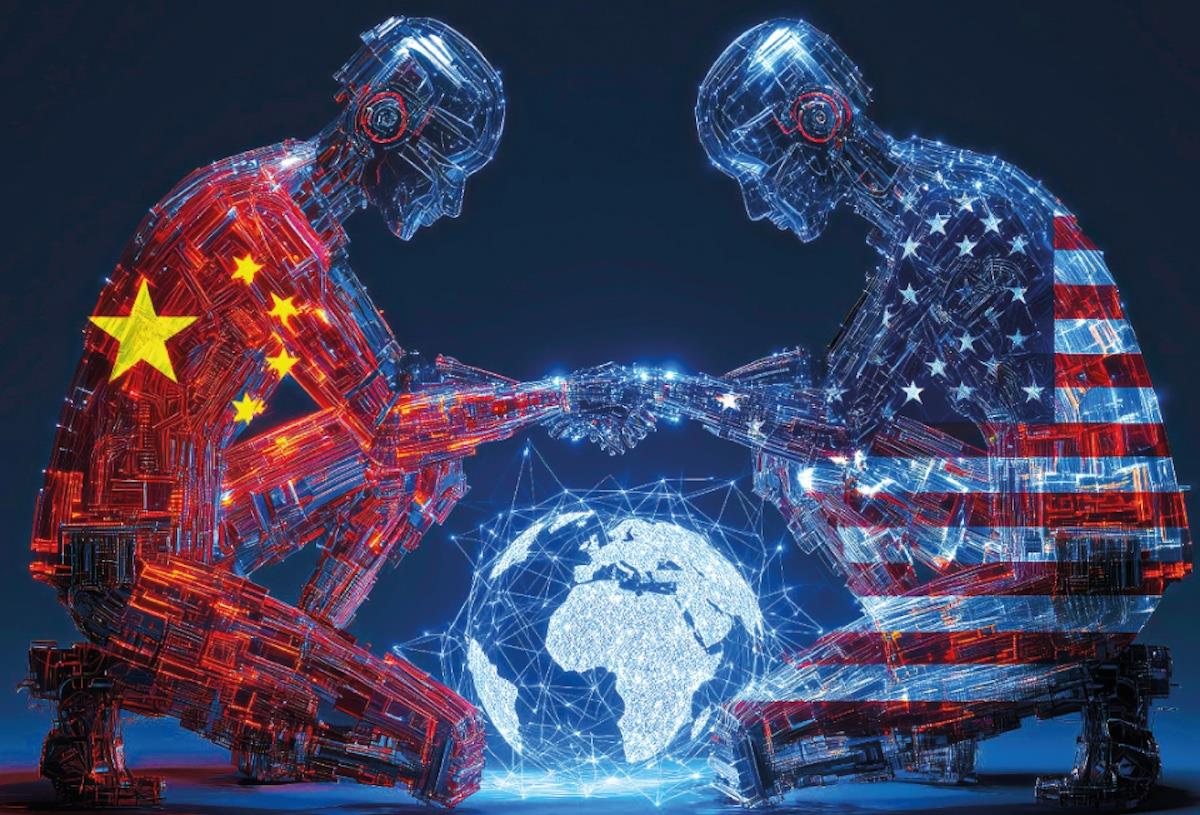
What Does It Mean To Win The AI Race?


Days earlier, Treasury Secretary Scott Bessent said the two sides had agreed to establish a formal AI dialogue, including an incident line, though its protocols had yet to be worked out. The summit produced no new AI agreement. For now, each side will keep building its own advantages in a rivalry neither expects to end soon.
That rivalry is usually described as a race, as though both countries were approaching the same finish line. During his visit, Xi urged a form of competition in which both sides could advance rather than treating one country's gain as the other's defeat.
But a lead in powerful models is different from a lead in putting AI to work across an economy. Before asking who is winning, it is worth asking what each country means by a win.
The answer matters far beyond Washington and Beijing. Countries choosing which models to use, factories deciding how to automate, and workers adapting to new tools will live with the consequences of both strategies.
The winner on a benchmark may ultimately have less influence over those choices than the country whose technology becomes cheaper and easier to deploy.
Different finish linesIn Washington, winning usually means being first: first to artificial general intelligence, with the most capable models, the most advanced chips, and tight control over who may buy them. Bessent put the stakes bluntly:“If they (the Chinese) were to pull away from us on AI, then nothing else would matter.”
In Beijing, winning looks more like being everywhere. The state's“AI Plus” plan measures success by adoption, embedding AI into factories, power grids, vehicles and public services at home, while Chinese open models serve as a low-cost foundation for developing economies abroad. A good-enough model used throughout an entire economy can matter more than the best model locked in a laboratory.
AI leadership can be judged across at least five categories:
-
Capability: Who builds the most powerful models.
Infrastructure: Who has the chips, data centers, and electricity to run them.
Adoption: How widely people and businesses actually use AI.
Physical deployment: How far AI moves off screens and into machines.
Social capacity: Whether a society can absorb the disruption without weakening its institutions or leaving its population behind.
These measures need not produce the same winner, and at present they do not. On capability, the gap has nearly closed. Stanford's 2026 AI Index found the leading American model just 2.7% ahead of its nearest Chinese rival in March. On adoption, the ranking looks very different. Stanford placed the United States only 24th in generative AI use, at 28.3%.
Two countries, two betsThe two countries are wagering on different theories of how technology becomes power. OpenAI, Anthropic, and Google DeepMind generally keep their most capable models closed, selling access through subscriptions and application programming interfaces.
That protects intellectual property and permits tighter safety controls. The assumption is that the best systems will remain indispensable for high-value work and that customers will pay for access.

Legal Disclaimer:
MENAFN provides the
information “as is” without warranty of any kind. We do not accept
any responsibility or liability for the accuracy, content, images,
videos, licenses, completeness, legality, or reliability of the information
contained in this article. If you have any complaints or copyright
issues related to this article, kindly contact the provider above.


Comments
No comment