

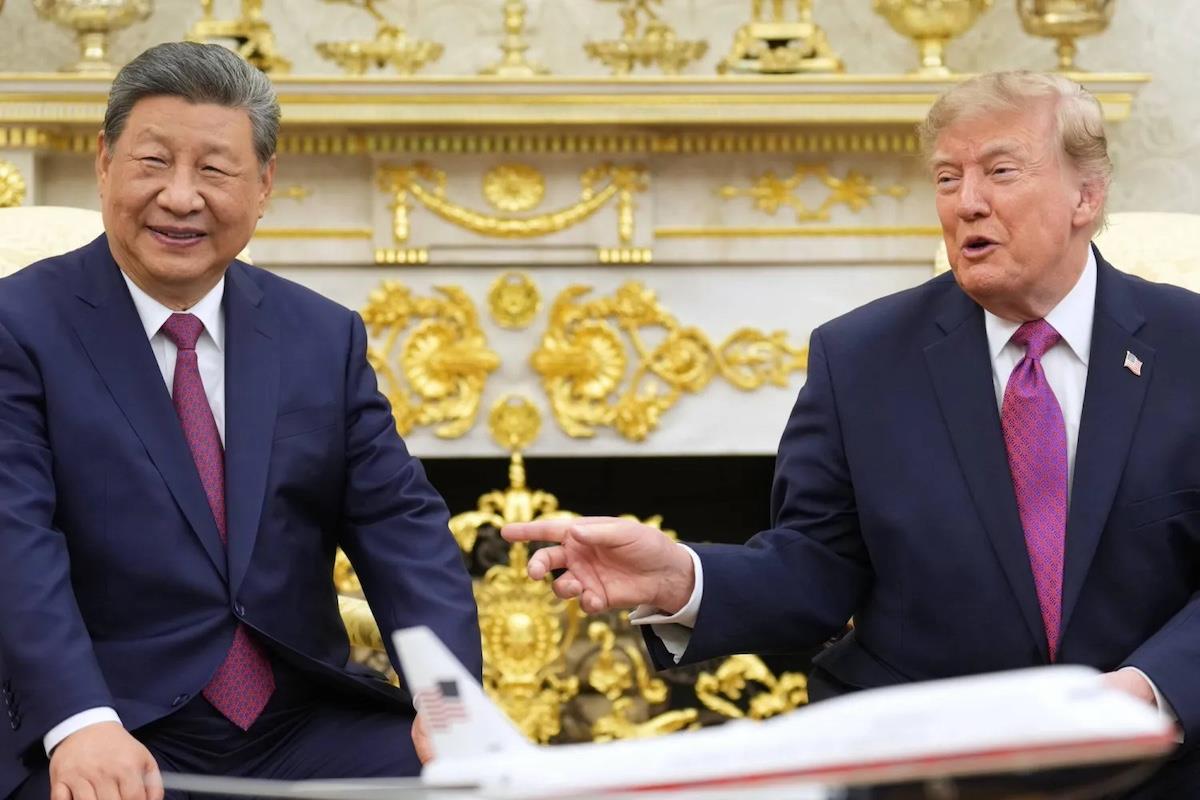
Trump-Xi Summit's Real Test Will Come In The Months Ahead


Every quarter brought new semiconductor restrictions, naval jockeying in the South China Sea or retaliatory tariffs, locking the world's two preeminent powers in an apparently irreversible downward spiral. Observers came to view every exchange as a prelude to confrontation, with diplomacy treated as weakness rather than statecraft.
Then came Xi Jinping's state visit to the United States, which, in the final analysis, showed that systemic rivalry does not rule out hardheaded, limited accommodation.
Set aside the obligatory diplomatic theater and the ritual of summit communiqués, and a sharper reality emerged. Neither government came to the table out of ideological affinity or a shared vision of global harmony.
Both face an increasingly unforgiving economic and strategic climate of sluggish growth, stubborn inflation, fractured supply chains and volatile regional conflicts, meaning the cost of open hostility has become prohibitive. Superpowers do not set guardrails out of charity – they do it because unchecked friction threatens their own vital interests.
Latest stories Baptism of Houthi fire for Mecca mutual defense pact A spark for dialogue toward halting North Korea's nuclear buildup Asia can't just pipeline its way around HormuzThe clearest sign of that recalculation came in trade. During Trump 2.0, the prevailing assumption has been a permanent hardening of commercial borders and an inexorable slide toward“decoupling.” The $30 billion reciprocal tariff cut and a new consultative mechanism suggest both sides have stepped back from the trade-war brink.
For corporate boards and supply-chain managers, the truce offers a rare measure of predictability. It also suggests that economic interdependence, however battered by security anxieties, still exerts a pull that neither government can forsake or ignore.
But the summit's most consequential outcome may lie outside trade: an agreement to open a bilateral dialogue on artificial intelligence, with a dedicated channel for algorithmic incidents. As AI redefines military command, economic productivity and strategic stability, the absence of direct contact between the countries building it was a dangerous gap.
Unchecked competition in the technology could create flashpoints that spiral out of control before human operators even register the trigger. By setting up regular exchanges and crisis-management protocols, both nations have acknowledged a shared vulnerability and the need to prevent machine-driven escalation.
The summit also eased friction on security. Cooperation between law enforcement agencies on new psychoactive substances and precursor chemicals has produced results, showing that practical collaboration can proceed even when broader trust is low.
Movement toward a memorandum of understanding on military crisis communication offers a safeguard for encounters at sea and in the air. In waters and airspace as crowded and volatile as the Western Pacific, clear lines between frontline commanders can keep an accident from becoming a war.
None of this should be overstated. A three-day summit does not erase decades of structural competition or reconcile rival visions of regional order, not least over Taiwan.
Deep disagreements over technological dominance, intellectual property and maritime security in the Indo-Pacific remain. One miscalculation by commanders in contested waters could undo months of careful diplomacy. Strategic stability of this kind needs constant upkeep.
Domestic politics will make the momentum harder to sustain. In Washington, hostility toward China is one of the few positions that unites a polarized country, and any administration seen as too accommodating risks a backlash from hawkish lawmakers in both parties. In Beijing, leaders insist on defending core national sovereignty and technological autonomy.
Sign up for one of our free newsletters-
The Daily Report
Start your day right with Asia Times' top stories
AT Weekly Report
A weekly roundup of Asia Times' most-read stories
Whether the new understandings last will depend largely on discipline at the top and on both leaders' ability to shield practical diplomacy from domestic pressures. The real test will be execution in the coming months.
For the tariff cuts to build lasting confidence, both governments must resist the temptation to weaponize trade at the first sign of domestic economic strain. For the AI dialogue to hold and matter, it must become a substantive working forum and not sink into a bureaucratic talking shop.
The summit ultimately showed that great-power competition need not descend into unmanaged chaos. The stakes of a total breakdown in communication between Washington and Beijing are too high. By aiming at modest, achievable deliverables, both sides showed that pragmatic diplomacy is still possible in a fractured global order.
The challenge for policymakers is to nurture these fragile gains with sobriety and care. If pursued with realism and sustained political will, the understandings reached in Washington could help keep rivalry from tipping toward catastrophe, a scenario neither power nor watching world can afford.
Sign up here to comment on Asia Times stories OrThank you for registering!
-
Share on X (Opens in new window)
Share on LinkedIn (Opens in new window)
LinkedI
Share on Facebook (Opens in new window)
Faceboo
Share on WhatsApp (Opens in new window)
WhatsAp
Share on Reddit (Opens in new window)
Reddi
Email a link to a friend (Opens in new window)
Emai
Print (Opens in new window)
Prin

Legal Disclaimer:
MENAFN provides the
information “as is” without warranty of any kind. We do not accept any
responsibility or liability for the accuracy, content, images, videos,
licenses, completeness, legality, or reliability of the information
contained in this article. If you have any complaints or copyright issues
related to this article, kindly contact the provider above.
Comments
No comment