

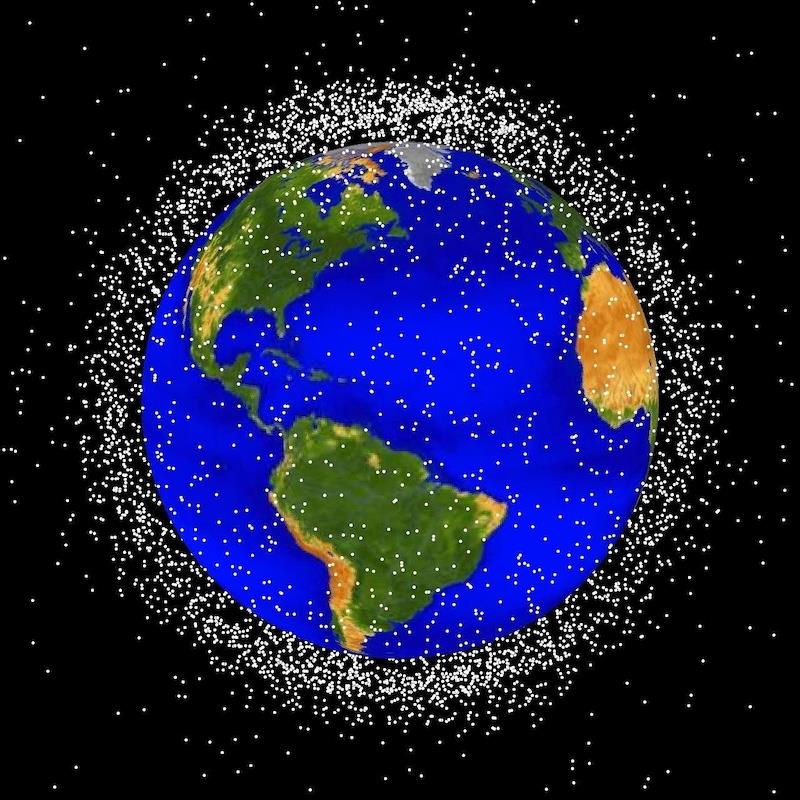
Space Junk Crisis: Robots And Technologies Cleaning Up Earth's Orbit


| Country / actor | Debris in orbit | Share of total |
|---|---|---|
| China | 4,228 | 34% |
| CIS (basically Russia) | 3,929 | 31% |
| United States | 3,884 | 31% |
| Total | 12,041 | 96% |
Accu's analysis also attempts to establish where the catalogued debris originated.
Its Space-Track data attributes 4,228 debris objects to China, 3,929 to the Commonwealth of Independent States, or CIS, and 3,884 to the United States.
Together, those three categories account for 12,041 objects, or 96 percent of the 12,550 debris objects in the dataset.
The figures need context because they reflect decades of very different space programs and individual events rather than simply measuring current behavior.
China's total has been heavily influenced by the 2007 destruction of the Fengyun-1C weather satellite in an anti-satellite test, which generated thousands of pieces of debris.
The CIS category reflects the legacy of decades of Soviet and subsequent space activity.
The US figure similarly covers a long history of launches. The Accu report also discusses the 2009 collision between the operational Iridium 33 communications satellite and the defunct Russian Kosmos 2251 satellite, which generated thousands of fragments.
Accu also calculates what it calls a“debris intensity score”, comparing the number of debris objects attributed to an actor with its number of operational satellites.
On that measure, its data gives China a ratio of 3.81 debris objects per satellite, France 2.80 and the CIS 2.49. The global average calculated by the study is 0.71.
But identifying debris is considerably easier than removing it.
The space robot has to catch something that does not want to be caughtA dead satellite is not conveniently waiting for a service engineer.
It may be tumbling. It may have no functioning communications system. It may have been designed decades before anyone contemplated robotic servicing. Its precise condition may be unknown.
And unlike a robot operating on a factory floor, an orbital servicing vehicle cannot simply stop everything and ask someone to reposition the workpiece.
This makes active debris removal, or ADR, closely related to some of the hardest problems in autonomous robotics: perception, navigation, motion planning, manipulation and control around an uncertain object.
A removal spacecraft must first find its target and approach it without creating a collision. It then has to determine the target's position, orientation and movement before getting sufficiently close to capture or otherwise interact with it.
The operation becomes even harder when the target was never designed to be grabbed.
That is one reason the emerging generation of debris-removal spacecraft increasingly combines autonomous rendezvous and proximity operations with robotic manipulation.
ClearSpace-1 prepares a four-armed robot for orbitOne of the most prominent projects is ESA's ClearSpace-1 mission.
The current mission is intended to remove ESA's 95 kg PROBA-1 satellite, launched in 2001. The spacecraft was not designed with a dedicated docking or capture mechanism.
ClearSpace-1 is therefore being developed to rendezvous with an“unprepared and uncooperative” object and capture it using four robotic arms. ESA currently lists the planned launch for 2029.
The robotic aspect of the mission is significant.
Rather than docking with a cooperative spacecraft through a standardized interface, the servicer must approach an uncontrolled, non-functional target and physically secure it.
ESA says the mission is intended to demonstrate technologies including robotic capture, close-proximity guidance, navigation and control. Once captured, PROBA-1 and the servicing spacecraft will be placed on a trajectory that enables atmospheric re-entry.
If successful, the importance of ClearSpace-1 will extend beyond disposing of a single satellite. The technologies required to capture an old spacecraft overlap substantially with those needed for a future orbital servicing industry capable of inspecting, repairing, repositioning or eventually recycling spacecraft.
In that sense, space junk may become one of the first large commercial test cases for a new category of autonomous space robotics.
Japan has already put autonomous rendezvous to the testJapan is pursuing a related approach through JAXA's Commercial Removal of Debris Demonstration, or CRD2.
The program is being developed with commercial partners to demonstrate technologies for dealing with large pieces of Japanese-origin orbital debris.
Its first phase used Astroscale's ADRAS-J spacecraft to approach and inspect an existing upper-stage rocket body.
ADRAS-J demonstrated rendezvous and proximity operations around an uncooperative object, including a fly-around inspection, and in December 2024 approached to approximately 15 metres from the target. JAXA describes collision with the debris during such operations as a“critical hazard”, illustrating the precision required even before physical capture begins.
The next step is removal.
JAXA's CRD2 Phase II is intended to progress from inspection toward actually removing large orbital debris, turning the sensing and navigation demonstrated in the earlier mission into part of a complete disposal operation.
The progression resembles a robotic manipulation problem on an enormous scale: first locate the object, then characterize it, establish its motion, approach it safely and finally make physical contact.
Except the robot and the object are both travelling around Earth at orbital velocity.
Britain plans its own debris-removal missionThe UK is also investing in active debris removal and the broader field of in-orbit servicing, assembly and manufacturing.
The UK Space Agency has supported competing concepts from Astroscale and ClearSpace for a national ADR mission.
Astroscale's proposed COSMIC spacecraft would use rendezvous and proximity operations together with a robotic arm to capture inactive British satellites. The concept is designed to remove two defunct spacecraft rather than perform a single capture.
The British government has now allocated up to £77 million toward a National Active Debris Removal Mission intended to demonstrate the country's ability to rendezvous with and remove UK-registered orbital debris. Its current strategy envisages a mission launch in 2029.
That investment reflects another important development: debris removal is becoming part of the wider market for robotic servicing in space.
A spacecraft capable of autonomously approaching and manipulating a dead satellite has many of the underlying capabilities required to interact with a functioning one.
The same technological family could eventually support inspection, life extension, repair, refuelling, repositioning and assembly.
Future satellites could make life easier for the robotsThere is, however, an obvious way of making debris removal easier: design spacecraft to be removed in the first place.
Most of today's large orbital debris was never built with robotic servicing in mind.
Future spacecraft could incorporate standardized interfaces that give servicing vehicles known locations for navigation and physical capture.
ESA is already pursuing this concept through its Design for Removal, or D4R, approach.
Four next-generation Copernicus satellites are being equipped with standardized interfaces. ESA is also developing a servicing spacecraft concept known as CAT that would rendezvous with compatible spacecraft and capture a mechanical interface called MICE.
The idea is that CAT could lower a satellite sufficiently for atmospheric drag to bring it down within the required period, release it, and potentially move on to another target.
This changes the robotics problem substantially.
Instead of asking a robot to identify some structurally suitable place to grab an unfamiliar spacecraft, engineers can provide it with a known target specifically designed for autonomous capture.
It is analogous to the difference between asking an industrial robot to manipulate arbitrary objects and giving every workpiece a standardized fixture.
Not every solution needs to grab the debrisPhysical capture is only one proposed approach.
ESA is also studying laser-based momentum transfer, in which powerful ground-based lasers would apply a very small force to debris to alter its trajectory.
The objective is not to blast objects apart – which would create precisely the opposite of the desired result – but to“nudge” non-manoeuvrable debris sufficiently to reduce collision risks.
ESA's work envisages precise laser tracking combined with high-power momentum-transfer lasers and has examined the possibility of a network of stations. The agency identifies substantial engineering and regulatory challenges, including pointing accuracy, atmospheric effects, thermal behavior of targeted debris, air-traffic safety and the obvious dual-use implications of powerful lasers capable of interacting with objects in orbit.
Other concepts being investigated across the sector include drag devices, magnetic capture and different mechanisms for securing non-cooperative spacecraft.
There is unlikely to be one machine capable of cleaning everything.
The diversity of orbital debris – from tiny fragments to large rocket stages and entire satellites – means different classes of object will probably require different mitigation or removal strategies.
The economics may be harder than the roboticsEven if engineers solve the capture problem, another question remains: who pays to remove something that no longer produces revenue?
Accu identifies cost, scale, legal complexity and dual-use concerns among the major barriers to large-scale active debris removal.
There is also an unusual ownership issue. A dead satellite may be useless, but that does not automatically make it abandoned property available for anyone to collect.
And a spacecraft capable of approaching, capturing and changing the orbit of an inactive satellite could theoretically do the same to an active one.
That makes debris-removal robotics technologically valuable but politically sensitive.
The Accu report notes:“One of the biggest barriers preventing space debris removal from scaling is that many of the highest-risk objects in orbit were never designed with removal in mind. Large defunct satellites and rocket bodies often have different geometries, unknown structural conditions and may be tumbling, so a single removal system cannot always be applied universally.
“There are also significant legal and political barriers: the technology capable of removing a dead satellite could just as easily be perceived as a threat to a live one. Moving forward, I believe we will require increased international cooperation, standardised ADR interfacing protocols and liability frameworks to make space debris removal routine.”
The cheapest debris to remove may be the debris we never createActive removal is therefore only part of the answer. Another is preventing today's satellites from becoming tomorrow's abandoned objects.
Ben Imber, project lead at Sheffield Hallam Rocketry Team, says the engineering response is beginning much earlier in spacecraft development.
He says:“Bigger organisations are now actively working towards solutions far earlier in the design process. For example, engineering satellites to burn up completely on re-entry, or planning de-orbiting trajectories at the end of a machine's lifespan. This opens up new doors in the development of new materials, new concept designs and more effective manufacturing processes.”
But he adds:“This is still a relatively new realm and is only really being considered by larger organisations. As low Earth orbit becomes more occupied, some form of widespread agreement or inspection process will need to take place.”
Simon Ganem, team lead at Bath University Rocketry Team, argues that disposal should become part of the basic specification of a spacecraft rather than something considered after its mission.
He says:“Every satellite placed in orbit should have a proven end-of-life plan, enough reserved propellant and enough redundancy to carry it out. In low Earth orbit, that could mean a controlled de-orbit so the spacecraft burns up; in higher orbits, it may mean moving to a graveyard orbit. Removing old debris is useful, but it is far better to stop today's satellites becoming tomorrow's targets.”
From orbital waste to a new robotics industryThere is a strange circularity to the space debris problem.
Increasingly sophisticated machines are being developed to deal with the remains of earlier generations of sophisticated machines.
The task now facing engineers is not simply to build better satellites. It is to build spacecraft capable of finding, understanding and physically interacting with other spacecraft that may be dead, tumbling and entirely uncooperative.
That requires many of the technologies currently transforming terrestrial robotics: autonomous perception, sensor fusion, motion planning, robotic manipulation and increasingly capable software for operating when conditions cannot be completely predicted in advance.
ClearSpace-1's four robotic arms, Astroscale's autonomous proximity operations and robotic capture systems, and ESA's standardized interfaces point toward an orbital environment in which robots could eventually maintain infrastructure rather than simply add more hardware to it.
The immediate motivation is risk reduction. The longer-term consequence could be the emergence of a genuine service economy in orbit.
For now, however, the arithmetic described by Accu remains sobering: nearly half of the objects in its Space-Track dataset are already debris, rocket bodies or unassigned objects, while fragmentation events continue adding material to an environment where some objects can remain for centuries.
And as Sacchi warns:“Even in a scenario where no further launches take place, debris levels would still increase, as collisions and fragmentation events generate new debris faster than existing objects can naturally re-enter the atmosphere.”
That means the engineering problem is no longer simply how to avoid creating more space junk.
Increasingly, it is how to build robots capable of going up and getting some of it back.

Legal Disclaimer:
MENAFN provides the
information “as is” without warranty of any kind. We do not accept any
responsibility or liability for the accuracy, content, images, videos,
licenses, completeness, legality, or reliability of the information
contained in this article. If you have any complaints or copyright issues
related to this article, kindly contact the provider above.
Comments
No comment