

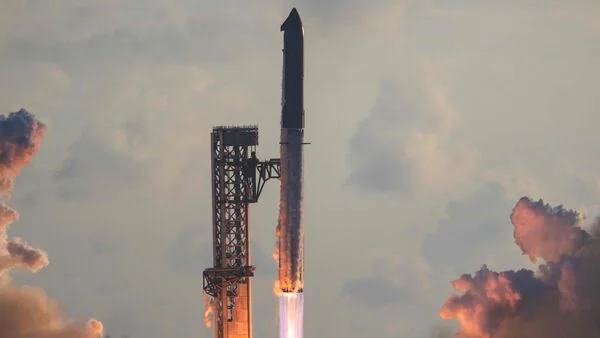
Video Spacex's Starship Reaches Orbit In Historic First But Flight Ends Early: 6 Things To Know


However, the company cut the flight short after an engine malfunction, with the spacecraft splashing down in the Pacific Ocean north of Hawaii about three hours after liftoff from Texas.
Also Read | Starship Flight 14: Why the launch matters for Starlink and Musk's Moon ambitionThe mission was originally planned to last 10 hours, with Starship completing six laps around Earth to demonstrate its readiness for NASA's Artemis moon programme.
Here's what to know about the flight and SpaceX's next steps.1. Starship reaches orbit for the first timeSpaceX's Starship, the biggest and most powerful rocket ever built, achieved orbit for the first time during Monday's launch.
The spacecraft nearly failed to reach orbit after one of its engines shut down prematurely. However, flight controllers decided to proceed after the remaining systems continued functioning.
"Starship is orbital," Mission Control announced, drawing cheers from the SpaceX team.
NASA Administrator Jared Isaacman congratulated SpaceX on reaching orbit and "managing every step in a safe, responsible and especially inspirational way."
2. Rocket deploys 26 advanced Starlink satellitesStarship carried 26 of Musk's most advanced Starlink satellites into orbit. They are set to join the company's existing network of 11,000 older models providing internet services.
The satellites were released one by one, drawing cheers from the SpaceX team at the Starbase launch site.
Also Read | SpaceX Starship to launch first orbital flight today: When and where to watch 3. Engine trouble prompts early returnSpaceX had planned a 10-hour flight involving six laps around Earth at an altitude of 170 miles (275 kilometres), followed by a splashdown in the Pacific Ocean near Chile.
Although Starship achieved orbit and reached a speed of 17,500 mph (28,000 kph), flight controllers brought it back after just a couple of laps.
SpaceX said the decision to end the flight early was made "out of an abundance of caution" following the engine trouble.
4. SpaceX targets full reusabilityThe 407-foot (124-metre) Starship is designed to be fully reusable, a key factor in SpaceX's plans to lower launch costs.
The company is working towards bringing the spacecraft back to Starbase, where giant mechanical arms would catch it.
Musk has said he gives the catch attempt even or slightly better odds of success. If it works, SpaceX plans to refly the spacecraft by the end of the year or early next year.
5. Starship's role in NASA's Artemis programmeSpaceX is working to secure orbital flight certification for Starship, a critical step towards future lunar and Mars missions.
NASA's Artemis III mission could take place as soon as next summer, involving an Orion capsule carrying astronauts and competing lunar landers.
Also Read | Exclusive-Anthropic warns AI may pose existential risks to humanity in IPO filingThe subsequent Artemis IV mission is scheduled for no earlier than 2028, with astronauts expected to land on the moon aboard either Starship or Jeff Bezos' Blue Moon lander, depending on which is ready first.
6. Musk's long-term plansMusk originally developed Starship to transport people to Mars. For now, SpaceX plans to focus on lunar missions and use the spacecraft to deploy large numbers of satellites into orbit.
The company also intends to phase out its Falcon 9 rocket within several years. A second Starship launch site is nearing completion at Florida's Kennedy Space Center, while a third is planned for Louisiana.

Legal Disclaimer:
MENAFN provides the
information “as is” without warranty of any kind. We do not accept any
responsibility or liability for the accuracy, content, images, videos,
licenses, completeness, legality, or reliability of the information
contained in this article. If you have any complaints or copyright issues
related to this article, kindly contact the provider above.
Comments
No comment