

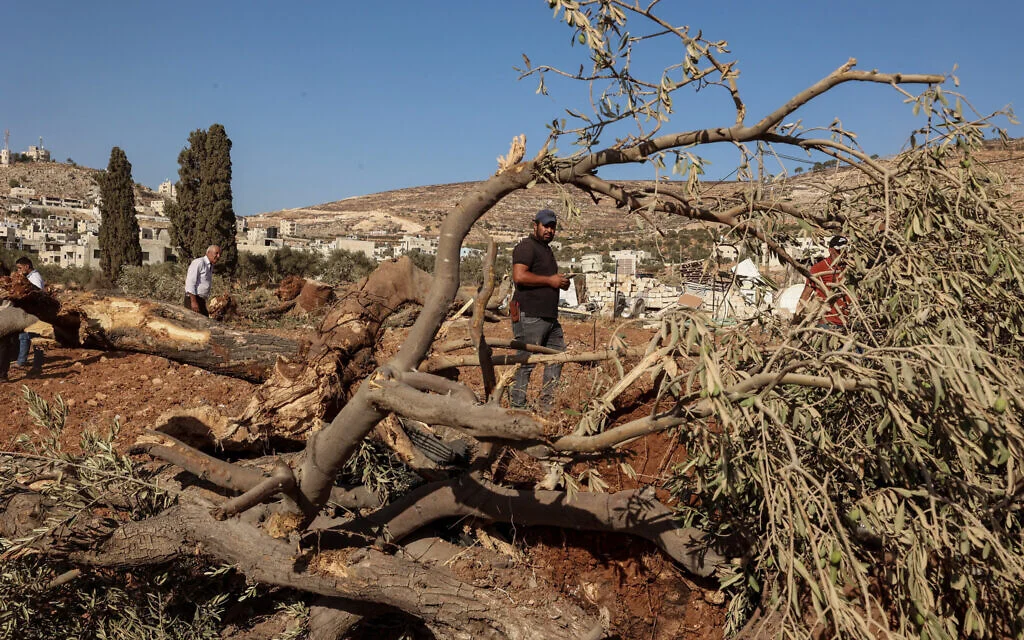
Uprooted Before Harvest: 2026 Olive Season Under Pressure As Palestinian Farmers Struggle To Reach Their Lands


For generations, the olive harvest has been more than an agricultural event. Families gather in their fields to pick the fruit together before taking it to local presses to produce olive oil, a staple of Palestinian households and an important source of income.
This year, however, many farmers say their biggest concern is no longer how much their trees will produce, but whether they will be able to reach them safely.
The Palestinian Ministry of Agriculture estimates that the occupied West Bank and Gaza Strip could produce about 21,000 tonnes of olives this season, enough to meet local demand while leaving a surplus for storage or export.
But access to the crop remains a major challenge.
Samer Samara, director general at the Palestinian Ministry of Agriculture and head of the Higher Committee for the Olive Harvest Campaign, said that about 200,000 donums of olive groves face access difficulties because of their proximity to settlements, bypass roads, military bases and outposts.
Tens of thousands of additional donums are located beyond the separation barrier, further complicating farmers' access to their land, he said.
The olive sector is a significant part of the Palestinian economy.
According to the Ministry of Agriculture, agriculture accounts for about 8 per cent of Palestinian GDP and provides more than 60,000 jobs. The destruction or loss of access to olive groves therefore threatens both household incomes and a deeply rooted agricultural tradition.
Palestinian officials and humanitarian monitors have reported a sharp increase in damage to olive trees and agricultural land in 2026.
Data from the Palestinian Wall and Settlement Resistance Commission indicate that about 49,000 olive trees were targeted during the first eight months of this year, compared with 26,988 during the same period in 2025.
Palestinian officials have also reported the uprooting of thousands of dunums planted with mature olive trees across the West Bank in recent weeks.
In some cases, farmers have reportedly attempted to collect olives from trees that had already been cut down, even though the fruit had not fully ripened.
On September 24, Israeli forces used bulldozers to clear 31 donums of private land in Beit Rima, northwest of Ramallah, uprooting more than 400 mature olive trees, according to Palestinian officials.
Two days earlier, Israeli army bulldozers ploughed through rows of olive trees in Deir Nidham, near Ramallah, causing losses to farmers shortly before the beginning of the harvest, according to local sources.
On September 20, Palestinian sources said that Israeli settlers entered the Al -Khalal area of Ni'lin, west of Ramallah, and cut or damaged dozens of olive trees following days of nearby land levelling.
The Wall and Settlement Resistance Commission said Israeli authorities have issued 51 vegetation-removal and land-clearance orders affecting about 2,093 donums in different parts of the West Bank since the beginning of 2026, including areas around Jenin, Qabatiya and Ramallah.
Access to land
Restrictions on access have become another major concern as the harvest approaches.
According to Palestinian officials, around 128,000 donums of agricultural land have been inaccessible to their owners because of restrictions on access permits since the outbreak of the war in Gaza in October 2023.
Fayyad Fayyad, director-general of the Palestinian Olive Council, said the agricultural sector has suffered significant losses since the war began, with olive production declining by about 20 per cent.
The restrictions are particularly significant for farmers whose land lies near settlements, military installations or the separation barrier.
Field sources have also reported that Israeli authorities intend to impose stricter restrictions this year on Palestinian access to areas classified as“state lands.”
Palestinian farmers said that the restrictions prevent them from cultivating and harvesting their land and could ultimately facilitate the expansion of settler control over agricultural areas.
Settler attacks
The harvest season is also approaching amid a reported increase in attacks by Israeli settlers on Palestinian agricultural land.
The United Nations Office for the Coordination of Humanitarian Affairs (OCHA), Palestinian news agency WAFA have reported attacks involving the destruction of trees, damage to agricultural property, theft of equipment and the occupation of agricultural structures.
In August alone, 628 settler attacks targeting property and agricultural land were recorded across the West Bank, according to Palestinian figures cited by humanitarian monitors. The attacks reportedly damaged more than 21,000 trees, including approximately 19,000 olive trees.
For farmers, such incidents add another layer of uncertainty to a season that traditionally brings families together in the fields.
The Palestinian Ministry of Agriculture has set mid-October as the official start of the olive harvest across the governorates.
Farmers are preparing to begin harvesting while Palestinian officials and community groups have called for protection and support committees in areas considered particularly vulnerable to attacks or access restrictions.
The challenges facing the olive sector have consequences that extend beyond the harvest itself. For many Palestinian families, olive trees provide seasonal income and food, while the groves themselves represent land that has been cultivated by generations.
The olive harvest therefore remains both an economic activity and an important part of Palestinian agricultural and cultural life.

Legal Disclaimer:
MENAFN provides the
information “as is” without warranty of any kind. We do not accept any
responsibility or liability for the accuracy, content, images, videos,
licenses, completeness, legality, or reliability of the information
contained in this article. If you have any complaints or copyright issues
related to this article, kindly contact the provider above.
Comments
No comment