

How Robotics Companies Can Create Better Trade Show Booth Demos


Ten feet over, a smaller vendor had a robot stacking boxes into a mock shelf while a rep in a headset narrated every pick. That booth had a line. The difference wasn't the hardware. It was the demo design, and demo design is something you can plan for, budget for, and rehearse before you ever ship a crate.
This piece is for the robotics marketer or product lead who's about to spend five figures on a show and wants the floor time to actually convert. I'll walk you through why robotics demos fail at expos, what a working booth demo costs you in planning hours, and a framework I've watched run well at multiple shows.
Why Most Robot Demos Die on the Show FloorRobotics faces a problem that software vendors don't: your product needs square footage. A SaaS company shows up with a laptop and a banner. You show up with a cell, a controller cabinet, a power drop, and a safety perimeter. All of that costs money before a single attendee walks past.
The second problem is comprehension speed. Attendees give you about three seconds to communicate what the machine does. If your demo requires a two minute explanation before it makes sense, you've lost them to the LED wall next door.
And the third problem, which I think is the real killer: engineers build demos for evaluation, but attendees watch demos for narrative. A robot cycling through a pick and place routine is evaluation.
A robot moving a package from a conveyor to a pallet in a rhythm that looks like a real warehouse is narrative. Same hardware. Wildly different foot traffic.
The Three-Second Rule for Robot DemosStrip your demo down to what's visible in the first three seconds of a loop. If a passerby can't tell“this thing sorts packages” or“this thing welds” from across the aisle, restructure it.
Contrast is what sells. Movement against stillness reads as activity. Color change reads as state. Sound, used sparingly, reads as feedback. If your demo runs one continuous motion with no rhythm, it looks like a machine being tested, not a machine doing work.
I'd bet on a slower, clearer loop over a fast, technically impressive one every time. Speed reads as blur from ten feet away. Clarity reads as competence.
What an Expo Booth Actually Costs YouFloor space, power, rigging, freight, labor, and the exhibit itself all stack up quickly. According to the National Institute of Standards and Technology, manufacturing and automation firms invest heavily in demonstration and validation infrastructure, which is a polite way of saying that showing your technology works is part of the cost of doing business in this sector.
The exhibit structure itself is where budgets usually go sideways. Custom builds cost more and travel worse. Modular rentals tend to cost less and arrive faster, which matters when your engineering team is already stretched thin prepping the demo.
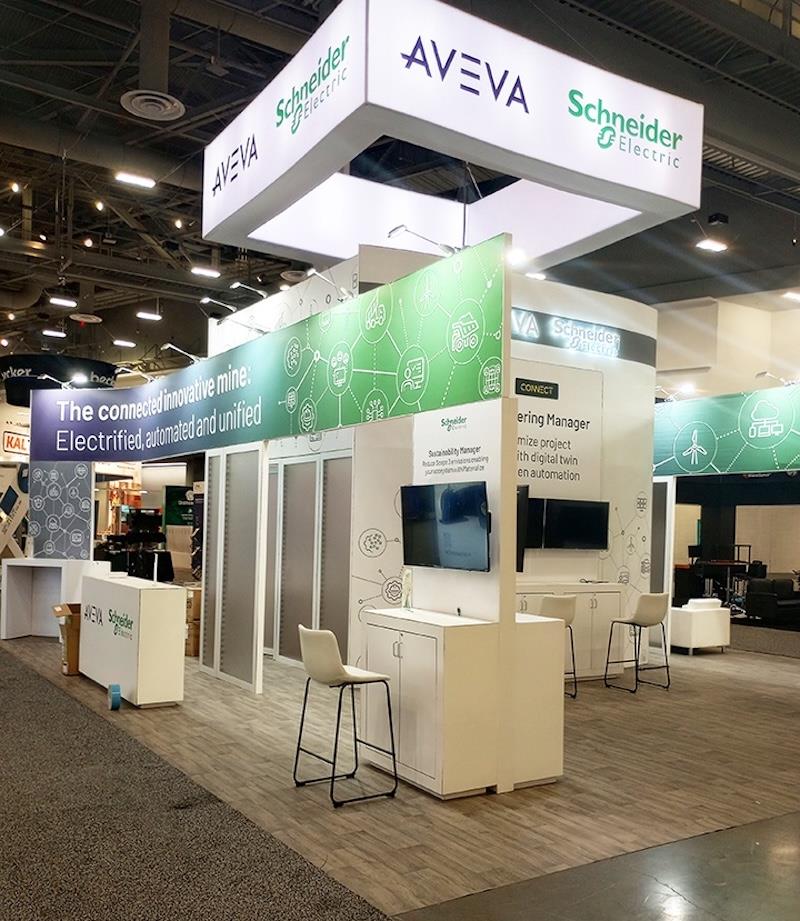
If your show is in a city where the exhibit infrastructure already exists, renting beats building for most first time exhibitors. Consider what a trade show booth rental in Las Vegas vendor offers versus a custom build: rental packages often include install, dismantle, and graphics, which removes a whole category of coordination from your plate.
I've seen companies save weeks of internal back and forth by choosing this route, especially when the show is a one-off and the booth won't be reused.
How to Structure a Demo That ConvertsHere's the sequence I've watched work across different show sizes. It's not complicated, but it takes rehearsal.
Set the scene first. Before the robot moves, the booth has a prop that tells the story. A shelf. A conveyor stub. A tote. Something the audience can map onto their own operation. Run a short loop, not a full cycle. Ninety seconds, max. Long enough to register, short enough that someone walking by catches the interesting part. Have a human narrate. Reps who talk over the loop outperform silent demos every time. Have them name the use case out loud, not the specification. Leave a physical takeaway. A spec sheet doesn't move. A small object the robot“produced” during the demo does. People carry physical things back to their teams and talk about them. Build a QR path. One QR code, one landing page, one form. Three QR codes on the same panel means nobody scans any of them.The narration point matters more than people think. In my experience, reps who know how to say“this handles the same motion your pickers do, but for fourteen hours straight” outperform reps who talk about payload and repeatability numbers. You have to translate the spec into a sentence a warehouse manager repeats in their Monday meeting.
The Two-Loop FrameworkHere's the framework I keep coming back to, and I haven't seen it written down elsewhere. Run two loops on the same robot, and switch between them every twenty minutes or so.
Loop A is the narrative demo. One task, clean rhythm, human narration. It exists to stop foot traffic and start conversations.
Loop B is the deep demo. Same hardware, more complex motion, fewer props, longer cycle. It exists to keep the qualified buyer at the booth for another ten minutes while your engineer talks payload and integration.
The trick is timing the switch. You want Loop A running when the floor is loudest and traffic is highest. You want Loop B running during slower stretches, when the people who stop are the ones who already know what they're looking at.
If you don't plan the switch, you'll end up running whichever loop the last conversation demanded, and you'll lose the passerby traffic for the rest of the afternoon.
One caveat: this works best with a single robot. If you're running multiple cells, the framework gets messy. Pick one cell as your traffic driver and let the others stay technical.
The Pre-Show Checklist Robotics Teams SkipMost of the demos I've watched fail were failing before the doors opened. Run through this in the last week before shipping.
-
Is the demo loop visible from both aisle approaches, or only one?
Can a stranger watching for three seconds name what the robot does?
Does every rep know the one sentence translation of the spec sheet?
Is there a charging plan for demo batteries that runs overnight?
Have you tested power draw on the actual show floor circuitry, not the shop?
Does the booth have a designated spot for a real conversation, away from the motion?
That last one gets skipped constantly. You need a corner where a serious buyer can hear your engineer without shouting over the demo. As the field has matured, research like the work cataloged by the Institute of Electrical and Electronics Engineers reinforces how quickly robotics teams are pushing new capabilities to market.
Less time in the lab means less institutional memory about how to show the hardware to customers. That's a booth design problem, not an engineering problem.
What to Measure After the ShowBooth leads are a weak metric on their own. What I'd track instead: how many attendees stopped for more than thirty seconds, how many asked a question that referenced a specific use case, and how many returned with a colleague.
Those three numbers tell you whether the demo did its job. A high badge scan count with low dwell time means you built a booth, not a demo. Low badge scans with high dwell time means your demo works and your capture process doesn't.
Either failure is fixable. The next show you work, pick one loop, rehearse the narration out loud, and time how long a stranger stands there. If it's under fifteen seconds, you know what to change.
What's the one thing your robot does that a stranger could understand in three seconds? That's your demo. Everything else is a spec sheet.
Space and motion are the medium here. According to the National Aeronautics and Space Administration, robotics systems built for extreme environments emphasize clear, observable task sequences because remote operators rely on visual feedback.
That principle translates directly to a show floor: if the motion isn't legible, the machine doesn't sell itself.

Legal Disclaimer:
MENAFN provides the
information “as is” without warranty of any kind. We do not accept any
responsibility or liability for the accuracy, content, images, videos,
licenses, completeness, legality, or reliability of the information
contained in this article. If you have any complaints or copyright issues
related to this article, kindly contact the provider above.
Comments
No comment