

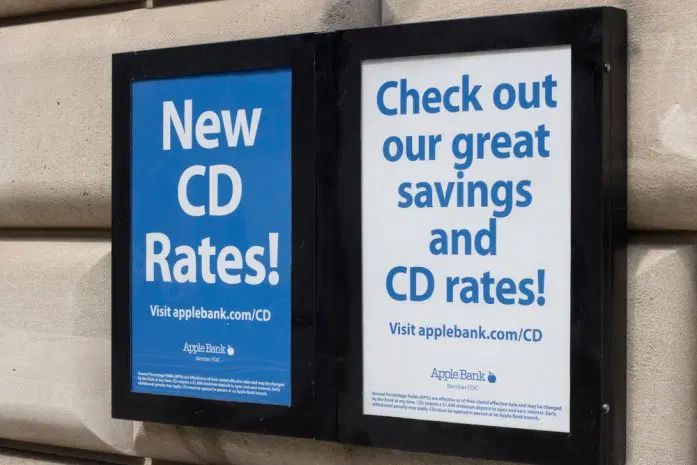
Money Market Yields Slide After The September Fed Cut-When To Move Cash To A CD


Money market yields are moving after the Federal Reserve's September decision, but there is a twist worth catching before moving a pile of cash. The Fed raised its benchmark rate by a quarter point on September 16, taking the target range to 3.75% to 4%.
That changes the savings conversation in an unusual way. A money market account keeps its rate flexible, while a CD can lock in a fixed yield for a set period. With some CDs still offering rates above 4%, the question is less about chasing the highest number and more about deciding how much access the cash really needs.
A Fed Move Does Not Instantly Rewrite Your Bank AccountMoney market accounts generally carry variable rates. Banks can change them after a Federal Reserve decision, but they do not have to move in perfect lockstep with the central bank. Bankrate notes that institutions set their own deposit rates, and the highest-paying accounts can differ dramatically from national averages.
That means a saver should check the actual APY on the account, not assume the rate followed the Fed by exactly 0.25 percentage point. One September tracker found that only a portion of the savings accounts it monitored had changed rates during the first nine days after the Fed move.
There is another wrinkle. Some competitive money market accounts still offer yields around 4%, while ordinary accounts can pay far less. Bankrate listed several money market accounts above 3.5% and one at 4.05% as of September 25.
That spread makes shopping around more valuable than simply deciding that“money market rates are falling” or“money market rates are rising.” The account sitting in front of you matters.
A CD Solves a Different ProblemA CD makes sense for money that has a job but does not need to perform that job tomorrow. Perhaps the cash covers a future home project, a planned tuition payment, or a reserve that someone expects to leave untouched for several months.
The appeal comes from the fixed rate. Once the CD opens, the bank generally pays the agreed APY through the maturity date. That can remove one source of uncertainty if deposit rates move in an unfavorable direction later.
The Cash You Might Need Should Stay FlexibleThe biggest mistake in this decision involves treating every dollar in a savings account as if it has the same purpose. Emergency money needs quick access. A CD may charge an early-withdrawal penalty if the cash comes out before maturity.
That penalty can wipe out some of the interest advantage. Worse, the saver might need to break the CD at exactly the wrong moment because an unexpected expense arrived.
A money market account can therefore remain useful even if its APY trails a CD. The ability to access the money without breaking a term commitment has value of its own. For cash that might cover a sudden repair, insurance bill, medical expense, or temporary income gap, flexibility can matter more than squeezing out another fraction of a percentage point. That does not mean every dollar needs to remain liquid. It means the decision should start with the cash's purpose, then move to the rate.
The Real Comparison Happens After the Teaser RateA flashy APY can make a CD look irresistible, particularly when a bank advertises a rate near 5%. But the rate alone tells only part of the story.
Check the term first. A 12-month CD and a five-year CD represent very different commitments, even if both advertise attractive yields. Then check the early-withdrawal penalty, minimum deposit, renewal policy, and what happens when the CD matures.
Automatic renewal deserves special attention. A CD can roll into another term if the account holder does nothing. The renewal rate may differ from the original rate, and the new term can create another period of restricted access. That little maturity notice sitting in an inbox can become surprisingly expensive if nobody opens it.
A Split Strategy Can Avoid the All-Or-Nothing ChoiceThere is no requirement to choose between keeping everything in a money market account and locking everything into CDs. Dividing cash can create more flexibility.
Someone with a large cash reserve might keep the portion needed for near-term expenses in a competitive money market account. Another portion could go into a shorter CD. Cash with a longer time horizon could use a longer CD if the rate and terms make sense.
CD ladders offer another variation. Instead of putting the entire balance into one maturity date, a saver spreads deposits across several maturity dates. That creates periodic opportunities to access cash or reinvest it.
The approach also reduces the pressure to guess what interest rates will do next. Nobody needs to predict the next Fed decision perfectly. The accounts simply mature at different points.
A Rate Worth Locking in Still Needs the Right TimelineThe September rate environment offers a useful reminder: Federal Reserve decisions influence deposit rates, but they do not turn every savings product into the same financial instrument. The Fed raised rates this month, yet individual bank yields have responded differently.
For savers, that makes the CD decision surprisingly personal without requiring a complicated financial strategy. Cash needed soon generally benefits from access. Cash with a clear future date can make a stronger candidate for a fixed-rate CD.
Before moving money, compare the actual APY with the term and withdrawal rules. Then ask a very ordinary question: Could this money stay untouched until the CD matures? If the answer is no, the extra yield may not justify the loss of flexibility.
Would you lock up part of your cash in a CD right now, or keep it flexible in a money market account?

Legal Disclaimer:
MENAFN provides the
information “as is” without warranty of any kind. We do not accept any
responsibility or liability for the accuracy, content, images, videos,
licenses, completeness, legality, or reliability of the information
contained in this article. If you have any complaints or copyright issues
related to this article, kindly contact the provider above.
Comments
No comment