

The More Life Company Bets On Delivery, Not Discovery


The thesis in one paragraph
The More Life Company Corp. (CSE: MLCO; OTC: TMLCF) is a micro-cap with an unusual proposition: it does not try to invent new molecules. It tries to make existing ones work better. In agriculture, its Agrarius plant-signalling technology has posted double-digit yield gains in third-party and partner field trials across seven crops in Brazil and Colombia. In human health, its patented Quicksome oral delivery platform has just produced its first human pharmacokinetic data. At roughly six Canadian cents a share in mid-September, the market values the whole enterprise at about $27-million.
That price reflects real risks. Revenue is negligible and cash is tight. But it overlooks the company's intellectual property: Quicksome and Quicksol are patented and company-owned, and MLCO holds global distribution rights to Agrarius with exclusivity across the Western Hemisphere. The price also reflects a company that most investors met under a different name, with a different story. The question for investors is whether the new story is supported by the evidence. On the evidence published so far, it is worth a closer look.
Small-cap investors have learned, often expensively, that "platform technology" is the most overused phrase in Canadian junior markets. So the analysis below starts where a banker's due diligence would: with the data, the capital structure and the comparable transactions.
From Mountain Valley MD to More Life: a deliberate reset
On Aug. 20, the company formerly known as Mountain Valley MD Holdings Inc. began trading on the Canadian Securities Exchange under the symbol MLCO. Its U.S. over-the-counter symbol changed to TMLCF the following day. The rebrand came with a continuance from British Columbia to Ontario and a short-form amalgamation with a wholly owned subsidiary. No shareholder action was required.
"We wanted a name that could be understood before it was explained," president and chief executive Dennis Hancock said at the time. The name matters less than what it signals: a narrower company. Management now organizes the business around three platforms:
- Agrarius, a biological plant-signalling technology aimed at higher crop yields, reduced fertilizer use and resilience to pests and climate stress. The company holds it under licence with global distribution rights and exclusivity across the Western Hemisphere.
- Quicksome, a company-owned, patented desiccated liposomal formulation designed for rapid absorption through the lining of the mouth, targeting peptides, hormones and wellness applications.
- Quicksol, a patented solubility technology for the macrocyclic lactone class of compounds, with animal-health applications.
The reset was financed in the spring. In April, the company closed a non-brokered private placement of up to $2-million in units priced at 2.5 cents, each carrying a warrant exercisable at 8 cents for 12 months, alongside share-for-debt settlements of about $485,000. The deals cleaned up the balance sheet and set a visible hurdle: the warrants are only worth exercising if the stock trades above 8 cents before they expire in the spring of 2027.
Agrarius: the field data does the talking
Agrarius is the company's nearest path to revenue, and the evidence behind it has been accumulating in the one place that matters most for crop inputs: Brazil, the world's largest agricultural exporter and a leading market for biologicals.
The most recent result, released Sept. 15, came from G12 Agro, an independent Brazilian agricultural research organization. In a randomized complete block trial on Orquestra table potatoes in Itai, Sao Paulo, two Agrarius applications lifted the yield of special-grade potatoes (45 to 70 millimetres, the size that commands the best price) by 32.5 per cent over the untreated control, to 32.6 tonnes a hectare. A single application raised total yield by 27.6 per cent. Spiros Fournogerakis, vice-president of Latin American operations, translated that into grower terms: roughly eight additional tonnes, or about 320 more bags, of premium potatoes per hectare.
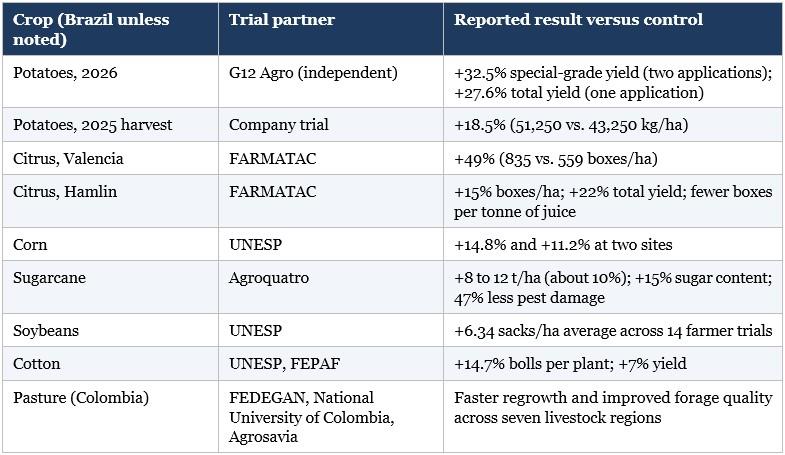
Source: company press releases, Dec. 1, 2025, and Sept. 15, 2026.
The citrus numbers deserve a second look. Brazil's orange belt has been battered by huanglongbing, or citrus greening, a bacterial disease with no cure. The partner trials reported a visible reduction in symptoms on treated trees. That is an observation, not a controlled disease endpoint, but it points to where a yield-support product could find urgent demand.
A caution belongs here too. Apart from the G12 Agro study, most of these trials were run with commercial or academic partners and reported by the company. None has yet appeared in peer-reviewed literature. Yield responses in biologicals also vary by soil, season and management. What investors should watch for next is repeatability across seasons and, above all, the first paid distribution agreement. Management says it is advancing discussions with growers and distributors, with further crop results due over the coming months.
Quicksome: first human data, and a regulatory door opening
If Agrarius is the near-term story, Quicksome may prove the most valuable asset, and the company owns it outright. The technology packs active ingredients into dried liposomes with proprietary stabilizers, pressed into a tablet that dissolves under the tongue. The pitch is room-temperature stability, no needles and fast absorption directly into the bloodstream.
On Sept. 22, the company reported its first human exposure data. In an exploratory study under third-party medical supervision, eight adult men aged 28 to 71 took a single sublingual dose of USP testosterone. Tablets dissolved in three to eight minutes. Six of the eight reached peak serum testosterone at about 20 minutes. In the 15-milligram group, levels rose from pre-dose readings of 311 to 432 ng/dL to peaks of 1,436 to 5,981 ng/dL, and generally returned toward baseline within three to six hours.
"The speed and magnitude of the serum testosterone response observed following administration were notable," said Dr. Sanjeev Goel, the company's medical adviser.
Read carefully, the study proves one thing and leaves several open. It shows that Quicksome can move a clinically relevant molecule into the blood quickly and in quantity. It was not designed to establish efficacy, optimal dose, formal bioavailability or equivalence to approved products, and several peaks sat well above the typical adult male range. The company says its next steps are dose optimization, repeat-dosing work and extension to estradiol and progesterone. For a delivery platform, speed and magnitude are the hard part; titrating down is usually the easier engineering problem.
The larger prize may be peptides. In May, the company reported initial Quicksome formulation work on BPC-157, GHK-Cu, KPV, SNAP-8 and retatrutide. Two months later, on July 23, the U.S. Food and Drug Administration's Pharmacy Compounding Advisory Committee voted 8-6 to recommend adding BPC-157, KPV and TB-500 to the list of substances U.S. compounding pharmacies may use, over the objections of agency scientists. The vote is advisory. Any change requires formal rulemaking, which typically takes eight to 12 months.
If the rule follows the vote, compounding pharmacies will need stable, needle-free formats for peptides that today are mostly injected. That is precisely the gap Quicksome is designed to fill. "Quicksome is a platform technology, not a single-product opportunity," Mr. Hancock said in May. The company's stated model is to license the platform to compounders and regional distributors rather than to own or manufacture the underlying molecules.
Case studies: what the market has paid for
Comparable transactions do not value a pre-revenue micro-cap. They do show what the destination looks like if the company executes.
Biologicals attract strategic buyers. In 2022, Bioceres Crop Solutions (NASDAQ: BIOX) acquired Marrone Bio Innovations in an all-stock merger valued at about US$236-million. Marrone brought a portfolio of 18 commercial biological products. Two years earlier, Syngenta bought Italian biostimulant specialist Valagro to anchor its own biologicals unit. The lesson for MLCO is twofold: large agricultural companies pay for proven biological portfolios, and they pay for commercial traction rather than trial data alone.
The end market is growing. Grand View Research sizes the global biostimulants market at US$3.1-billion in 2025, rising to US$5.9-billion by 2033, an 8.5 per cent compound annual growth rate, and singles out Brazil as a key growth driver. Even a fraction of a per cent of that market would be material for a company of MLCO's size.
Delivery platforms can be royalty engines. In pharmaceuticals, San Diego-based Halozyme Therapeutics built a large business by licensing its ENHANZE drug-delivery technology to major drug makers in exchange for milestones and royalties, rather than developing its own drugs. Quicksome operates at a far earlier stage and in a different regulatory lane. But the model, a delivery technology licensed across many molecules and partners, is the one MLCO says it is pursuing.
None of these comparisons implies a valuation for MLCO. Each shows the conditions under which platform stories get re-rated: repeatable data, a signed commercial partner and recurring revenue.
The numbers: a $27-million option on execution
MLCO is priced as an option, not as an operating business. The stock rose about 400 per cent in the 52 weeks to late August, yet the entire company is still valued at less than many single-asset junior explorers.
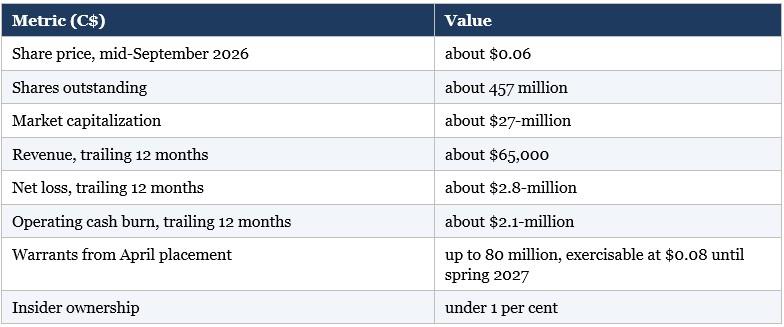
Sources: StockAnalysis; company releases. Trailing figures are from the most recent filed statements and may not fully reflect the April financing.
Three observations follow. First, the burn rate is modest for a company running trials on two continents, which reflects the licensing model: partners and trial organizations carry much of the field cost. Second, the 8-cent warrants are the swing factor. If the stock clears that level and the full tranche is exercised, the company could collect up to about $6.4-million without a new offering, several years of runway at the current burn. Third, insider ownership is low. Investors should want to see management buy stock in the open market.
Catalysts to watch over the next 12 months
- A first commercial Agrarius agreement with a Brazilian grower group or distributor. This is the single most important milestone.
- More crop data. Management has flagged additional crop-specific results in the coming months, including second-cycle sugarcane, coffee, cotton, citrus and farmer-led wheat and barley evaluations.
- FDA rulemaking on compounded peptides following the July advisory vote, and any Quicksome licensing agreement with a U.S. compounding pharmacy or regional distributor.
- Quicksome dose optimization, repeat-dosing data and first results in estradiol and progesterone.
- Warrant exercises at 8 cents, which would fund the company without a discounted offering.
- Restored OTCQB status for TMLCF, reopening access for U.S. retail and institutional accounts.
Risks: the analyst's ledger
Any honest assessment of MLCO has to put the risks on the table with the same weight as the opportunity.
- Financing and dilution. With about $65,000 in trailing revenue and a burn of roughly $2-million a year, the company depends on equity markets. Further issuance is likely and could be priced at a discount.
- Thin balance sheet. The most recent reported figures show modest cash against comparable debt and negative shareholders' equity. Investors should read the auditor's commentary in the annual statements.
- Evidence quality. Most field results are partner-run and company-reported, not peer-reviewed. The testosterone study involved eight people and was exploratory.
- Regulatory uncertainty. The FDA is not bound by its advisory committee. Rulemaking could narrow, delay or reverse the peptide opportunity. Hormone products face their own regulatory pathway.
- Commercial execution. Crop input sales depend on distribution, pricing and grower trust built over several seasons. A small team must execute in Brazil and Colombia simultaneously.
- Liquidity. Daily CSE volume is often in the tens of thousands of shares, and the U.S. symbol is currently restricted at several brokers. Positions can be hard to enter or exit.
The bottom line
The More Life Company is not a finished business. It is a set of company-owned patented technologies and exclusive distribution rights, with encouraging early evidence, a clean new identity and a market value that assumes very little. Agrarius has produced double-digit yield gains across seven crops, now including an independent randomized trial. Quicksome has shown it can deliver a hormone into the bloodstream within about 20 minutes, just as U.S. regulators move toward reopening the compounded peptide market.
The next 12 months should answer whether its partners will pay. For investors with a high tolerance for risk and a long enough horizon to wait for that answer, MLCO offers a clear set of milestones against which to hold management accountable.
Forward-looking statements. This article contains forward-looking information, including statements about trial programs, regulatory processes, commercialization, financing and warrant exercises. These statements are based on the company's public disclosures and are subject to risks and uncertainties that could cause actual results to differ materially. Readers should review the company's filings on SEDAR+ for a full discussion of risk factors. Figures are in Canadian dollars unless otherwise stated and are current as of Sept. 25, 2026.
The accuracy of the information is not guaranteed. Consult with your financial advisor before making any decisions relating to The More Life Company or any other company named herein. Unauthorized use, disclosure or distribution of this article is prohibited. The More Life Company is not liable for errors or omissions in this article. This article is not and should not be construed as an offer to sell or the solicitation of an offer to purchase or subscribe for any investment. No information in this article should be construed as individualized investment advice. A licensed financial advisor should be consulted prior to making any investment decision. We make no guarantee, representation or warranty and accept no responsibility or liability as to its accuracy or completeness. Irrational Exuberance Media LLC assumes no warranty, liability or guarantee for the current relevance, correctness or completeness of any information provided within this article and will not be held liable for the consequence of reliance upon any opinion or statement contained herein or any omission. Yolowire has been compensated four hundred and fifty dollars by Irrational Exuberance Media LLC for distribution of this The More Life Company article. Furthermore, we assume no liability for any direct or indirect loss or damage or, in particular, for lost profit, which you may incur as a result of the use and existence of the information, provided within this article. Be extremely careful, investing in securities carries a high degree of risk; you may likely lose some or all of the investment. Yolowire was not compensated by any public company mentioned herein to disseminate this press release.
Sources
- Rapid Systemic Delivery of USP Testosterone in Exploratory Quicksome Study, Sept. 22, 2026
- Positive Third-Party Agrarius Potato Trial Results in Brazil, Sept. 15, 2026
- New U.S. Trading Symbol, Aug. 20, 2026
- Completion of Name Change From Mountain Valley MD Holdings Inc., Aug. 18, 2026
- Quicksome Sublingual Delivery Platform for Compounded Peptide Applications, May 29, 2026
- Non-Brokered Private Placement and Shares for Debt, March 31, 2026
- Year-End Business Update, January 2026
- Positive Agrarius Agricultural Trial Results, Dec. 1, 2025
- FDA Panel Votes to Loosen Restrictions for Four Peptides, PharmExec, July 24, 2026
- Bioceres and Marrone Bio merger announcement, SEC filing, March 2022
- Biostimulants Market Report, Grand View Research
- MLCO statistics and price history, StockAnalysis

Legal Disclaimer:
MENAFN provides the
information “as is” without warranty of any kind. We do not accept any
responsibility or liability for the accuracy, content, images, videos,
licenses, completeness, legality, or reliability of the information
contained in this article. If you have any complaints or copyright issues
related to this article, kindly contact the provider above.
Comments
No comment