

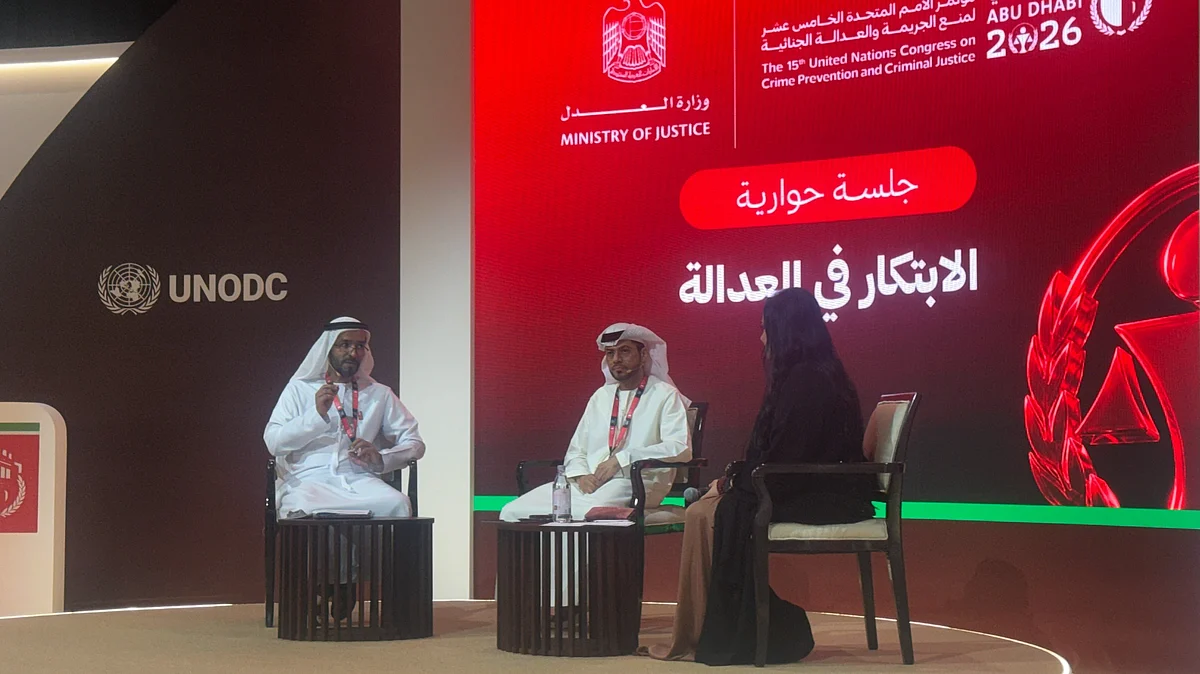
UAE Launches Ethics Code For Use Of AI In Legal Processes That Affect People


The announcement came at a panel titled "Innovation in Justice" at Adnec Abu Dhabi, on the sidelines of the 15th United Nations Congress on Crime Prevention and Criminal Justice, which brings together more than 5,000 participants from 97 countries till October 1.
Recommended For You"No decision that affects an individual can be made by AI alone," said Dr Abdullah Al Hammadi, Assistant Undersecretary for Support Services at the Ministry of Justice. "There must always be human accountability, human oversight, and a clear record of who made the call, and when."
Justice as a testing ground for innovationAl Hammadi argued that legislative innovation is not merely about modernising services. It is a strategic tool for solving society's deepest challenges, from housing and education to migration and public health. Countries that have designed smart regulatory frameworks, he noted, have managed to turn structural crises into managed transitions. The results closer to home are already visible.
Stay up to date with the latest news. Follow KT on WhatsApp channels.
Court hearings, marriage documentation and power of attorney services are now fully virtual in the UAE. The ministry's AI legal advisory platform offers citizens virtual family legal consultations. None of these services went live without rigorous testing phases, Al Hammadi said, ensuring accuracy and minimising risk before public rollout. The momentum is broader: Abu Dhabi's Judicial Department explored AI integration into judicial services in June, and the Public Prosecution discussed AI-assisted workflows in August to accelerate case processing.
The threat that demands a responseOne of the session's most striking moments came when Al Hammadi raised an uncomfortable truth: the same AI tools that can serve justice can be weaponised against it. UN reports, he said, have documented a rise in criminal networks using AI to target and recruit victims of human trafficking.
"We cannot talk about AI in justice without talking about AI in crime," he warned. "The gap between the tools available to criminals and the tools available to law enforcement is not an abstract concern. It costs lives."
Governance, sovereignty and the road aheadDr Abdullah Al Kaabi, Senior Director of Technology Consulting at PwC Middle East, offered a sharp comparative lens. He pointed to Brazil's success since 2018 in deploying AI systems to classify legal appeals, saving judges significant time without removing their decision-making authority. He contrasted this with the Netherlands, where a programme that automatically profiled suspects was suspended in 2020 after it was found to embed systemic bias, a cautionary tale of what happens when governance lags behind technology.
"Success always comes down to governance, not the tool itself," Al Kaabi said.
Al Hammadi closed with a principle central to the UAE's digital strategy: sovereign AI. The country's data and systems, he said, must remain within its borders, and its tools must be built domestically rather than imported. He pointed to the Falcon project as evidence of the scale of that ambition, noting that the UAE is now among the world's top investors in national AI infrastructure.
These commitments align with the Abu Dhabi Declaration expected to be adopted at the congress, a five-year international roadmap covering responsible AI use, cross-border cooperation and asset recovery.
"Technology will always be a tool in service of the judge, the lawyer and the citizen," Al Hammadi said. "Never a replacement for them."
ALSO READ- UAE hosts largest ever UN Crime Congress as Abu Dhabi welcomes 110 nations Abu Dhabi Declaration: What 119 countries agreed on AI, cybercrime and trafficking UAE turns to AI to detect drug trafficking patterns, stresses international cooperation

Legal Disclaimer:
MENAFN provides the
information “as is” without warranty of any kind. We do not accept any
responsibility or liability for the accuracy, content, images, videos,
licenses, completeness, legality, or reliability of the information
contained in this article. If you have any complaints or copyright issues
related to this article, kindly contact the provider above.
Comments
No comment