

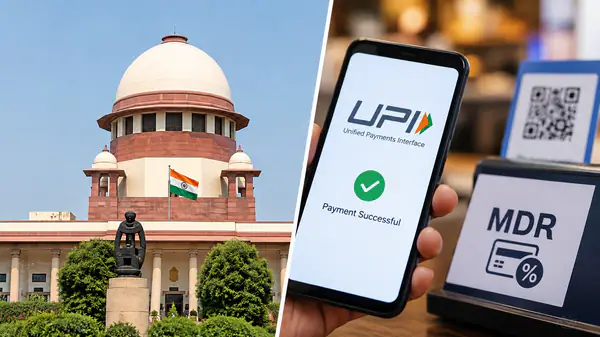
SC Questions Legal Basis For New UPI Charges, Declines Plea To Stay Levy


The apex court also issued notice to the Reserve Bank of India (RBI), the payments regulator, and the National Payments Corporation of India (NPCI), which operates the Unified Payments Interface (UPI) network.
The court was hearing a plea filed by advocate Anjan Datta challenging the legal basis for the levy and the manner in which it was introduced. A bench headed by Chief Justice Surya Kant, along with Justices Joymalya Bagchi and J.V. Mohana, questioned the Centre on the legal nature of the charge and the authority under which it could be imposed.
The bench questioned the government's explanation that the MDR was neither a tax nor a fee.
“What is the executive scope of making this expropriation? We would have understood if it was a fee. It's not a fee, then what is the character?” the bench asked.
The government announced on 15 September that a 0.4% MDR will be levied on person-to-merchant (P2M) UPI payments of ₹2,000 or more, with a cap of ₹300 on transactions of ₹75,000 or more. Person-to-person (P2P) UPI payments, however, will remain free. The new levies come into effect on 15 October.
Also Read | UPI MDR to pinch retailers with bigger baskets, spare othersAdditional Solicitor General N. Venkataraman, appearing for the Centre, said the government was not collecting the money. Instead, the charge was a settlement fee paid between participants in the payment system.
“There's a cost for doing debit/credit card transactions. UPI is no different: two operators provide the service. one are the banks. It is not a statutory collection by the government of India. It's a settlement fee amongst the players, which NPCI facilitates. The government is not taking a rupee of this,” Venkataraman said as he explained that banks and payment operators incur costs in processing UPI transactions and that the proposed MDR would be shared within the payment ecosystem, and not with the government.
During Monday's hearing, the petitioner's counsel also argued that the UPI had helped reduce black-money transactions and sought a stay on the new charges.
The Supreme Court, however, declined to grant interim relief.
Certain essential sectors will incur a flat ₹5 charge, while capital market transactions will incur a 0.02% MDR capped at ₹300. Small merchants receiving up to ₹1 lakh per month through UPI quick-response code payments have also been excluded from the MDR framework.
Also Read | Centre to monitor UPI MDR charges daily from 15 OctoberThe petitioner challenged the framework on constitutional and legal grounds, arguing that the government had not adequately explained the basis for the ₹2,000 threshold or other classifications. It also questioned the executive's power to determine which electronic payments should remain free.
The plea also raised concerns that merchants could eventually pass the additional cost on to consumers. It sought quashing or suspension of the new framework or, alternatively, a fresh process based on disclosed data and an impact assessment.

Legal Disclaimer:
MENAFN provides the
information “as is” without warranty of any kind. We do not accept any
responsibility or liability for the accuracy, content, images, videos,
licenses, completeness, legality, or reliability of the information
contained in this article. If you have any complaints or copyright issues
related to this article, kindly contact the provider above.
Comments
No comment