

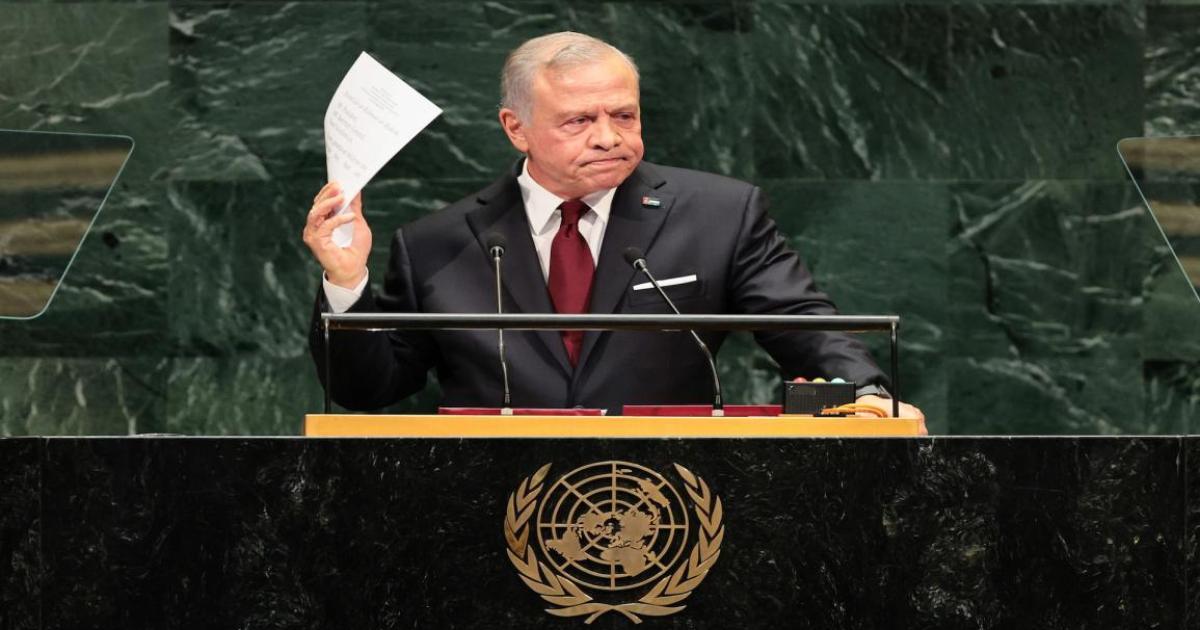
Jordanian Opinion Writers On The King's UN Speech: Political Confrontation With Israel


A common question running through the commentaries is what comes after the New York speech. The writers approached that question from different angles. Some focused on Jordan's security and strategic position, others examined international law and what they described as its selective application, while several focused on the future of Jordanian-Israeli relations and the need to translate the King's message into concrete policies and domestic measures.
Hussein Al-Rawashdeh: What Comes After the King's Speech?
In an article published by Al-Dustour, writer Hussein Al-Rawashdeh puts the question directly in his headline:“What Comes After the King's Speech?”
For Al-Rawashdeh, the question is not limited to the speech itself. It also concerns the impact it has had on public opinion in Jordan and beyond, as well as the wider regional and international implications of the position outlined by the King.
He writes that the question concerns“the speech delivered by the King at the opening session of the United Nations General Assembly,” but also“the major resonance and impact it has had on public opinion locally, regionally and internationally.”
More importantly, Al-Rawashdeh argues that the speech“represented a turning point in the political discourse toward Israel, in terms of its intensity, warning and confrontation.”
He also draws attention to the timing of the speech, noting that it came as Israel approached elections and shortly before an Arab-Islamic meeting with US President Donald Trump. He links the timing to the need for Jordan to assess what the post-Iran war period could mean for the region, and particularly for Jordan, amid what he describes as attempts to liquidate the Palestinian cause.
For Al-Rawashdeh, the starting point for understanding the next phase is to remain calm and rational. He argues that the King“clearly defined the direction of the Jordanian compass,” making the country's higher interests a red line.
“The Israeli government poses a threat to Jordanian national security,” Al-Rawashdeh writes.“Jordan will not look away from this threat. It will protect its security, water and borders.”
He stresses that Jordan is not seeking war, but says it is prepared for it if its vital interests come under threat.
The central message of the King's argument, in Al-Rawashdeh's reading, is therefore“Jordan First”: any Israeli threat, whether connected to developments in the West Bank or southern Syria, would be confronted by Jordan“with strength and resolve.”
The writer then poses two central questions for the next stage:“What is Tel Aviv thinking about Jordan in the coming phase, and what is Jordan thinking about in order to confront this threat?”
Answering the first question, he argues, requires a political mechanism capable of thinking and making decisions strategically in light of the changes in Jordan's relationship with Israel.
“What is completely clear, from what is exposed or remains concealed,” he writes,“is that Tel Aviv harbors nothing but further ill intentions toward Jordan.”
Al-Rawashdeh points to Israeli discussions following the King's speech, saying they have touched on issues including“the Jordanian option for administering the West Bank, the disengagement decision, and the Hashemite custodianship over Jerusalem and its holy sites.”
But he identifies what he considers a more important concern:“attempts to interfere with the Jordanian domestic arena, whether through demographics, the economic situation, or the relationship between the state and society.”
His answer to the second question is therefore centered on what he calls“reordering the Jordanian house.”
He argues that Jordan needs a broad national discussion and a comprehensive assessment of the country's position in different fields, including addressing weaknesses and mistakes and strengthening the institutions of the state and society.
The writer also calls for reaffirming and defining the Jordanian-Palestinian relationship on the basis of Jordan's legal and administrative disengagement decision, which he sees as important for deterring Israel from pursuing plans aimed at resolving the Palestinian issue at Jordan's expense.
Al-Rawashdeh also credits the King's actions before the speech, including what he describes as efforts to engage major global centers of political and economic power, diversify alliances and options, and strengthen national resilience through defense agreements.
But he argues that the next responsibility lies with state institutions and society to seize“the moment of the speech” and turn it into a broader Jordanian equation based on understanding both“ourselves and the adversary,” meaning what Jordan wants, what others want for Jordan, and what is required to protect national interests.
Laith Nasrawin: The Speech Put International Law at the Center
Constitutional law professor Laith Kamal Nasrawin approaches the speech from a legal perspective. He argues that the King went beyond condemning Israeli actions or simply calling for them to stop, and instead raised a broader question about the value of international law itself and the ability of the international community to enforce the decisions it adopts.
Nasrawin writes that the King presented“a clear legal vision of what is happening in the occupied Palestinian territories,” moving beyond condemnation to question“the value of the law it has created, the usefulness of the resolutions it issues and leaves unenforced, and the reasons why its rules are applied differently from one state to another.”
The King's decision to place international law at the heart of the speech, Nasrawin argues, reflects the idea that the central problem is not the absence of legal rules governing occupation and armed conflict or protecting civilians.
Rather, he writes, the problem lies in“the extent to which there is a commitment to applying and enforcing them equally and without exception.”
Nasrawin also highlights the King's insistence on using precise descriptions for Israeli actions, rather than terms that might soften their character.
“Demolishing Palestinian homes to expand illegal settlements is not law enforcement,” he writes, summarizing the King's argument.“Seizing occupied land is not registration of ownership, but actual annexation. Checkpoints that disrupt Palestinian life are not merely security measures, and forcing Palestinians to leave their land is forced displacement constituting a war crime.”
For Nasrawin, the importance of this legal characterization lies in its ability to move the discussion from political condemnation toward questions of legal responsibility and accountability.
The speech, in his reading, does not stop at describing violations. The King also referred to practical instruments available to the international community, including“sanctions, asset freezes, embargoes and diplomatic isolation.”
Nasrawin argues that this raises a fundamental legal and political question about the use of such measures against other states for violations of international law, and their absence in the case of Israel.
He pays particular attention to the King's description of international resolutions concerning Israel as“ink on paper,” saying the phrase captures the widening gap between international decisions and their implementation.
“The credibility of international law is measured not only by the number of conventions and resolutions issued in its name,” Nasrawin writes,“but by the extent to which all states are subject to its rules and enforcement mechanisms.”
Selective enforcement, he argues, undermines confidence not only in individual resolutions but in international law and international institutions themselves.
For Nasrawin, the King's message ultimately shifts responsibility for inaction from the realm of inability to the realm of political choice. The tools exist, the legal rules exist and the facts are known. What is missing, in this reading, is the political will to use the available mechanisms.
Hassan Al-Daajeh: Water Security Is Part of National Security
Strategic studies professor Hassan Al-Daajeh focuses on southern Syria and its connection to Jordan's water security.
He argues that Jordanian national security can no longer be understood solely through the ability to control borders and prevent incursions.
“Water reaching homes, food produced by the land, and the stability of agricultural communities are all essential components of the equation of sovereignty,” Al-Daajeh writes.
From this perspective, southern Syria has an importance that goes beyond geography because developments there could affect Jordanian resources and interests.
Al-Daajeh directly links this assessment to the King's UN speech, saying the warning over Israeli actions in southern Syria and the emphasis on the protection of Jordan's northern borders and water security establish a strategic connection between border security and the protection of vital resources.
He points to Jordan's chronic water scarcity, demographic and climate pressures, and challenges affecting water networks and groundwater.
Citing the country's water strategy, he notes that per capita annual water availability has fallen below 61 cubic meters.
This figure, he argues,“reveals the narrow margin for maneuver available to the state when resources decline or supplies are disrupted,” making prevention and preparedness less costly than managing the consequences of a crisis after it occurs.
Al-Daajeh gives particular attention to the Yarmouk Basin, where Jordanian and Syrian interests intersect.
Any disruption in the operation of water facilities, the exchange of information or technical coordination, he argues, could make planning more difficult.
“Stability in Syria, its territorial integrity and the ability of its institutions to manage its resources represent a direct Jordanian interest,” he writes, arguing that these conditions provide a more sustainable basis for cooperation and the protection of mutual rights.
The writer also stresses that water scarcity is not merely a technical issue. It affects households, farmers, food prices and employment.
“Water distribution equity is part of social stability,” he writes,“and water security becomes an everyday issue felt by citizens.”
Al-Daajeh proposes a series of practical measures, including stronger Jordanian-Syrian coordination through a permanent mechanism bringing together water specialists, diplomats and border officials.
He also calls for regular exchanges of flow and storage data, agreed monitoring tools, early-warning mechanisms for breakdowns and pollution, and joint drought and emergency plans.
At the diplomatic level, he argues that Jordan should make the protection of water resources and infrastructure an explicit part of its Arab and international diplomacy.
He also highlights the importance of the National Water Carrier project, which is designed to produce 300 million cubic meters of desalinated water annually.
Alongside the project, he calls for a water system capable of absorbing shocks through diversified sources, strategic storage, interconnected networks, reduced water losses and stronger physical and cybersecurity protections.
Ultimately, Al-Daajeh argues that“reducing Jordan's vulnerability to water pressure” should become a national security objective, achieved by increasing resources under national control and avoiding critical dependence on any single external source.
Lamis Andoni: The Speech Raises Questions Inside Jordan
Writer Lamis Andoni, in her article“What Comes After the King's Speech in Jordan,” focuses more directly on the domestic implications of the speech and the future of Jordan's relationship with Israel.
Andoni argues that the speech was more than simply a strong political statement. She describes it as an“absolute condemnation” of the Israeli government and highlights the King's call for the United Nations to impose sanctions on Israel.
She also stresses the significance of the position coming from a country that has maintained a peace treaty with Israel since 1994.
Andoni describes the King's intervention at the UN as an effort to“push for the implementation of international and humanitarian law and the UN charters themselves.”
For her, the speech raises questions about what Jordan should do next.
She draws particular attention to Jordan's experience with energy relations with Israel and revisits the gas import agreement, recalling the protests that surrounded the construction of the gas pipeline in northern Jordan and the expropriation of agricultural land associated with the project.
Andoni recalls visiting villages in northern Jordan at the time, describing what she witnessed as a“shock” among landowners who depended on relatively small plots of agricultural land for their livelihoods.
She writes that there was a strong sense among some landowners that their land was being used“for the benefit of Israel,” particularly among people who had served for years in the Jordanian military and security services.
Andoni uses the gas agreement as an example of what she sees as Jordan's economic dependence on Israel.
Jordan, she argues, has become partially dependent for its energy on“a state that has expansionist ambitions and threatens its security,” adding that“no peace treaty protects or restrains Israel.”
She also warns against reducing the problem to the figure of Israeli Prime Minister Benjamin Netanyahu, arguing that a change of government would not necessarily mean a change in the wider policies she criticizes.
Andoni calls for serious consideration of freezing agreements with Israel and suggests that Jordan could consult leading Jordanian, Arab and international legal experts on the matter.
She also places considerable emphasis on the domestic front.
Jordan, she argues, cannot pursue the line announced by the King in New York without addressing the internal front, and she calls for a broader national framework capable of bringing together different political forces.
She suggests that the King's speech could become part of“a draft national program that allows broad participation by Jordanians who are worried about their country and their future.”
For Andoni, protecting Jordan also requires a cohesive domestic front based on citizenship, freedoms and national sovereignty.
Mahmoud Al-Rimawi: Jordan Is Moving Toward Political Confrontation with Tel Aviv
Writer Mahmoud Al-Rimawi approaches the speech primarily through the lens of Jordanian-Israeli relations.
In an article published by The New Arab, he argues that after years of political stagnation and rupture in relations between Amman and Tel Aviv, the King's speech has moved the relationship toward what he describes as“the threshold of a political and diplomatic confrontation” with Israel. ()
Al-Rimawi writes that previous speeches by the King focused largely on international legitimacy, opposition to settlement expansion and calls for a just peace.
The latest speech, however, was“more forceful in tone and more assertive in its political message,” particularly through its call for sanctions, an embargo, asset freezes and diplomatic isolation.
He sees this as a shift from describing Israeli conduct to calling for concrete international pressure.
Al-Rimawi also links the speech to the risks facing Jordan and Syria, pointing to southern Syria and its water basins.
He notes that Jordan, because of its limited water resources, depends on groundwater and on water flows from Syrian territory toward the Yarmouk Dam in northern Jordan.
He argues that Jordanian concerns extend beyond water to what he describes as Israeli efforts to establish a sphere of influence in southern Syria and potentially affect geographical links between Jordan and Syria.
When describing Jordan's relationship with Israel, Al-Rimawi uses a particularly striking formulation:
“This is not a cold peace between Amman and Tel Aviv, but a cold war moving toward a hotter phase.”
He argues that the King's speech addresses the Jordanian public directly, preparing it to confront risks if necessary, while simultaneously sending a message to the Israeli government.
The speech, he says, abandons the language of traditional diplomacy by naming things directly, including Israel's use of collective punishment, seizure of land and natural resources, and efforts to erase the Palestinian people rather than merely make a two-state solution impossible.
Al-Rimawi also sees a message to Washington in the speech, particularly in the King's criticism of what he described as global inaction toward war crimes.
He notes that the speech was followed by statements from several world leaders, including French President Emmanuel Macron, Qatari Emir Sheikh Tamim bin Hamad Al Thani and Spanish Prime Minister Pedro Sánchez.
The writer also notes the absence of an immediate public Israeli response to the King's speech, arguing that Israel understands that the Jordanian monarch's message carries weight in the United States, the West and international policy circles.
Al-Rimawi concludes by calling for coordinated Arab and Muslim action based on“gradual and concrete measures” against Israel, including a review of relations, in an effort to impose consequences for what he describes as Israeli expansionist and destructive policies.
From the Speech to Policy
Taken together, these commentaries suggest that the main debate among opinion writers is no longer simply about assessing the King's speech itself. Their focus has increasingly shifted toward what Jordan might do after articulating its concerns.
Al-Rawashdeh places the emphasis on“reordering the Jordanian house” and strengthening the country's internal resilience.
Nasrawin focuses on international law and the gap between international resolutions and their enforcement.
Al-Daajeh moves the discussion toward water security, arguing that southern Syria and the Yarmouk Basin have become part of Jordan's national security equation, alongside the need to strengthen Jordan's water independence.
Andoni raises the possibility of reviewing Jordan's political and economic relationship with Israel, including the legal options surrounding existing agreements, while stressing the importance of a stronger domestic front.
Al-Rimawi reads the moment primarily as a shift in Jordanian-Israeli relations, describing it as a move from political estrangement toward political and diplomatic confrontation.
Across these different readings, the central issue is what comes after the King's warnings.
The commentaries raise questions about how Jordan could translate concerns over the West Bank, forced displacement, southern Syria and water security into concrete policies, while maintaining domestic cohesion during a period of intense regional instability.
The articles therefore treat the New York speech not simply as the culmination of a political position, but as the opening of a new debate over Jordan's next steps, from foreign policy and national security to water resources, the Jordanian-Palestinian relationship and the future of relations with Israel.
In that sense, Hussein Al-Rawashdeh's question remains at the center of the discussion: What comes after the King's speech?

Legal Disclaimer:
MENAFN provides the
information “as is” without warranty of any kind. We do not accept any
responsibility or liability for the accuracy, content, images, videos,
licenses, completeness, legality, or reliability of the information
contained in this article. If you have any complaints or copyright issues
related to this article, kindly contact the provider above.
Comments
No comment