

Six Takeaways From The Rejection Of The Neutrality Initiative


As a correspondent at the Federal Palace for SWI swissinfo, I report on federal politics for the Swiss Abroad. After studying at the Academy of Journalism and Media at the University of Neuchâtel, my career path initially took me to various regional media, working in the editorial offices of Journal du Jura, Canal 3 and Radio Jura bernois. Since 2015, I have been working in the multilingual editorial department of SWI swissinfo, where I continue to practise my profession with passion.
-
More from this aut
French Departm
I write original and in-depth data-driven articles using my skills in data analysis and visualisation. I cover a wide array of topics, among which are Switzerland's place in global trade, climate change and demographics. Born and raised in France, I studied international relations in Lyon, then graduated from Lille journalism school in 2011. I have been living in Switzerland since 2012 and worked at RTS for eight years before joining SWI swissinfo in 2020.
-
More from this aut
French Departm
I work as editor and correspondent at the Federal Palace. I report on Swiss politics for the Swiss Abroad and manage our political talk show Let's Talk. I started in local journalism in the early nineties and have worked in many journalistic fields, held management positions and covered a range of topics. I joined SWI swissinfo in 2017.
-
More from this aut
German Departm
-
Deutsch
de
Sechs Lehren aus dem Nein zur Neutralitätsinitiative
Original
Read more: Sechs Lehren aus dem Nein zur Neutralitätsiniti
Français
fr
Six leçons à tirer du rejet de l'initiative sur la neutralité
Read more: Six leçons à tirer du rejet de l'initiative sur la neutra
Italiano
it
Sei lezioni da trarre dal rifiuto dell'iniziativa sulla neutralità svizzera
Read more: Sei lezioni da trarre dal rifiuto dell'iniziativa sulla neutralità svi
Español
es
Seis lecciones que deja el rechazo de la iniciativa sobre la neutralidad
Read more: Seis lecciones que deja el rechazo de la iniciativa sobre la neutra
Português
pt
Seis lições da rejeição da proposta de neutralidade suíça
Read more: Seis lições da rejeição da proposta de neutralidade su
日本語
ja
スイスの中立イニシアチブ否決から読み解く6つの教訓
Read more: スイスの中立イニシアチブ否決から読み解く
العربية
ar
ستة استنتاجات من رفض مبادرة الحياد
Read more: ستة استنتاجات من رفض مبادرة ا
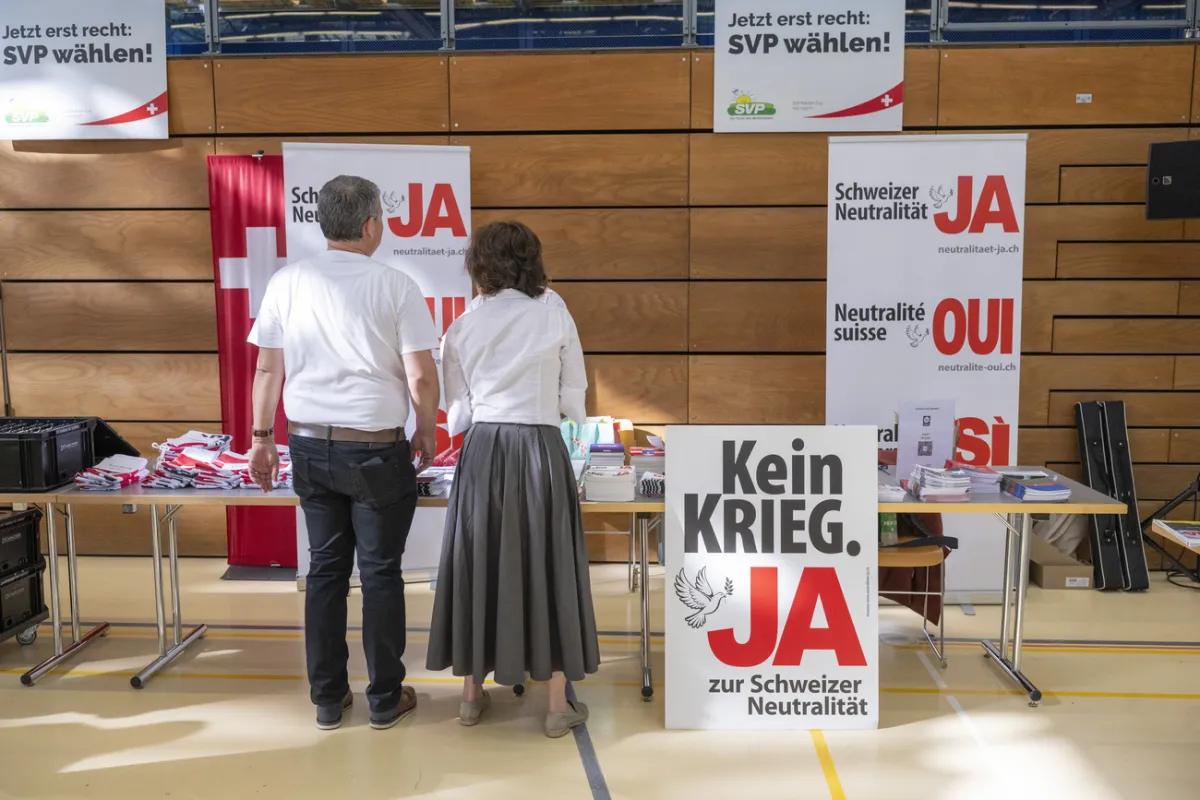
When it comes to Swiss neutrality, the war in Ukraine marks a clear rupture. Before 2022, the topic rarely sparked strong feelings. Neutrality seemed a rather static and musty concept; at most, it was of interest to a handful of bookish historians.
The return of conflict to European soil has changed the game. After a brief period of hesitation, the Swiss government – under international pressure – took over European Union (EU) sanctions against Russia. This decision took neutrality out of the archives and put it back at the heart of political debates: was Bern right to follow its European neighbours? Or should it have held back in the name of a stricter interpretation of its neutrality? Citizens have now given their answer: they accept a vision of neutrality as an evolving instrument, which can be adapted by government in the face of geopolitical upheavals.
Significantly, voters over the age of 65 were more critical than others of the initiative. This can be understood in light of this generation's Cold War experience, when the threat of large-scale conflict loomed. At the time, Switzerland was strictly neutral in both military and legal terms, while remaining clearly within the Western sphere. In 2026, as war gets close to Europe again, they have chosen a similar path by refusing to endorse a stricter interpretation of neutrality.
2. For voters, flexible neutrality and diplomatic credibility can go hand in handIn advocating the idea of total neutrality, supporters of the initiative said they wanted to preserve Switzerland's credibility as a provider of good offices and as an independent venue for mediation. This position was championed not only by the populist right, but also by a movement – billed as apolitical – created specifically for the occasion: the Committee for International Geneva and its Neutrality. This group warned Switzerland's international reputation for impartiality was at stake, and that“a little bit neutral is no longer neutral”.
However, a majority of voters aligned with a different view, put forward above all by diplomatic and humanitarian circles, that the main risk was actually the opposite: by applying an absolutist neutrality, the depositary state of the Geneva Conventions could appear to be handling victims and aggressors indiscriminately, or even de facto favouring the latter. Yet in the eyes of many, Switzerland's diplomatic credibility stems in part from its neutrality, but above all from a steadfast commitment to peace, international law and human rights. For voters, it is not an undermining of Swiss neutrality to give the government scope to respond through political channels when these principles are flouted.
3. At a time of unpredictable geopolitical shifts, isolation is not the optionThe result on Sunday also reflects a desire not to cut Switzerland off from the rest of Europe in an increasingly uncertain geopolitical context. The decision to take over the EU sanctions on Russia in 2022 sparked much debate – and ultimately the launch of the neutrality initiative. But a large swathe of the population seems now to have shown an understanding for the government's strategic reasoning. A majority does not want to commit to systematically stand aloof from European sanctions – and run the risk of sparking incomprehension or isolation from its neighbours.
Similarly, a majority did not want to rule out all future cooperation with military alliances, for fear of being unable to count on help in case it was needed. Recently, the head of the Swiss Armed Forces warned that Switzerland is no longer immune to the threats looming over Europe, and that in the event of conflict, the country would depend on support from its neighbours to defend itself. In such a context, the initiative appeared to many citizens as an overly risky gamble on the future.
More More Foreign Affairs Explainer: Russia pushes Europe's neutral states closer to NATOThis content was published on Jul 19, 2023 Switzerland wants to cooperate more closely with NATO. Other neutral nations in Europe are also seeking closer ties with the alliance.
Read more: Explainer: Russia pushes Europe's neutral states closer to
Legal Disclaimer:
MENAFN provides the
information “as is” without warranty of any kind. We do not accept any
responsibility or liability for the accuracy, content, images, videos,
licenses, completeness, legality, or reliability of the information
contained in this article. If you have any complaints or copyright issues
related to this article, kindly contact the provider above.
Comments
No comment