

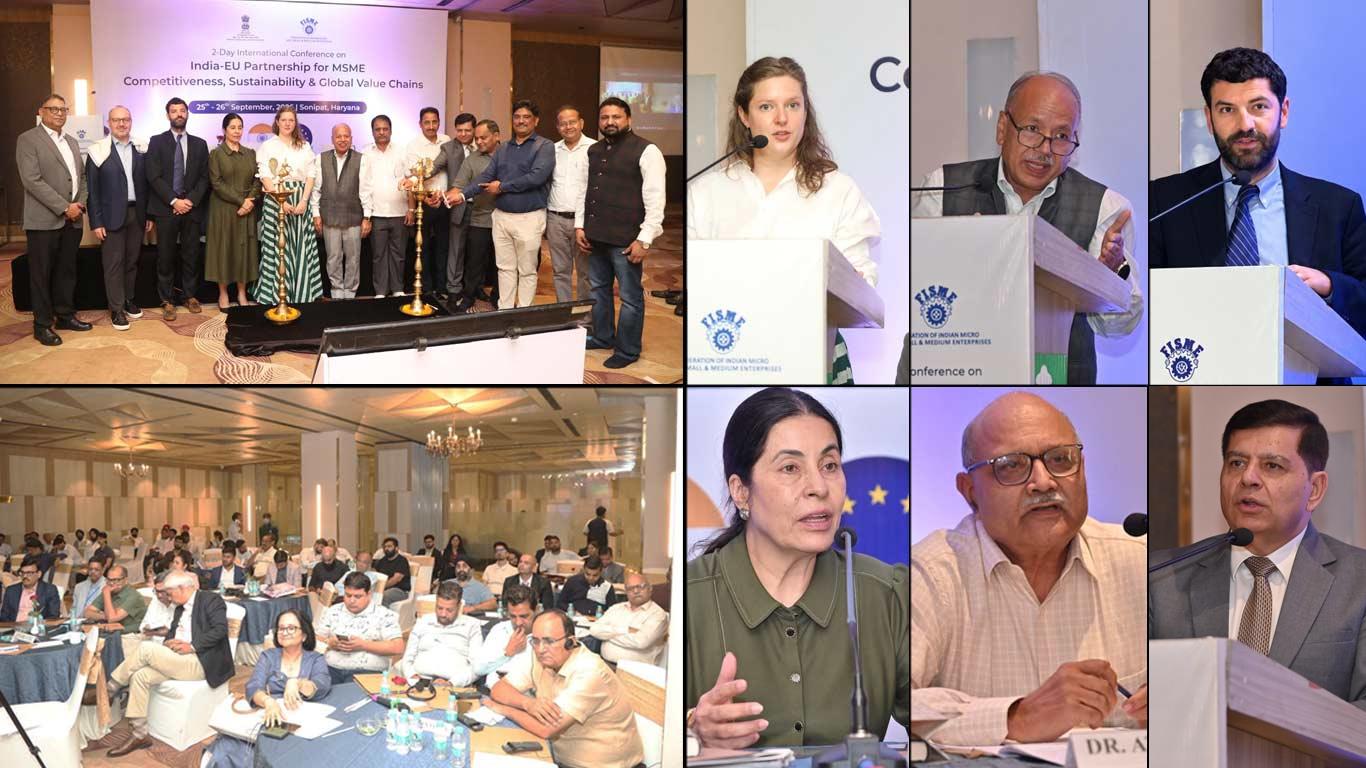
FISME's India-EU FTA Conference Highlights Msmes Need Stronger Compliance, Readiness To Unlock Export Opportunities


The conference, titled“India-EU Partnership for MSME Competitiveness, Sustainability & Global Value Chains”, focused on the FTA framework, non-tariff barriers, rules of origin and sector-specific opportunities across textiles, footwear, plastics, food processing, light engineering and auto components.
Lower Tariffs Must Be Matched With Export Readiness
Sanjeev Chawla, Additional Development Commissioner, MSME DFO, Karnal, said lower tariffs alone would not guarantee higher exports unless Indian businesses could meet requirements related to environmental, social and governance (ESG) standards, the Carbon Border Adjustment Mechanism (CBAM), certification, child labour and deforestation.
He highlighted the role of industry associations such as FISME in creating awareness and helping MSMEs build compliance capabilities.
“Market access must be matched by market readiness. Government policy is therefore focused on helping MSMEs overcome the practical barriers to exports through EPM, covering market access, standards and certification, logistics, trade intelligence, branding and export finance,” Chawla said.
FTA Benefits Depend On MSME Capacity
FISME President Rakesh Chhabra said deeper India-EU integration could provide MSMEs with access to European markets, supply chains and technology partnerships, but stressed that tariff concessions alone would not translate into exports.
“Market access on paper must be converted into a presence on the ground. And that is where the real challenge begins,” he said.
Prof. Sangeeta Khorana, Professor of International Trade Policy at Aston Business School, UK, noted that Indian firms have historically used only 20-30 per cent of available FTA tariff preferences, underscoring the need for greater collaboration between businesses, industry associations and government.
Speakers also highlighted opportunities in garments, leather, services and manufacturing, while stressing the importance of quality, traceability, intellectual property protection and contractual preparedness.
MSMEs Need Stronger Origin, Product Compliance Systems
Carmine Soprano, Economist at Tor Vergata University of Rome and Visiting Senior Fellow at LSE, said,“With over 6000 EU firms now operating in India, the real opportunity for MSMEs comes not from tariff reduction, but by integration into EU value chains.”
Francesco Salustri, Associate Professor of Economics at Roma Tre University, highlighted that tariff preferences create opportunities, but capabilities determine whether firms can participate.
“Lower duties can open a door, but an enterprise can work through the door only if it can document origin, satisfy product rules, finance upgrading, provide credible information, and win the confidence of buyers,” Salustri noted.
Sustainability Rules Add To Export Compliance Burden
Kate Foster, International Affairs and Trade Policy Lead at the Federation of Small Businesses, UK, said,“Access to the EU market means dealing with 27 member states, each implementing rules differently. As India moves towards India-EU FTA, compliance readiness will matter as much as gains from tariff rationalisation.”
Prof. Wolfgang Sofka of Copenhagen Business School emphasised that industry bodies such as FISME could help train firms to convert knowledge into intellectual property, but building such capabilities at scale would require collaboration between industry and academia.
The conference concluded that tariff preferences alone would not ensure higher exports, with early preparation, institutional support and capacity building needed for MSMEs to integrate into European value chains.
(KNN Bureau)

Legal Disclaimer:
MENAFN provides the
information “as is” without warranty of any kind. We do not accept any
responsibility or liability for the accuracy, content, images, videos,
licenses, completeness, legality, or reliability of the information
contained in this article. If you have any complaints or copyright issues
related to this article, kindly contact the provider above.
Comments
No comment