

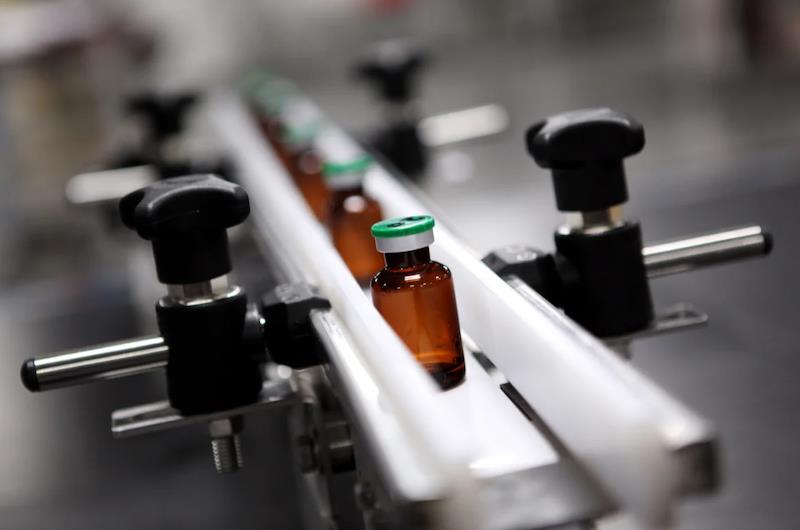
How To Optimize Product Movement For High-Performance Robotic Automation


By Noah Bougie, lead instrumentation and controls engineer, ACS, and Scott Blais, Jr., sales and business development manager, mk North America
Generic, off-the-shelf product-moving systems are often the hidden bottlenecks that limit advanced robotic automation system cycle times.
While industry media often focuses on the brains of automation, such as vision systems and artificial intelligence (AI), a multi-axis robot is ultimately only as fast as the product movement feeding it.
If parts slip, drift, or bounce on a standard friction belt, the robot loses critical fractions of a second searching for its target.
Eliminating handshake latency between robotic arms and moving conveyors, optimizing high-precision part positioning, designing dynamic accumulation zones that protect fragile products, selecting appropriate conveyance technologies, leveraging structural T-slot aluminum to optimize cell footprints, and embedding tracking hardware directly into transport lines can significantly influence the performance, flexibility, and scalability of highly automated environments.
Core issues that contribute to hidden product movement bottlenecksMany slowdowns that plague automated environments aren't caused by a faulty component or sluggish equipment. They often stem from decisions made, skipped, or overlooked before the system was ever built.
Sequencing is the first target. Overlooking sequencing strategies creates hidden drag. Because speed is the metric everyone chases first, teams frequently plan to push parts through a line as fast as possible without mapping for the full sequence of operations.
A strategic approach means designing for the correct fit, not the quick fit. This means clearly identifying every platform, operation, and operator role in the material handling process before optimizing production speed. It's essential for this approach to extend to the systems and people interfacing with the line.
As automation becomes more precise and collaborative, direct control and interaction between robots, conveyors, and human operators need to be engineered deliberately, whether that means via a cooperative cell where an operator loads pallets between robotic cycles or a spur line that allows technicians to bypass automated operations entirely to perform maintenance without halting production.
Continuity drives this forward-thinking strategy. Repeatable accuracy depends on consistent interaction between the product, conveyor, and every piece of equipment it touches. That same consistency extends past commissioning into the line's ongoing service life.
Aftermarket support, meaningful vendor relationships, and a clear plan for what happens when equipment goes down are not afterthoughts. They determine whether a system continues performing after installation and whether a supplier relationship lasts.
Best practices for product movement, material handling, controls, and systems integration
Before selecting equipment, advanced robotics facility teams need to work backward from the part itself and the space it moves through. From there, a handful of core design decisions determine whether a line performs at the level that advanced robotics demands today and in the future.
Space, material, and motion define the systemAvailable floor space, along with the material's weight, size, and surface characteristics, dictates which conveyance technologies are viable. It's also an important factor in determining whether the solution can expand vertically to save space rather than simply consume a more linear footprint.
From there, the motion profile is defined: incremental/indexed movement, continuous flow, or zones of accumulation and batching. That choice determines the primary driving principle.
A friction-driven flat belt, for instance, is prone to slippage under the repeated stop-start cycles of an indexing application, while a positive-engagement system like a timing belt holds up far better to a stop-and-start,“herky-jerk” motion.
Balance throughput, payload, and scalabilityThroughput, payload, and scalability often pull resources in opposite directions, which means the most essential early step isn't picking hardware. It's clearly defining priorities through short- and long-term goals. A line built purely for tomorrow's throughput can create a tug-of-war for the flexibility needed for next year's volume or product mix.
Understanding these conflicting ideals is the first step, followed by continuously reviewing priorities to guarantee the design aligns with overall objectives.
Some of these objectives might align with the following strategies, depending on the specifications of the advanced robotics line.
Optimize high-precision part positioningIn practical terms, this means ensuring a part lands in the same physical location, within a fraction of a millimeter, every single time it reaches a robot for pick-up or placement.
Sensors and electronic controls alone are not enough; by the time a sensor detects that a part is out of place and signals the system to stop, valuable milliseconds have already passed. That's why precision positioning typically relies on physical locating features.
For example, a male-to-female pin-and-bushing arrangement mechanically engages a part or its carrier and pulls it into a fixed, repeatable stop.
This physical“hard stop” removes the part from the conveyor's own motion and vibration entirely, which is how some conveying systems achieve repeatability down to roughly 1.2 mm.
Precision positioning is less about smarter software and more about designing physical mechanisms that make the part's location predictable before the robot has to react.
Design dynamic accumulation zones that protect fragile partsThis becomes more complex as more lines branch across multiple spurs to serve different products or operations. Cushioned or dampened stops, singulation gaps, and zero-pressure accumulation logic keep parts from colliding while still holding the line's pace.
Build in modularity with structural T-slot aluminum framingT-slot extrusions make the cell reconfigurable, so cross members can be added, extrusions adapted, and sensors repositioned on the fly without the fabrication work steel would demand.
That flexibility matters enormously once a system is running and engineers discover adjustments they couldn't have planned for in advance.
Integrate tracking hardware for greater transparencyGrowing demand for supply chain transparency is driving tracking integration deeper into these lines, whether through barcodes, radio-frequency identification (RFID), or vision systems that inspect for quality and report back to a central programmable logic controller (PLC), allowing manufacturers to trace a part from the start of production through its full life cycle and pinpoint exactly where and why a failure occurred.
Eliminate handshake latency with PLC controlNone of the above works without tight synchronization between the robot and the conveyor. Establishing a PLC as the master controller keeps every piece of equipment operating on the same call-and-response logic rather than negotiating independently.
Each best practice starts with a clear understanding of what the system is meant to accomplish. That takes communication. Industry knowledge only goes so far without collaboration and front-end planning to support it. Without cooperation across these steps, costly rework is inevitable.
The responsibility for optimizing product movement demands product advocacyOptimizing product movement doesn't rely purely on technical expertise and precision robotics. It's an organizational, people-centric strategy that starts with an honest assessment of ownership.
It is vital to address whether resources and technical expertise are available in-house, whether it requires a third-party vendor, or how many vendor channels will be involved.
Skipping that conversation or defaulting to a build simply because it seems cheap up front will create far more costs down the road.
From the earliest planning conversations, where the right questions are asked about goals, constraints, and ownership, to aftermarket support once a system is up and running, the partnerships between vendors, integrators, and end users create a highly automated and resilient environment rather than just a fast system.
This frees employees to handle more complex tasks instead of the repetitive ones, which builds stronger organizations.
Human collaboration is irreplaceable. Successful system performance is achieved when every link in the chain, from supplier to systems integrator to end user and operator, acts as a product advocate and understands their contribution to production success.
A vendor or integrator who treats a project as a quick sale rather than a long-term relationship is far less likely to flag the tradeoffs, constraints, or better-fit solutions a customer might not know to ask about.
That gap often shows up as downtime, rework, or an underperforming system. Product advocacy and collaboration ensure the entire chain is as strong as it can be.
Product movement is about the big picture as much as the detailsComplex systems are only as effective as the people who implement and maintain them. No matter how advanced a conveyor, accumulation, or cell design, production suffers when those technologies can't work together and scale over time.
When manufacturers envision optimizing product movement as an early continuity question that requires collaborative input, they remain adaptable to future growth.
About the authorsNoah Bougie is lead instrumentation and controls engineer for ACS.
ACS engineers, integrates, and builds technically complex equipment, controls, and facilities for industry-leading companies in markets including automotive, aerospace, energy, chemical, manufacturing, and more.
ACS specializes in control systems, custom machines, testing solutions, automation, and production systems, as well as the design and construction of integrated facilities. For more information, call (608) 663-1590 or visit
Scott Blais Jr. is sales and business development manager for mk North America, Inc., bringing over 12 years of experience in industrial manufacturing, material handling, and automation.
Scott leads sales, marketing, and business development initiatives, supporting manufacturers and system integrators across North America.
mk specializes in conveyor systems, pallet-handling solutions, and modular aluminum framing for a wide range of industrial applications. For more information, call (860) 310-2406 or visit .
<
Legal Disclaimer:
MENAFN provides the
information “as is” without warranty of any kind. We do not accept any
responsibility or liability for the accuracy, content, images, videos,
licenses, completeness, legality, or reliability of the information
contained in this article. If you have any complaints or copyright issues
related to this article, kindly contact the provider above.
Comments
No comment