

An Advocate For The Laws Of War In A World That No Longer Believes In Them


Based in Geneva, I cover the work of the United Nations and other international organisations there. My focus is on humanitarian aid, human rights, and peace diplomacy. I studied business and economics at the University of Lausanne before training as a journalist and joining SWI swissinfo in 2021.
-
More from this aut
French Departm
-
Deutsch
de
Alain Délétroz – Verteidiger des Kriegsrechts in einer Welt, die nicht mehr daran glaubt
Read more: Alain Délétroz – Verteidiger des Kriegsrechts in einer Welt, die nicht mehr daran g
Français
fr
Alain Délétroz, défenseur des lois de la guerre dans un monde qui n'y croit plus
Original
Read more: Alain Délétroz, défenseur des lois de la guerre dans un monde qui n'y croit
العربية
ar
آلان ديليترو: المدافع عن قوانين الحرب في عالم لم يعد يؤمن بها
Read more: آلان ديليترو: المدافع عن قوانين الحرب في عالم لم يعد يؤم
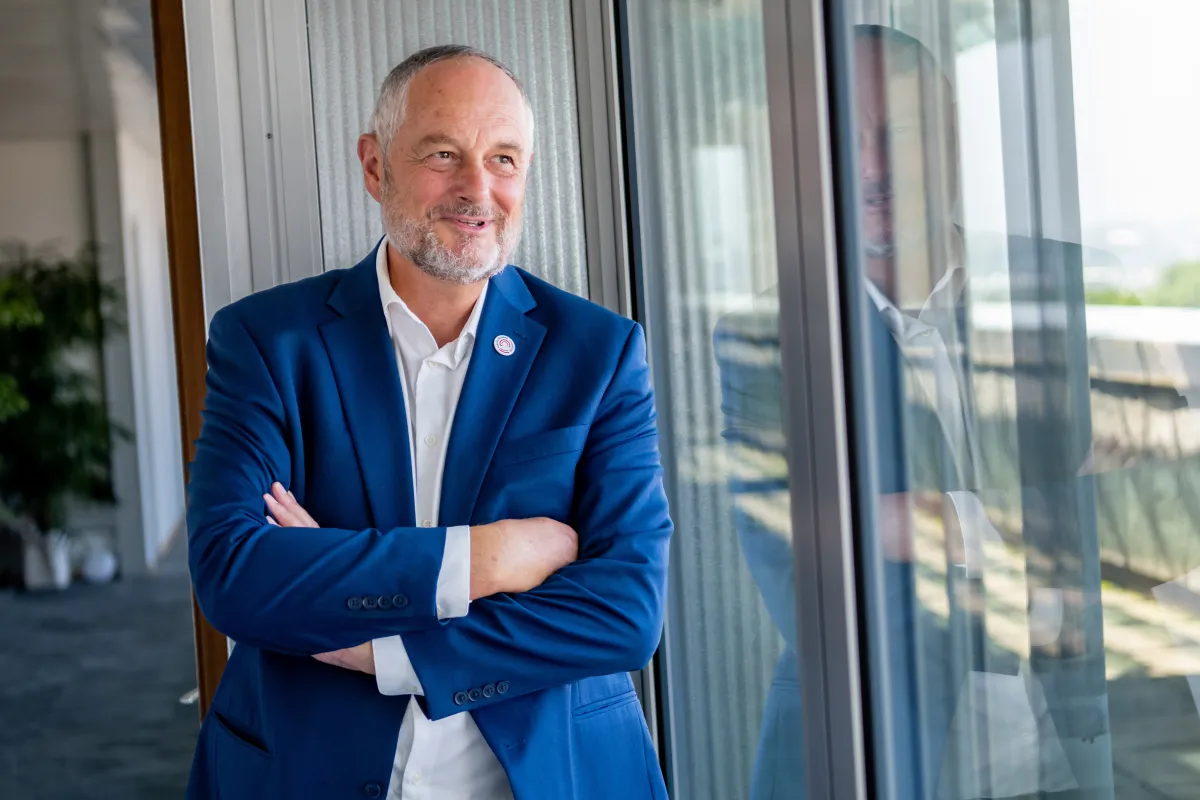
Alain Délétroz, 190cm tall, has the ideal stature for his unusual work: encountering some of the most ruthless armed groups on the planet to raise their awareness of the laws of war. His intense gaze compels attention, but his calm, measured voice and affability reveal a profound humanism and sensitivity.
Swissinfo met with him recently to discuss his career. Although he has travelled the world, he remains true to his roots in canton Valais and offered us coffee and Swiss chocolate while we spoke.
When asked what led him, in 2017, to accept his current post, he replied:“From a very young age, I've been drawn to what makes humans remain human even in the worst circumstances.” His unshakeable“faith in humanity”, he explained, evolved from his Catholic upbringing and propelled him into humanitarian work. He began his career in 1994 as an International Committee of the Red Cross (ICRC) delegate in Moscow.
“What struck me in my various jobs, especially during my first years as a young delegate, was seeing that this spark of humanity can be found in the hearts of people who have committed the worst crimes,” he said.“In fact, that is what Geneva Call works on.”
In sensitising armed groups to the Geneva Conventions that define the laws of war, the NGO originally aimed to fill a gap in the humanitarian sector. A quarter-century later, Geneva Call has established itself as a key player among Geneva's international organisations. It is also one of the most discreet, although Délétroz willingly let Swissinfo peek behind the curtain.
Spark of humanityToday, Geneva Call is in contact with more than 200 armed groups scattered across the globe. Approaching them and gaining their trust requires a thorough understanding of local circumstances, so over the last ten years the organisation has developed a network of field offices.
“It's no longer staff from the Geneva headquarters who [fly in] to initiate dialogue. Our local colleagues do this work,” Délétroz explained. He then joins them later, when there is an opportunity to meet with high-ranking commanders.
How does he manage to convince warlords, with whom he seemingly has nothing in common, to respect international humanitarian law that is alien to them?“A purely legal argument is insufficient, in itself, to bring about a change in behaviour by armed groups that have committed, sometimes for years, serious violence against civilian populations,” he said.“You have to find something else.”
This“something else” is precisely the“spark of humanity” that Délétroz referred to throughout our meeting.“You have to try to find the thing that, in their mental framework or ideology, allows you to forge a connection,” he said. But he clarified that there is“no formula”.
His mastery of languages, including Quechua (which he learned as a young man from indigenous Peruvians) and Russian, surely is an enormous asset. So is his deep faith, which he has maintained throughout his life, and which he nourished as a seminarian for two years in the Spiritan missionary religious congregation within the Catholic Church.
Délétroz emphasises the importance of cultural and religious factors for these armed groups, which are invariably pursuing what he called“a cause”.
“If you question it, it's over. Obviously, when I arrive in certain conflict [zones], as a [civilian], it is difficult for me to convince myself that their cause is just,” he admitted. But humanitarian neutrality allows him to set aside political considerations.“We don't discuss the reasons people are fighting each other, but rather the way in which they are doing this and their responsibility towards civilian populations.”
This can lead to interactions that, to an outside observer, might seem surprising or even shocking.“I was recently on the phone discussing a delicate matter with a commander no one would describe as gentle. At the end of our conversation, he told me, 'You and I share the same values',” Délétroz said with an embarrassed laugh. But his job, by definition, is to speak with everyone.
When he describes his many trips to war zones – recently, for example, to the Democratic Republic of the Congo and soon to Ukraine and the Middle East – Délétroz carefully avoids naming his interlocutors. But this does not stop him from speaking more frankly than is typical in the discreet world of Geneva's international organisations.
More More International Geneva Cambodia's Tun Channareth renews fight for mine-free world in GenevaThis content was published on Jul 18, 2025 A long-standing campaigner against anti-personnel mines, Cambodian Tun Channareth was in Geneva to defend the convention banning them, which has been weakened by the withdrawal of several Eastern European countries.
Read more: Cambodia's Tun Channareth renews fight for mine-free world in G
Legal Disclaimer:
MENAFN provides the
information “as is” without warranty of any kind. We do not accept any
responsibility or liability for the accuracy, content, images, videos,
licenses, completeness, legality, or reliability of the information
contained in this article. If you have any complaints or copyright issues
related to this article, kindly contact the provider above.
Comments
No comment