

Fintech Festival Highlights Role Of Smarter Regulation In Digital Finance


The second Jordan Fintech Festival opened at the Dead Sea on Wednesday under the theme“Where Regulation Meets Innovation”, bringing together regulators, financial institutions, technology companies and investors to discuss developments shaping digital finance.
Central Bank of Jordan (CBJ) Governor Adel Sharkas said digital transformation and innovation have become key pillars of Jordan's broader modernisation drive, contributing to productivity, competitiveness, job creation, investment and entrepreneurship.
He pointed to the Economic Modernisation Vision 2023-2033, which identifies digital transformation and promising sectors among its priorities as the Kingdom seeks to respond to rapid technological change and capitalise on emerging opportunities.
The festival's second edition reflects Jordan's growing presence in fintech and its ambition to play an active role in shaping the industry, Sharkas said.
He stressed that financial innovation does not require less regulation, but“smarter regulation” capable of supporting new technologies while addressing associated risks.
Jordan's expanding digital payments market illustrates the pace of change. More than 695 million electronic payment transactions were recorded in 2025 through CliQ, eFAWATEERcom and card purchases, with their combined value exceeding JD50 billion, equivalent to around 118 per cent of gross domestic product, Sharkas said.
The CBJ has developed mechanisms allowing emerging technologies and business models to be tested within a defined supervisory framework, including digital financial identity, electronic Know Your Customer verification, or eKYC, open finance, regulatory technology, or RegTech, and virtual assets.
Its regulatory sandbox, JO REGBOX, allows companies to test new models while regulators assess potential risks and determine appropriate regulatory responses.
Twelve innovative products from 12 companies have been tested through the sandbox in areas including financial and insurance services, open finance and virtual assets, Sharkas said.
He added that these developments form part of a broader digital transformation encompassing digital infrastructure, cybersecurity, government digital services, digital identity, artificial intelligence and advanced computing.
Regulators, innovators urge to strengthen cooperation
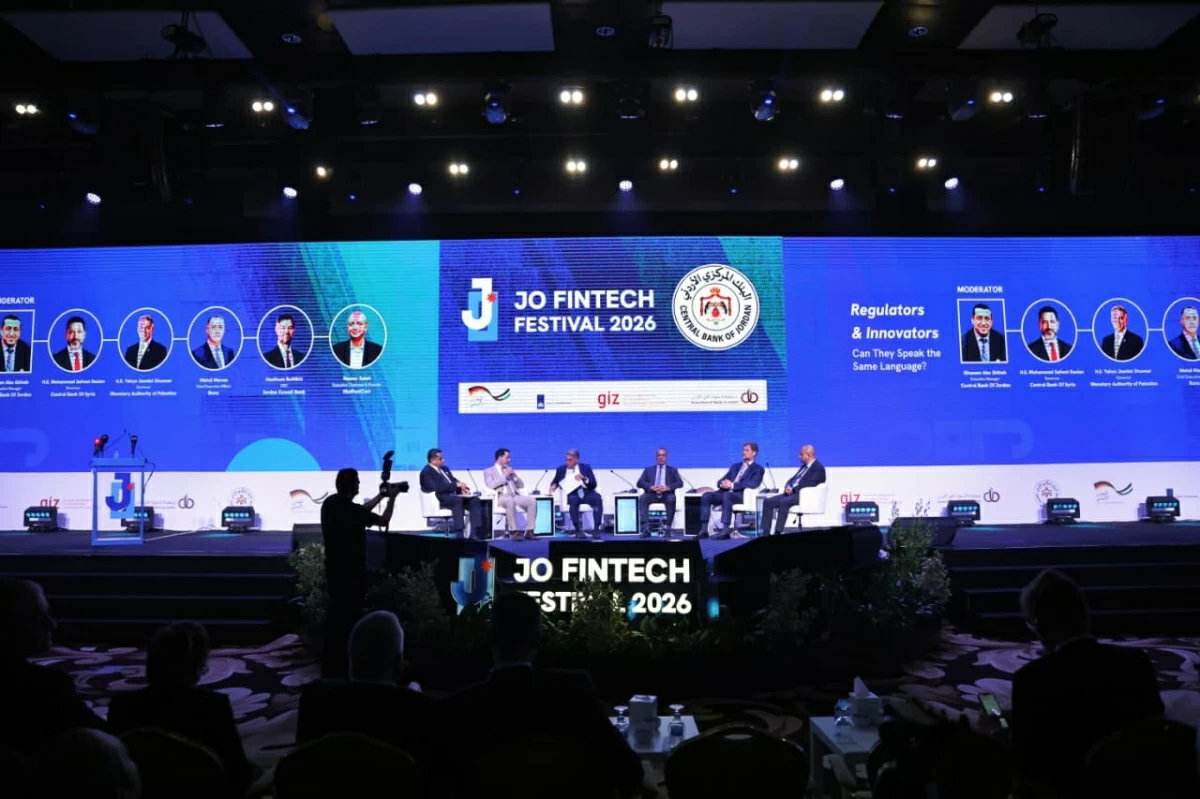
A high-level panel titled“Regulators & Innovators - Can They Speak the Same Language?” brought together regulators and private-sector representatives to discuss the relationship between financial innovation and regulation.
The panel, moderated by Ghassan Abu Shihab, featured Governor of the Central Bank of Syria Mohammad Safwat Raslan, Governor of the Palestine Monetary Authority Yahya Jawdat Shunnar, Buna CEO Mehdi Manaa, Jordan Kuwait Bank CEO Haethum Buttikhi and MadfoatCom Executive Chairman and Founder Nasser Saleh.
Speakers stressed the need for closer cooperation between regulators, banks and fintech companies as technologies and customer expectations evolve.
Fintech companies generally focus on solving specific customer problems, while banks retain responsibilities related to safeguarding deposits, compliance, credit decisions and governance, a speaker said.
Early alignment, regulatory oversight, compliance, cybersecurity, risk management and scalability were identified as key factors in building sustainable partnerships.
Speakers also highlighted open finance as a means of strengthening integration between financial institutions and fintech companies, supported by regulatory and governance frameworks.
The panel also highlighted developments in Palestine, where digital payments have expanded despite severe infrastructure constraints. A speaker said there are around 1.3 million electronic wallets in Gaza and more than 700,000 in the West Bank, while electronic payment channels have processed around 126 million transactions worth $35 billion.
Digital payment systems have supported remote transactions and the delivery of donor funding, while mobile networks, SMS and USSD services have helped maintain payments in areas facing connectivity constraints, the speaker said.
Speakers called for stronger regional cooperation and greater integration across Arab economies, stressing closer coordination between the private sector, central banks and regulators.

Legal Disclaimer:
MENAFN provides the
information “as is” without warranty of any kind. We do not accept any
responsibility or liability for the accuracy, content, images, videos,
licenses, completeness, legality, or reliability of the information
contained in this article. If you have any complaints or copyright issues
related to this article, kindly contact the provider above.
Comments
No comment