

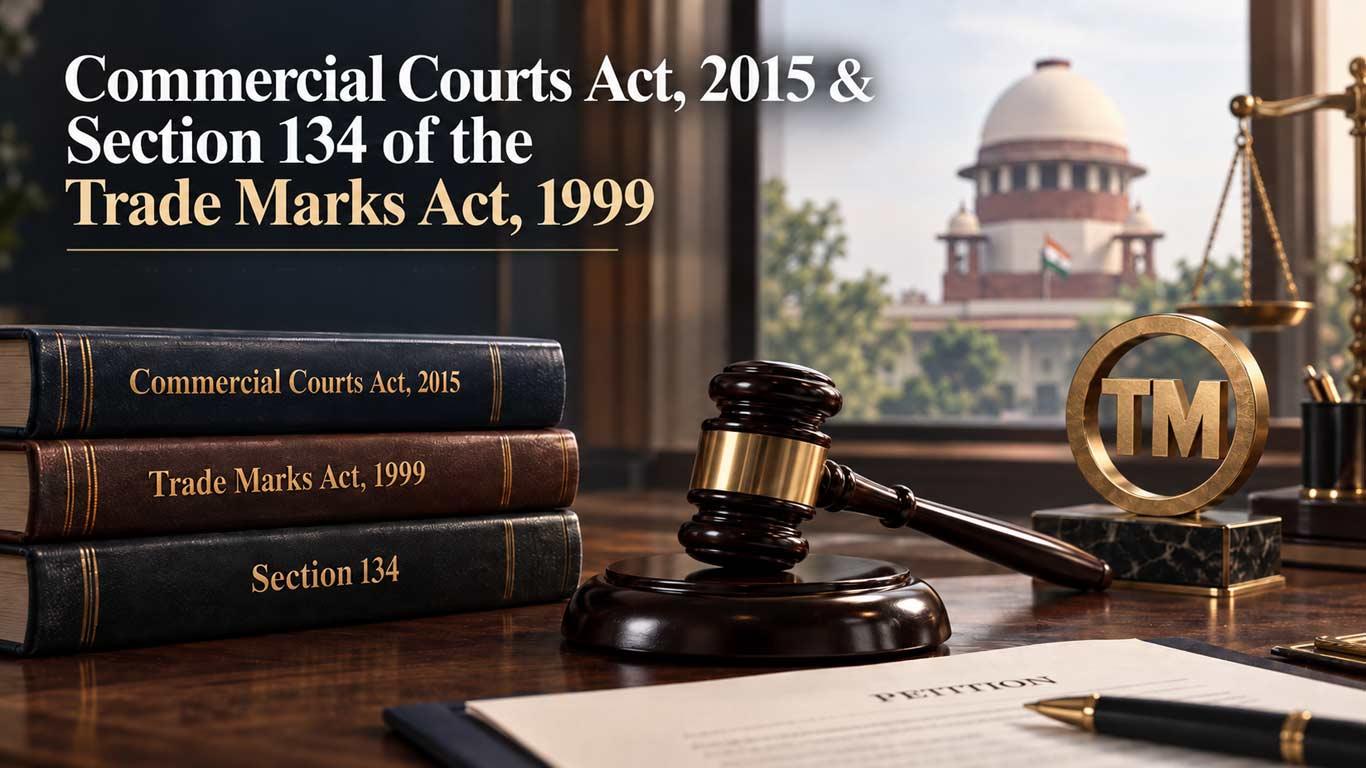
SC Refers Dispute Over Commercial Court Jurisdiction In Trademark Suits To Larger Bench


They questioned the possibility despite Section 134 of the Trade Marks Act, 1999 barring such suits before a court inferior to a District Court. The court has referred to a Larger Bench with the question.
A Bench of Justices JB Pardiwala and K Vinod Chandran noted an apparent conflict between two earlier Supreme Court judgments on the interplay between special statutes and the Commercial Courts Act.
Conflict Between Earlier Rulings
The issue arose after the Jharkhand High Court notified a Civil Judge (Senior Division) as a Commercial Court, enabling it to hear commercial disputes including a trademark infringement suit.
The appellants challenged the jurisdiction of the Civil Court, relying on Section 134 of the Trade Marks Act, which stipulates that suits relating to infringement of registered trademarks and certain specified reliefs cannot be instituted before a court inferior to a District Court.
The Supreme Court noted that Kandla Export Corporation v. OCI Corporation (2018) treated the Arbitration and Conciliation Act, 1996 as a special legislation vis-à-vis the Commercial Courts Act. On that reasoning, the special provisions of the Trade Marks Act would prevail over the Commercial Courts Act.
However, in Jaycee Housing Private Limited v. Registrar (General), Orissa High Court (2022), the Court held that the Commercial Courts Act, being a later enactment specifically dealing with commercial disputes, could prevail over jurisdictional provisions in the Arbitration Act.
Larger Bench To Settle Law
The Bench said the apparent conflict required authoritative resolution to ensure uniformity across States and prevent jurisdiction from depending on different notifications issued by High Courts.
“We are of the opinion that the matter has to be referred to the Larger Bench for resolving the conflict and also settling the law to be uniform throughout the States,” the Court said.
The Bench also observed that the legislative intent cannot be diluted through notifications issued by High Courts.
The matter has been directed to be placed before the Chief Justice of India for appropriate orders.
Impact on IP Enforcement
Resolving this conflict prevents trademark suits from being dismissed or remanded years later due to defective initial forum jurisdiction. Uniform National Forum Structure: Resolving state-by-state judicial notifications simplifies IP enforcement by ensuring consistent court hierarchies and jurisdiction across India.

Legal Disclaimer:
MENAFN provides the
information “as is” without warranty of any kind. We do not accept any
responsibility or liability for the accuracy, content, images, videos,
licenses, completeness, legality, or reliability of the information
contained in this article. If you have any complaints or copyright issues
related to this article, kindly contact the provider above.
Comments
No comment