

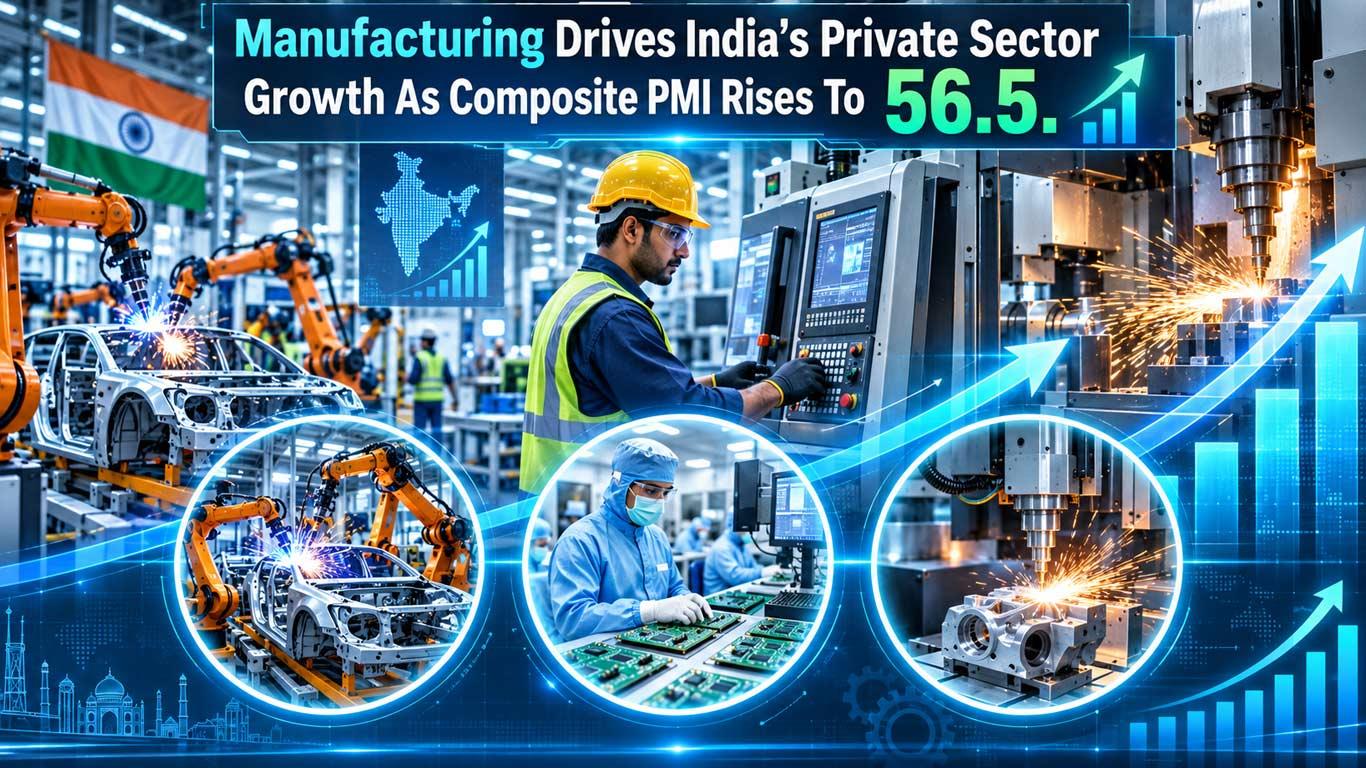
Manufacturing Drives India's Private Sector Growth As Composite PMI Rises To 56.5: HSBC


The HSBC Flash India PMI Composite Output Index rose to 56.5 in September from 54.3 in August, signalling the strongest expansion in private sector activity since June and taking the index back above its long-run average.
Manufacturing Growth Hits Seven-Month High
The manufacturing sector led the upturn, with the HSBC Flash India Manufacturing PMI rising to 55.7 in September from 52.8 in August, marking the strongest improvement in operating conditions in seven months.
Manufacturers reported stronger output and new orders, while purchasing activity accelerated and supplier lead times shortened. Input stocks increased at their fastest pace since February, while finished goods inventories recorded their strongest expansion in 11-and-a-half years.
Demand strengthened across both manufacturing and services, although goods producers recorded a sharper acceleration. Manufacturing sales growth reached a seven-month high, supported by demand for aluminium products, electronics, food, pharmaceuticals and new product models.
Job Creation Remains Strong
Aggregate new business increased at a faster pace in September, prompting firms across both sectors to expand staffing.
Employment rose solidly in manufacturing and services, with job creation rates broadly similar. Outstanding business also recorded a marginal increase after declining in the previous two months, although capacity pressures remained mild.
Export Orders Grow At Slower Pace
New export orders continued to increase across the private sector, but the pace of growth weakened from August to its slowest level in nearly three years.
Services firms recorded slower growth in overseas orders, while manufacturers reported a marginally stronger increase. Firms cited demand from markets including Brazil, Europe, the UAE and the US.
Input Cost Inflation Eases
Input cost inflation across the private sector eased to its lowest level since January, driven by softer cost pressures among services companies.
Manufacturers, however, faced higher costs, including for electrical components, food, fuel, metals, pharmaceutical ingredients and technology resources.
Factory-gate price inflation accelerated, while services price inflation moderated, leaving composite selling-price inflation broadly unchanged.
Business Confidence Improves
Business confidence regarding the year-ahead outlook strengthened in September, with optimism among manufacturers and service providers rising to a four-month high.
Pranjul Bhandari, Chief India Economist at HSBC, said stronger manufacturing activity and domestic orders drove the improvement, while renewed Middle East tensions prompted firms to build inventories as a buffer against uncertainty.
(KNN Bureau)

Legal Disclaimer:
MENAFN provides the
information “as is” without warranty of any kind. We do not accept any
responsibility or liability for the accuracy, content, images, videos,
licenses, completeness, legality, or reliability of the information
contained in this article. If you have any complaints or copyright issues
related to this article, kindly contact the provider above.
Comments
No comment