

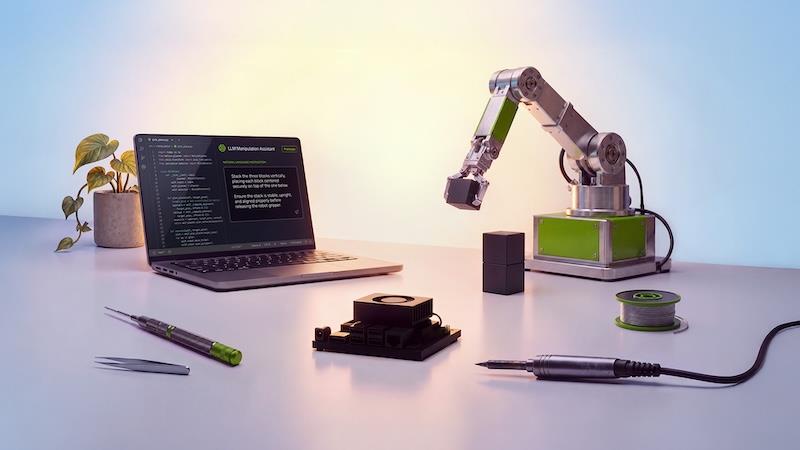
Nvidia Launches Jetson Orin Nano 2 Robotics Computer For Edge AI


The new module delivers 78 trillion operations per second of AI compute and features 8 GB of memory and an eight-core Arm CPU.
Nvidia says Jetson Orin Nano 2 provides twice the inference performance of the previous Jetson Orin Nano Super, using improved Tensor Cores and higher memory bandwidth while retaining the same form factor.
The company also says the new system consumes 40 percent less power when delivering the same performance as its predecessor in 15-watt mode.
Deepu Talla, vice president of robotics and edge AI at Nvidia, says:“Today's small and medium frontier models have reached the accuracy of last year's largest frontier models, unlocking real-time intelligence for edge devices.
“The Jetson Orin Nano 2 computer puts that breakthrough within reach of millions of developers, delivering the performance and energy efficiency needed for real-time reasoning at the edge.”
Nvidia is positioning the computer as an entry-level platform for increasingly sophisticated physical AI applications, as smaller AI models make it possible to perform more perception, reasoning and decision-making directly on edge devices.
The company says more than 3 million developers are now building on its robotics stack.
Running generative AI at the edgeJetson Orin Nano 2 is designed to run large language models and vision-language models locally, allowing machines to process images and language and respond to their surroundings without depending entirely on cloud computing.
The system is supported by Nvidia's open software stack, Jetson agent skills and its wider AI ecosystem.
Nvidia says developers will be able to use models optimized for memory-efficient edge inference, including Nvidia Cosmos and Nemotron as well as Gemma 4 and Qwen 3.
The company expects the additional performance to support applications ranging from home robots and industrial vision systems to delivery and inspection drones.
Cognex, Doosan Bobcat and Matic are among the first companies adopting or exploring the new platform.
Wing evaluates Jetson Orin Nano 2 for delivery dronesAlphabet subsidiary Wing plans to evaluate Jetson Orin Nano 2 for its drone delivery technology.
Wing already uses Jetson Orin Nano Super and Nvidia software in its delivery drone fleet. The company is investigating whether the new platform can provide greater real-time perception and reasoning capabilities while improving energy efficiency.
Dinuka Abeywardena, head of perception at Wing, says:“Drone delivery depends on AI that can enable fast, reliable understanding of the real world.
“Wing is exploring Jetson Orin Nano 2 to give us a path to more responsive, energy-efficient drones that can help make deliveries quicker and more dependable for customers.”
Matic brings new AI capabilities to home robotsMatic Robots is also adopting Jetson Orin Nano 2 for its home cleaning robots.
The company plans to use the computing platform for conversational AI, gesture detection, precision mapping and semantic understanding of homes, as well as autonomous cleaning.
Navneet Dalal, cofounder and CEO of Matic Robotics, says:“Home robots need to understand people, map spaces precisely, understand the layout of objects and spaces, and clean autonomously in dynamic and constantly changing environments.
“With Jetson Orin Nano 2, Matic can run state-of-the-art AI models at the edge in a compact home robotics platform built for real-time perception, interaction and navigation.”
Hardware ecosystem prepares for new moduleA wider group of Nvidia partners is developing carrier boards, complete hardware systems, customized AI software and reference designs around Jetson Orin Nano 2.
They include AAEON, ADLINK, Advantech, Aetina, Antmicro, Aptiv, Auvidea, AVerMedia, Chuanglebo, Connect Tech, ForeCR, JWIPC, Neurealm, Plink, Realtimes, RidgeRun, RS, Seeed Studio, Tauro Tech, Twowin, TZTEK and YUAN.
Nvidia says these products are intended to shorten development cycles and help companies move Jetson Orin Nano 2-based systems into production more quickly.
The company sees the new platform as part of a broader shift toward running increasingly capable AI models directly inside physical machines, where latency, power consumption and compact hardware are important constraints.
The Nvidia Jetson Orin Nano 2 module and developer kit are expected to become available in the first half of 2027.

Legal Disclaimer:
MENAFN provides the
information “as is” without warranty of any kind. We do not accept any
responsibility or liability for the accuracy, content, images, videos,
licenses, completeness, legality, or reliability of the information
contained in this article. If you have any complaints or copyright issues
related to this article, kindly contact the provider above.
Comments
No comment