

China Leads World In Physical AI Readiness, Openmind Report Finds


The OpenMind Physical AI Readiness Index 2026 assesses 58 countries and 22 metropolitan clusters on their ability to build, power, supply and operate advanced embodied AI, including humanoid and legged robots, general-purpose manipulators, autonomous mobile machines and increasingly autonomous industrial systems.
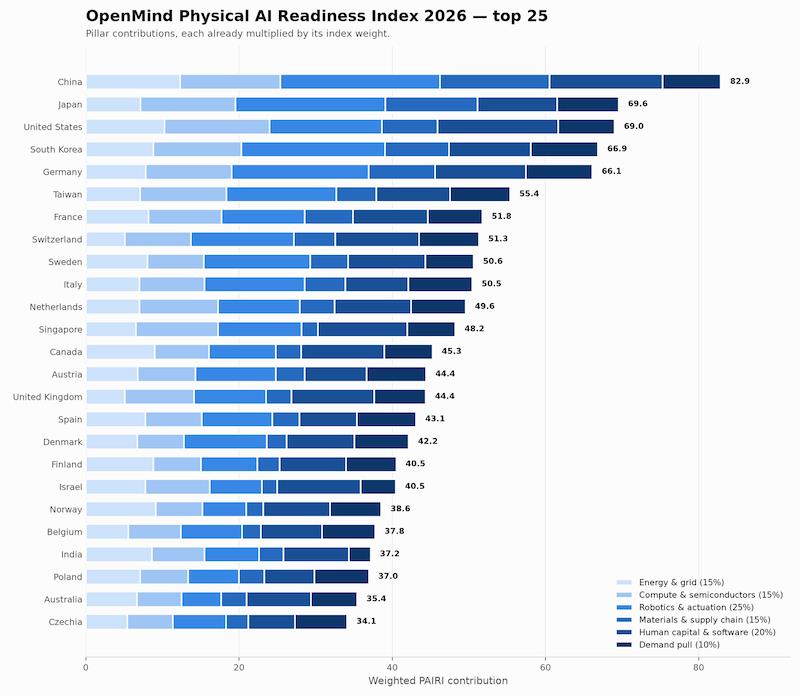
China receives a score of 82.9, compared with 69.6 for second-placed Japan and 69.0 for the United States. South Korea scores 66.9 and Germany 66.1.
The 13.3-point gap between China and Japan is the largest between any two adjacent countries in the index.
The findings add another dimension to the growing international debate over competition in artificial intelligence, particularly between the United States and China.
US President Donald Trump has repeatedly emphasized American leadership over China in AI. In February, Trump said:“AI is a big deal. AI is going to be maybe the biggest thing – bigger than the Internet, bigger than anything else. We are leading China by a lot. We are leading everybody by a lot.”
The OpenMind study does not attempt to measure the same thing. Instead, it argues that leadership in software and frontier AI models does not necessarily translate into an advantage when AI has to move from computers into physical machines.
OpenMind says:“Physical AI readiness is not an AI question. Every country that can plausibly compete has access to much the same models. They differ in electricity, actuators, magnets, machine tools, integration labour, and permission.”
China leads in the physical foundations of AISignificantly, OpenMind does not attribute China's overall lead primarily to AI research or software.
The United States scores 78.7 for human capital and software, compared with China's 73.8, and the US leads the index's compute and semiconductor category.
China's advantage instead comes from the physical infrastructure and industrial supply chains required to manufacture robots at scale.
China scores 95.3 for materials, compared with 48.5 for the United States, as well as 83.2 for robotics and actuation and 82.1 for energy.
The report says China installed 295,000 industrial robots in 2024, representing 54 percent of worldwide installations and more than all other countries combined.
The index uses six weighted categories: energy and grid infrastructure; compute and semiconductors; robotics and actuation; materials and supply chains; human capital and software; and demand.
Robotics and actuation receives the largest weighting at 25 percent, followed by human capital and software at 20 percent. Energy, compute and materials each account for 15 percent, while demand represents the remaining 10 percent.
The report's country rankings place China well ahead of a second group comprising Japan, the United States, South Korea and Germany. A broader group of European and East Asian economies follows, with the UK scoring 44.4.
Humanoid advantage comes down to motors and magnetsOne of the report's central arguments is that the supply chain for humanoid robots may prove more important than access to advanced AI chips.
According to OpenMind, a humanoid robot can contain between 1,000 and 2,000 chips, but semiconductors account for only around 10 percent of its bill of materials.
Actuators, by comparison, represent an estimated 40 to 60 percent. Gearboxes account for 30 to 50 percent of the cost of an actuator.
The critical components therefore include strain-wave and cycloidal reducers, planetary roller screws, frameless torque motors, precision bearings and rare-earth magnets. Japan remains particularly strong in high-precision components, while China has developed the manufacturing capacity required for volume production.
The report identifies permanent magnets as perhaps the most concentrated part of the supply chain.
China refines 91 percent of the world's rare earths and manufactures 94 percent of sintered rare-earth permanent magnets. OpenMind says industry estimates also put China's share of processing for heavy rare earths such as dysprosium and terbium, which are important for robot motors, at 99 percent or higher.
The economic consequences could be considerable.
Citing a McKinsey estimate, OpenMind says manufacturing a Tesla Optimus Gen 2 without Chinese suppliers would increase its estimated bill of materials from approximately $46,000 to $131,000 – an increase by a factor of 2.85.
China dominates early humanoid shipmentsThe report also points to China's rapidly expanding share of the emerging humanoid robotics market.
OpenMind estimates global humanoid shipments at between 13,300 and 18,000 units during 2025, with Chinese companies accounting for around 90 percent.
In the first half of 2026, shipments reached approximately 19,100 units, according to figures cited by the researchers, with Chinese vendors accounting for approximately 97 percent.
China's Ministry of Industry and Information Technology is projecting output of more than 100,000 humanoids in 2026 and has directed that more than 10,000 should be in commercial use by the end of the year, according to the report.
The researchers caution, however, against treating announced manufacturing capacity as actual production. Across humanoids, magnets and batteries, OpenMind says announced capacity can exceed delivered capacity by factors ranging from five to 50.
US leads in compute, but faces infrastructure constraintsThe United States retains substantial advantages.
OpenMind scores the US at 91.6 for compute and 78.7 for human capital, giving it significant strengths in AI computing, research, software and investment.
But its profile is considerably weaker in the materials and manufacturing infrastructure needed for physical AI. The report describes the US profile as“compute- and talent-heavy with a thin materials band”.
Energy infrastructure is another potential constraint.
OpenMind estimates China's electricity system is approximately 2.3 times the size of America's and says China added roughly 540 GW of generating capacity during 2025, compared with about 53 GW of US utility-scale additions.
Meanwhile, more than 2,000 GW of generation and storage projects are sitting in US interconnection queues, with projects completed in 2025 taking a median of more than five years to move from application to commercial operation.
Ability to build robots is only half the questionOpenMind separately examines what it calls“operating latitude” – whether a country provides the legal, labor and social environment necessary to deploy increasingly autonomous machines.
The researchers assess AI and machinery law, the strength of labor institutions, public attitudes and demonstrated willingness to allow autonomous machines to operate.
The results reveal an unusual pattern: some countries with strong technological and industrial capabilities may face greater obstacles to deploying robots.
Three of the five countries with the highest physical AI capability scores fall below the median for operating latitude. Germany, for example, scores 66.1 for capability but only 28 for operating latitude.
OpenMind says China is the only major economy combining what it considers top-tier physical AI capability with high operating latitude.
The report comes as governments are taking increasingly different approaches to AI. UK Prime Minister Andy Burnham told the UN General Assembly this week that Britain wants to help establish international principles and standards for frontier AI, describing the technology as both a major economic opportunity and a potential source of risk.
That debate has largely centered on frontier models, safety and regulation. OpenMind's research suggests that the emerging competition over physical AI may be determined by a different set of factors: factories, components, electricity, engineering skills, supply chains and the ability to deploy autonomous machines at scale.
Eight of top 10 robotics clusters are in East AsiaThe geographic concentration becomes still more pronounced when OpenMind looks at individual industrial regions rather than countries.
Eight of the 10 leading metropolitan clusters in its analysis are in East Asia.
The report identifies different roles within China's robotics ecosystem: Beijing specializes in algorithms, standards and datasets; the Yangtze River Delta provides volume manufacturing; the Pearl River Delta provides rapid hardware iteration; and Wuhu specializes in lower-cost industrial robotics.
By comparison, the San Francisco Bay Area receives the maximum score of 100 for human capital and software but only 32 for materials.
OpenMind argues that these localized manufacturing ecosystems matter because hardware development depends heavily on suppliers and specialist engineering knowledge that cannot necessarily be reproduced simply by providing more capital or AI compute.
The company acknowledges significant uncertainty in its rankings. Around 55 percent of the weighted index is based on cited quantitative data, while approximately 45 percent relies on analyst-assigned scores.
To test the result, OpenMind says it reran the index 2,000 times while varying analyst assessments and index weightings. The resulting 90 percent confidence intervals averaged 9.4 points, making many closely spaced country rankings uncertain.
China, however, remained in first place in every simulation, according to the researchers, including a separate test that reduced all Chinese-sourced inputs by 20 percent.
OpenMind says it plans to publish monthly updates to the index and has released the underlying dataset and methodology so researchers can apply different assumptions and weightings.

Legal Disclaimer:
MENAFN provides the
information “as is” without warranty of any kind. We do not accept any
responsibility or liability for the accuracy, content, images, videos,
licenses, completeness, legality, or reliability of the information
contained in this article. If you have any complaints or copyright issues
related to this article, kindly contact the provider above.
Comments
No comment