

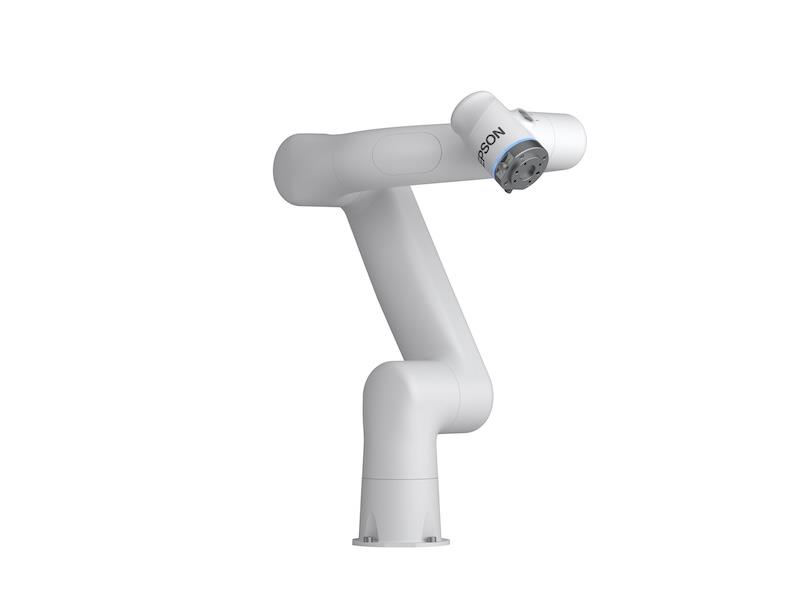
Epson Launches AX6, Its First Collaborative Robot


The new AX6 is part of Epson's AX Series and is designed to work in applications requiring greater interaction between robots and human workers.
The robot incorporates power- and force-limiting features that, subject to an appropriate risk assessment, can allow it to operate without traditional safety barriers.
Epson says the launch gives it a broader portfolio of robot safety options, ranging from conventional industrial robots designed to maximize speed and performance to collaborative robots intended to increase worker interaction and make redeployment easier.
The company also offers industrial collaborative tools intended to provide a balance between the two approaches.
Rick Brookshire, director, Product Development, Robot Development, says:“Collaborative robots have lowered the barriers to entry for many new robot users by simplifying programming and integration, while enabling new applications where space and user interaction are critical.
“With the introduction of the AX6, Epson can now address these applications while offering customers a complete range of robotic safety solutions.”
No-code programming and Python supportEpson has designed the AX6 to be accessible to users with different levels of robotics experience, combining no-code programming software with an intuitive user interface.
Used with the company's AX Portal collaborative robot software, the AX6 provides a range of development tools for building and configuring automation applications.
For more advanced applications, users can also work in a customizable Python development environment and upload their own libraries and modules.
The robot supports industrial kinematics for generating straight-line, curved and joint motions through either the no-code interface or the Python-based environment.
Operators can manually move the robot through free space to teach positions using buttons located at the end of the arm. The end-of-arm interface includes three customizable buttons and two dedicated buttons.
Compact carbon-fiber constructionThe AX6 uses a compact and lightweight carbon-fiber structure designed to reduce the space required for collaborative workcells.
It carries an IP54 rating and an ISO 5 cleanroom rating, making it suitable for applications where controlled environments and limited space are important considerations.
End-of-arm Ethernet and pneumatic connections are included to simplify the integration of grippers, dispensers and other tooling.
A multicolor LED ring at the end of the arm provides visual information about the robot's operating status.
The AX6 can operate from 100 V to 240 V AC supplies or a 48 V DC power source.
Epson also provides a 3D simulator that enables users to test programs virtually before running them on a physical workcell.
Epson expands robot safety portfolioThe AX6 adds a collaborative option to Epson's existing range of SCARA and 6-axis industrial robots.
Epson says it has sold more than 250,000 robots worldwide and offers hundreds of SCARA and 6-axis models based on a common PC-based platform.
Its robots are used for precision assembly and material handling applications across industries including automotive, aerospace, electronics, semiconductor manufacturing, biotechnology, pharmaceuticals, medical devices, plastics, food processing and consumer products.
The AX6 is available through Epson Robots' distributor network.

Legal Disclaimer:
MENAFN provides the
information “as is” without warranty of any kind. We do not accept any
responsibility or liability for the accuracy, content, images, videos,
licenses, completeness, legality, or reliability of the information
contained in this article. If you have any complaints or copyright issues
related to this article, kindly contact the provider above.
Comments
No comment