

Intrinsic Open Sources Core Industrial Robotics Technology


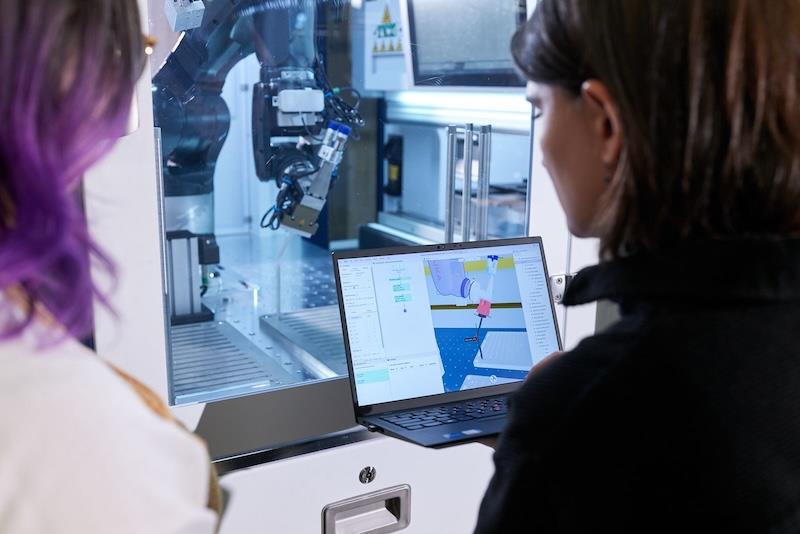
Announced at ROSCon 2026 in Toronto, Intrinsic Core is a set of ROS-compatible capabilities intended to provide developers with much of the underlying software infrastructure needed to build industrial robotics and physical AI applications.
Intrinsic says the technology is based on capabilities and services it uses in manufacturing deployments and is designed to reduce the amount of software and integration work robotics teams have to build from scratch.
Intrinsic Core is available on GitHub under the permissive Apache 2.0 license and can run on local hardware.
The release works with the Open Robotics Suite and includes a hardware-agnostic real-time control framework, digital twin, motion and grasp planning, pose estimation, simulation, camera calibration and preconfigured ROS-compatible hardware drivers.
The company says developers can use the components individually to improve existing robotics applications or combine them to build new systems using ROS and Intrinsic technologies.
Hardware-agnostic robot controlOne of the main components is Intrinsic Control, a hardware-agnostic real-time control framework designed for fast, sensor-based robot control.
The system enables robots to alter their behavior during a trajectory in response to changes in their environment, while generating collision-free paths.
Intrinsic says the hardware-independent approach also makes it possible to change robot arms, grippers and sensors without rewriting drivers for each configuration.
The open-source release also includes motion planning technology that automatically generates robot paths rather than requiring developers to program movements joint by joint.
Grasp planning uses real-time sensor feedback to adapt a gripper to the position and orientation of a part, while pose estimation uses Nvidia FoundationPose to provide six-degrees-of-freedom pose estimates for 3D objects.
This is intended to allow robots to locate and manipulate parts dynamically rather than depending on fixed physical fixtures.
Gazebo simulation and ROS driversIntrinsic Core includes simulation services powered by Gazebo, enabling developers to test and troubleshoot robotics applications as they build them.
The simulation environment can be used to visualize and validate application logic, state machines and complete workcell behavior.
Camera calibration tools automate the process of physically aligning and configuring robot vision systems.
Intrinsic is also releasing preconfigured ROS-compatible drivers for supported robots, grippers and 3D cameras, with the aim of reducing the integration work required to connect sensors and robots.
The company says the combination provides developers with a preconfigured software environment while retaining the flexibility to use the technology for anything from open research projects to private on-premises production systems.
Intrinsic releases open machine-tending designAlongside Intrinsic Core, the company has released the Intrinsic Open Machine Tending Solution, or OMTS, an open reference design for AI-enabled CNC machine tending.
The reference application runs on both Intrinsic Core and the Open Robotics Suite and is intended to give developers and systems integrators a starting point for building their own machine-tending systems.
It can be customized to use different hardware, including equipment from Fanuc and Universal Robots, as well as foundation models including Nvidia FoundationPose.
Intrinsic sees machine tending as a particularly promising application for more accessible industrial robotics because many smaller machine shops and fabrication businesses still operate with relatively little automation.
The company says the machine-tending project is the first in a planned series of open reference solutions for industrial automation applications.
Applications developed with Intrinsic Core can also work with the company's commercial products and services, including Intrinsic Flowstate, advanced AI models and its industrial cloud services.
Intrinsic says this is intended to provide a route from an open-source prototype to a production system without requiring developers to refactor or rewrite their applications.
5,000 developers test Intrinsic technologyThe company has already used several of the capabilities included in Intrinsic Core as part of its AI for Industry Challenge.
The competition attracted more than 5,000 developers and roboticists from 115 countries and focused on an electronics assembly problem involving cable handling and insertion.
Participants combined AI with conventional robotics techniques to tackle the task, with two teams ultimately achieving a 100 percent success rate on a physical robot workcell.
Intrinsic says the results demonstrate how open-source robotics software, ROS, AI and its own platform capabilities can be combined to address difficult manipulation problems in manufacturing.
The company describes Intrinsic Core as an early step in a broader open-source strategy aimed at making physical AI development more accessible.
Intrinsic acknowledges that using the platform still requires basic robotics expertise, but says providing more of the underlying control, simulation, perception and integration infrastructure should allow developers to spend more time on the application itself rather than repeatedly rebuilding the foundations required to make robots work.

Legal Disclaimer:
MENAFN provides the
information “as is” without warranty of any kind. We do not accept any
responsibility or liability for the accuracy, content, images, videos,
licenses, completeness, legality, or reliability of the information
contained in this article. If you have any complaints or copyright issues
related to this article, kindly contact the provider above.
Comments
No comment