

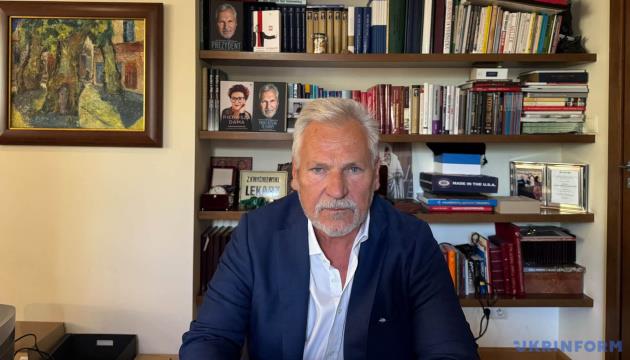
Kwaśniewski Says What Could Prompt Putin To Seek Ceasefire


“Perhaps it is precisely psychological changes and a shift in public sentiment in Russia that could prompt Putin to accelerate his search for a ceasefire,” Kwaśniewski emphasized.
He noted that, in his view, the psychological resilience of Russian society is the most interesting factor when assessing Russia's ability to continue its war against Ukraine.
“How long will society be willing to accept this 'special military operation,' which is a real war and costs thousands of lives? This is not only about those killed, but also those who return wounded,” the Polish politician said.
According to Kwaśniewski, the war is increasingly being felt directly on Russian territory.
“Thanks to the development of Ukrainian technologies, residents of Moscow, St. Petersburg, or somewhere in or beyond the Urals suddenly saw that this is not something you can simply watch on television. This is not a TV series. This is something they are already experiencing themselves,” he said.
In his view, Ukrainian attacks could gradually erode the sense of detachment from the war in Russian society – the principle of“my home is at the edge” [meaning that one is unconcerned with matters outside one's immediate surroundings].
“And the question is how long this society will be willing to simultaneously accept a deteriorating economic situation, casualties and a direct threat? I think this is Russia's main vulnerability today,” Kwaśniewski emphasized.
At the same time, he stressed that the political resilience of Russia's system remains high. According to him, Putin has managed to consolidate power to an extraordinary degree over the years.
“Perhaps this will sound strange, but he has a stronger position today than Stalin once had,” Kwaśniewski said.
He explained that, despite his powerful repressive system, Stalin had to take the Politburo [the main government group in the USSR] into account, whereas the current Russian president effectively has no parliamentary oversight, independent media or civil society capable of limiting his power.
Kwaśniewski assessed Russia's economic resilience as moderate. He noted that the country's transition to a wartime economy had allowed the Kremlin to continue the war despite enormous costs.
“They have been able to wage this war for the fifth year now, despite the colossal costs. The sanctions are working, but their effect is limited,” he said.
At the same time, Kwaśniewski believes that Russia's economic situation will deteriorate with each additional year of the war.
Read also: Nawrocki still sees Ukraine through lens of former IPN role, Kwasnie wski saysHe also stressed that he does not expect peace on terms that are fair to Ukraine as long as Putin remains in power.
“He wants to have all of Ukraine within his sphere of influence, and he will not change this thinking because it is his worldview,” Kwaśniewski emphasized.
According to him, the Russian president wants Ukraine to remain a buffer between Russia and Europe and to be within Moscow's sphere of influence rather than that of the West.
“And this needs to be said loudly to the world, because there is an impression that they do not fully understand what this war is about. And it is precisely about this: not a quarter or half of Ukraine – but all of Ukraine, which, in Putin's understanding, should be part of 'greater Russia,' that is, remain within the Russian sphere of influence,” Kwaśniewski said.
He also expressed the conviction that even the signing of a peace agreement would not necessarily mean the end of Russia's hybrid war against Ukraine.
“I don't think further manipulation on political issues or exploitation of Ukraine's vulnerabilities will stop,” Kwaśniewski said.
At the same time, in his view, Russia has already encountered something Putin did not expect – the strengthening of Ukrainian national consciousness.
“He will not be able to subjugate Ukraine, for example, through political manipulation. Terror can subjugate part of a territory, but not the entire country,” the former Polish president said.
As reported by Ukrinform, former Polish President Aleksander Kwaśniewski criticized U.S. President's Special Envoy Steve Witkoff over his statement that he has“full trust” in Vladimir Putin.

Legal Disclaimer:
MENAFN provides the
information “as is” without warranty of any kind. We do not accept any
responsibility or liability for the accuracy, content, images, videos,
licenses, completeness, legality, or reliability of the information
contained in this article. If you have any complaints or copyright issues
related to this article, kindly contact the provider above.
Comments
No comment