

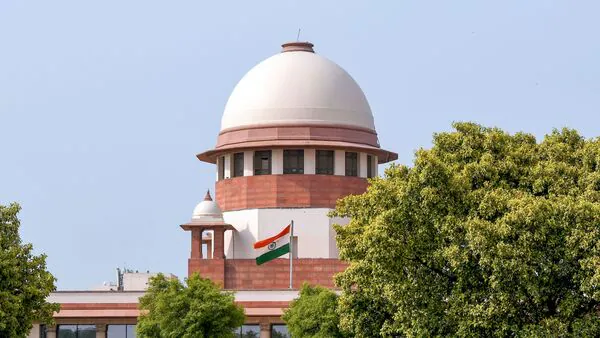
CEC, EC Appointment Law Challenged Supreme Court Refers Petitions To 5-Judge Bench


A bench of justices Dipankar Datta and Satish Chandra Sharma was dealing with petitions challenging the constitutional validity of a law
On Wednesday, Datta, who headed the bench, refused to accept the Centre's argument that the petitions raise important constitutional questions and should be referred to the five-judge Constitution bench.
"Free and fair elections depend on a truly independent ECI. It is not enough for the ECI to be independent; it must appear to be independent. The member nominated by the Prime Minister cannot be expected to defy the Prime Minister," Justice Datta observed, as quoted by LiveLaw.
Also Read | Rajya Sabha Election dates for 12 seats: Full schedule; who is likely to winJustice Datta also invoked a Cricket analogy. An umpire selected by a batting team, even if he gives the correct decision, will always be under a shadow of doubt, as he will be perceived to be loyal to the team.
Quick answers to key questions
.5 QUESTIONS1What is the significance of the Supreme Court's referral of the law governing CEC and EC appointments to a five-judge bench?⌵The referral highlights the Supreme Court's acknowledgment of potential constitutional issues raised by the 2023 law, which excludes the Chief Justice of India from the selection panel for appointing election commissioners.
2Why was there a split opinion among the judges regarding the CEC and EC appointment law?⌵The split opinion arose because Justice Dipankar Datta believed the petitions did not warrant referral to a larger bench, while Justice Satish Chandra Sharma disagreed, suggesting that the questions raised were significant enough for extended adjudication.
3How does the 2023 law impact the appointment process of the Chief Election Commissioner?⌵The 2023 law alters the appointment process by removing the Chief Justice of India from the selection panel, potentially leading to concerns about executive interference in the independent electoral body.
4What actions did the Supreme Court suggest regarding the structure for adjudicating constitutional issues?⌵The Supreme Court's bench requested the Chief Justice of India to consider establishing a permanent five-judge bench to better handle constitutional issues in the future.
5Should the government be concerned about the implications of the 2023 law on election commission independence?⌵Yes, concerns exist that excluding the Chief Justice from the selection process could undermine the electoral commission's independence, raising questions about its ability to operate free from political influence.
Justice Satish Chandra Sharma, another judge on the bench, disagreed with Justice Datta's views.
However, both judges agreed that the matter should be placed before CJI Surya Kant to decide the appropriate bench size for an effective and authoritative adjudication.
"A decision by a three-judge bench on which of the two opinions is correct would be of little worth and only delay at the decision on the significant issues that are raised," the bench observed in its unanimous order.
The bench also requested the CJI to explore the possibility of setting up a permanent five-judge bench for deciding constitutional issues.
Also Read | Mamata Banerjee losing TMC? Election Commission freezes party name, symbolThe bench was hearing pleas challenging the constitutional validity of the Chief Election Commissioner and Other Election Commissioners (Appointment, Conditions of Service and Term of Office) Act, 2023, which excludes the Chief Justice of India (CJI) from the selection panel for appointing election commissioners and Chief Election Commissioners.
On March 2, 2023, in a landmark verdict aimed at insulating the appointment of the CEC and ECs from the executive's interference, a five-judge Constitution bench ruled that their appointments will be made by the president on the advice of a committee comprising the prime minister, the Leader of the Opposition in the Lok Sabha and the CJI.
(With inputs from Livelaw)

Legal Disclaimer:
MENAFN provides the
information “as is” without warranty of any kind. We do not accept any
responsibility or liability for the accuracy, content, images, videos,
licenses, completeness, legality, or reliability of the information
contained in this article. If you have any complaints or copyright issues
related to this article, kindly contact the provider above.
Comments
No comment