

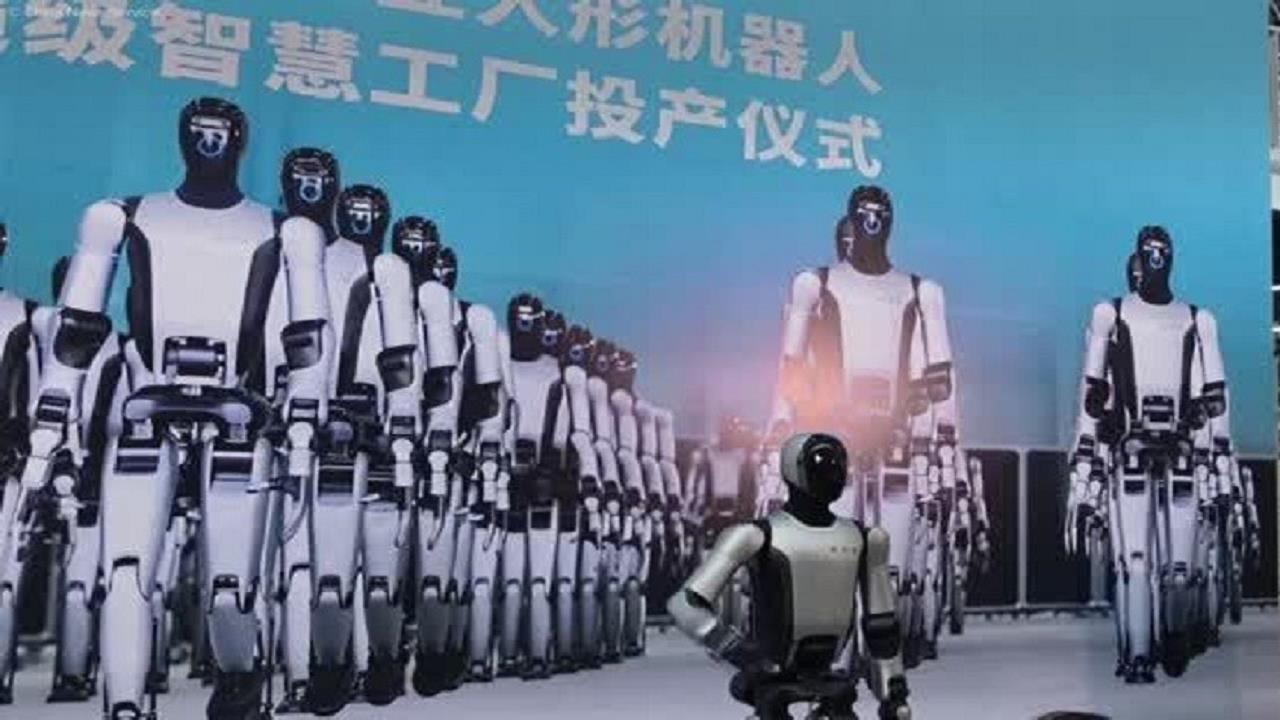
China Opens Smart Factory Where Humanoid Robots Build Other Robots


The new facility in Liuzhou, in southern China's Guangxi region, is operated through a partnership between Chinese robotics company UBTech Robotics and Germany's Siemens. Company officials say the factory has an annual production capacity of 10,000 humanoid robots and uses AI-powered automation throughout the manufacturing process.
The launch comes as China accelerates investment in humanoid robotics, a sector Beijing has identified as a strategic industry alongside artificial intelligence, semiconductors and advanced manufacturing. Chinese companies are racing to compete with firms in the United States, Europe and Japan in developing robots designed for factories, logistics, healthcare and household services.
Robots working alongside robotsUnlike conventional production plants, the Liuzhou factory uses humanoid robots and autonomous mobile machines to perform parts of the production process with minimal direct human intervention.
According to company officials, robots equipped with 3D vision cameras, force sensors and tactile sensors identify small components, pick them up and install them with high precision during assembly. Other mobile robots transport raw materials and finished parts across the factory floor, while autonomous forklifts handle logistics inside the facility.
Engineers also created a digital twin of the factory before production began. The virtual model, covering roughly 14,000 square meters, allows engineers to simulate manufacturing operations, identify bottlenecks and test production changes before deploying them in the physical factory.
Each completed humanoid robot undergoes approximately four hours of testing, including mobility, balance, durability and quality-control inspections before leaving the production line.
China's robotics pushChina is already the world's largest market for industrial robots and has been rapidly expanding into humanoid robotics as labor shortages and an aging population reshape its manufacturing sector.
Chinese authorities have encouraged automation to reduce reliance on workers for repetitive or hazardous industrial tasks. Industry analysts say younger workers are increasingly reluctant to take physically demanding factory jobs, making robotics an important long-term solution for manufacturers.
The Liuzhou factory is part of a broader national strategy to integrate AI into production, improve manufacturing efficiency and strengthen China's position in the global robotics supply chain.
Opportunities and challengesDespite rapid technological progress, experts say humanoid robots still face significant limitations. Robots often struggle in unpredictable environments, remain expensive to manufacture and require substantial computing power and maintenance.
Analysts also question whether the global market can absorb 10,000 humanoid robots annually in the near term, given that commercial adoption remains concentrated in industrial pilot projects rather than mass deployment.
The expansion of humanoid robot factories also raises concerns about the future of manufacturing jobs. While automation is expected to replace some repetitive tasks, economists say it is also likely to increase demand for workers with skills in robotics maintenance, AI programming and advanced manufacturing systems.
The Liuzhou plant reflects China's growing ambition to become a global leader in next-generation robotics, as competition with the United States intensifies over AI-powered technologies and intelligent manufacturing.

Legal Disclaimer:
MENAFN provides the
information “as is” without warranty of any kind. We do not accept any
responsibility or liability for the accuracy, content, images, videos,
licenses, completeness, legality, or reliability of the information
contained in this article. If you have any complaints or copyright issues
related to this article, kindly contact the provider above.
Comments
No comment