

FX Daily: Dollar Resilience Builds


The dollar continues to show very good resilience to lower energy prices and a risk-friendly environment. It's another sign that the Fed story is dominant, and the hawkish Fedspeak is enough to keep USD in demand. Richmond Fed President Thomas Barkin, who becomes a voter in 2027, reinforced that message yesterday, arguing that a single rate hike may not be enough to bring inflation under control. He also noted that resilient labour market conditions should keep consumer spending supported, implying that a dovish shift among the hawks may require clearer signs of labour market softening.
But high-frequency jobs indicators have remained strong. Initial jobless claims are back below 200k and ADP reported a bump in weekly hiring to 20k at the start of September. Consensus is starting to build around a strong September payroll print – around 80-100k.
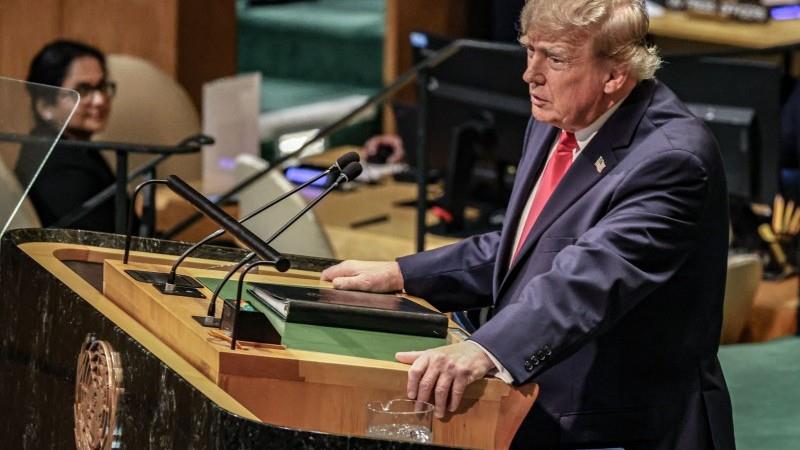
Geopolitics had a limited impact on FX yesterday. President Trump's UN speech generated few clear market signals, while constructive talks with Iranian delegates and the reopening of the Saudi East-West pipeline pushed Brent below $100/bbl. Whether this evolves into a more sustained decline remains to be seen. From a rates perspective, oil floating around the $90-100/bbl range is unlikely to force a dovish rethink in market expectations.
We'll be awaiting more headlines from New York ahead of tomorrow's Trump-Xi meeting. The Fedspeak agenda is quiet today, and the data calendar only includes S&P Global PMIs, which matter less for markets than the ISM surveys. We retain the view that the dollar faces upside risks over the next couple of weeks, when a revamp of data releases can prompt markets to add bets on an October hike. In that context, DXY reaching 101.0 remains a very achievable near-term target.
Francesco Pesole
EUR: Still downside risksEUR/USD is starting to look a tad cheap, as global equities support the pair's short-term fair value. Still, we see little technical justification for fading the current decline before 1.140-1.142, where EUR/USD would be breaching a 1.5 standard deviation misvaluation band, assuming rate differentials remain unchanged.
This week underscored another risk: when oil prices fall, markets may price out ECB tightening faster than Fed tightening. That was a major drag on EUR/USD in June, and any hint of a dovish rethink from ECB speakers could trigger a leg lower.
The next few weeks will determine whether either the ECB or the Fed goes for an October hike. While we still expect the next move from both central banks to come in December, any earlier tightening appears more likely to come from the Fed than the ECB. That leaves the balance of risks skewed to the downside for EUR/USD.
Eyes will be on PMIs today, which in the eurozone have greater monetary policy implications than elsewhere. Expectations are for a slight softening in the eurozone-wide composite gauge from 52.0 to 51.7. Let's see whether budget concerns in France and political developments in Germany have had any impact on sentiment. Meanwhile, the ECB speakers' calendar remains busy today.
Francesco Pesole
HUF: A well-paused decisionThe National Bank of Hungary meeting delivered exactly what the market expected – a pause in the rate-cutting cycle and a reduction of the inflation target from 3.0% to 2.5%. From the market's perspective, this was a case of ticking boxes that had been anticipated since the April general election. The market remained virtually unchanged in front-end rates following the NBH press conference, with pricing in less than one rate cut over the next 6-9 months, assuming a positive BUBOR spread over the NBH key rate. The curve has flattened significantly over the past two weeks, aligning with our earlier expectations outlined in our NBH preview.
Nevertheless, we see scope for further flattening, even though the curve is already deeply inverted. At the same time, the front end offers a buffer against a potential geopolitical escalation or a spike in energy prices. We believe the market would not hesitate to price in rate hikes at the front end of the curve if energy prices rise again and Hungarian inflation climbs in the coming months (NBH forecast of 3.1% average inflation for next year). Meanwhile, the long end still offers room for convergence trades, and long-term yields should grind lower.
The combination of a lowered inflation target and a halt to rate cuts creates a very positive environment for the FX market. On the other hand, the global backdrop remains largely negative, despite the recent relief rally. The US dollar is at record strength, EUR/HUF remains highly sensitive to energy prices, and Fed rate hikes could trigger renewed pressure on emerging market currencies, which have shown remarkable resilience so far. The overall picture is thus very mixed, and global factors could easily take the driver's seat. Although our bias remains bullish for the forint, and we could retest the 360 EUR/HUF level, further developments are heavily dependent on global factors at this moment.
Frantisek Taborsky
CEE: FX stability masks diverging rate outlooksThe region is benefiting from improved global sentiment and lower energy prices, prompting markets to scale back expectations for aggressive rate hikes. Czech rates, the most hawkish in the region, price around 100bp of tightening, versus 85bp in Poland. Today's calendar is again light, with only August Polish labour market data due. Despite continued rates volatility, FX remains stable. In our view, opposing forces are broadly balancing out and keeping CEE currencies steady: a stronger US dollar is weighing on the region, while improved sentiment and lower energy prices have yet to offset its impact.
Local drivers remain limited this week, and fresh catalysts may take time to emerge. We expect a more hawkish CNB to push EUR/CZK lower again, but this is unlikely in the near term unless Friday's minutes strike a surprisingly hawkish tone. By contrast, we see further upside in EUR/PLN given the central bank's dovish stance. Potential government measures to cut petrol prices could complicate the outlook: if approved, they might allow the central bank to postpone rate hikes, while also weakening the interest-rate differential and putting downward pressure on the zloty.
Frantisek Taborsky

Legal Disclaimer:
MENAFN provides the
information “as is” without warranty of any kind. We do not accept any
responsibility or liability for the accuracy, content, images, videos,
licenses, completeness, legality, or reliability of the information
contained in this article. If you have any complaints or copyright issues
related to this article, kindly contact the provider above.
Comments
No comment