

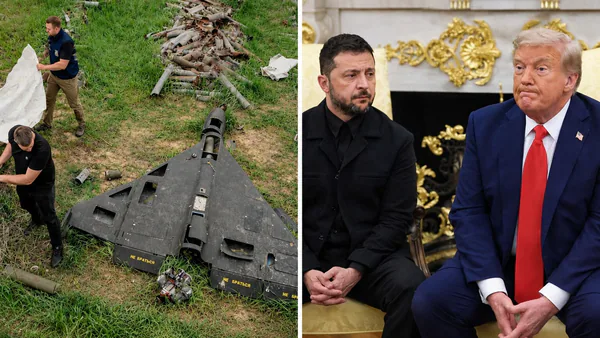
How Ukraine Mastered Drone Warfare And Why The US Needs Kyiv's Expertise Amid Landmark Deal Buzz


According to the report, citing sources, Ukrainian President Volodymyr Zelenskyy is prepared to sign the agreement on the sidelines of the United Nations General Assembly in New York this week.
However, the report said the deal could instead be finalised at a later date when the US is ready to sign.
Ukraine is in demand for drone techUkraine's battlefield-tested drone technology has particularly gained attention amid the recent war involving Iran.
During the early days of the conflict, Iran used Shahed-type one-way attack drones against American military installations across West Asia. Russia has used the same family of drones extensively against Ukrainian cities and infrastructure.
Earlier in March this year, Ukraine dispatched specialised military and drone-expert teams to West Asia following a formal request from the United States.
Also Read | Putin's Russia Tests NATO's Baltic Defence With 'Drone' Offensive? | DetailsIn a video address, Zelenskyy said Ukraine had“the greatest experience in the world in countering attack drones”, referring to expertise developed through years of Russian drone attacks.
Ukraine has also said that the US and 10 other countries across the Middle East and Europe have sought its assistance in dealing with the growing drone threat.
The economics of drone warfareOne of the biggest lessons from the Ukraine war has been the growing mismatch between the cost of an attacking drone and the weapon used to destroy it.
Iranian-style attack drones can cost tens of thousands of dollars, while interceptor missiles deployed by sophisticated Western air-defence systems can cost hundreds of thousands or even millions of dollars.
That creates a difficult economic equation when large numbers of relatively inexpensive drones are launched simultaneously.
NPR national security correspondent Greg Myre highlighted this problem in an earlier podcast with his publication, noting that US ships and military bases have air-defence systems designed largely to counter expensive missiles with expensive interceptors.
Myre said Ukraine "has pioneered a range of smaller, cheaper interceptor drones", with some costing as little as $1,000.
How Ukraine became a drone warfare laboratoryRussia's invasion has forced Ukraine to rapidly adapt its military technology and tactics, Myre said.
Years of repeated Russian drone attacks have given Ukrainian forces extensive operational experience in identifying, tracking and intercepting unmanned systems.
That experience has also created a feedback loop between Ukraine's military and its domestic defence industry, with systems tested in combat, rapidly modified and returned to the battlefield, according to Myre.
This battlefield-driven innovation is now attracting interest from countries facing similar threats.
Why the US wants Ukrainian expertiseFor the US, Ukraine's experience offers a way to address a problem that has become increasingly important for American forces: how to defend bases, ships and troops in West Asia against large numbers of relatively cheap drones without exhausting expensive air-defence interceptors.
Low-cost drones are also increasingly being used by state and non-state actors, including the Houthis and Hamas, against US allies, making counter-drone technology an important component of modern air defence.
Ukraine has also sought to expand its defence partnerships beyond the US.
According to the Kyiv Post, Kyiv has signed comprehensive 10-year defence and security agreements with Saudi Arabia, the United Arab Emirates and Qatar.
Also Read | UK to give support to Saudi Arabia against Houthis: Why Britain is stepping inThe agreements come as West Asian countries face growing drone threats following the US-Israel-Iran conflict and a series of attacks and retaliatory strikes involving unmanned systems.
As Myre observed, the dynamic between Washington and Kyiv has shifted:“Ukraine needs American air-defence capabilities, while the US has a growing interest in Ukraine's experience with inexpensive drone interceptors.”

Legal Disclaimer:
MENAFN provides the
information “as is” without warranty of any kind. We do not accept any
responsibility or liability for the accuracy, content, images, videos,
licenses, completeness, legality, or reliability of the information
contained in this article. If you have any complaints or copyright issues
related to this article, kindly contact the provider above.
Comments
No comment