

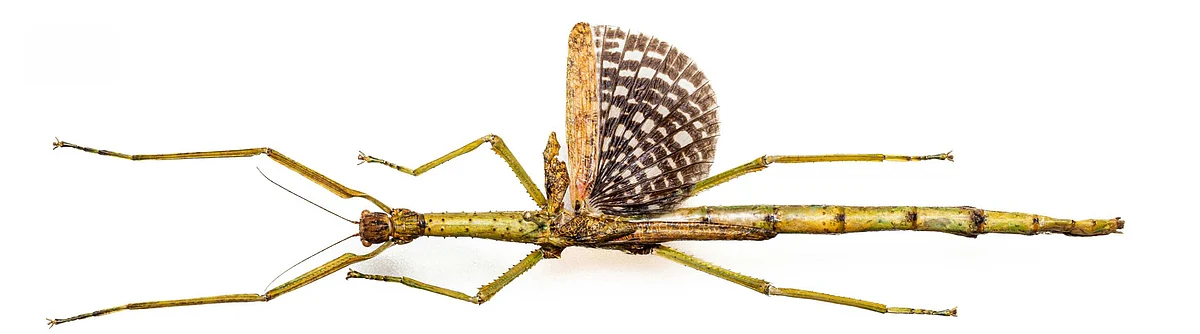
Two New Giant Stick Insects Discovered In Australia After Decades Of Mistaken Identity


Researchers at the University of Sydney found the two species while taking a fresh look at a group of Australian stick insects known as Anchiale.
Recommended For YouTheir research published on Tuesday revealed what scientists previously considered two species are actually five distinct species found from northern New South Wales through coastal Queensland and into the tropical north. And there could be another one waiting to be formally identified.
Stay up to date with the latest news. Follow KT on WhatsApp Channels. Hiding in plain sight
One of the newly recognised species, Anchiale robusta, was not exactly difficult to see. Females can grow to around 12 to 16cm in body length, while males reach around 9 to 10cm.
The insect had been known to scientists and enthusiasts for decades, but researchers discovered it had been misidentified.
To solve the mystery, the team combined DNA analysis with museum collections, field surveys, citizen science records and studies of captive populations. The evidence showed that the insect was a separate species.
“Taxonomy is often a bit like detective work,” said lead author Dr Braxton Jones from the Aola Richards Sydney Insect Hub at the University of Sydney.
“Even among some of Australia's most photographed and frequently reported insects, we're still finding species that have escaped scientific recognition.”
That is despite more than 1,000 citizen science observations of stick insects recorded through platforms including iNaturalist and the Atlas of Living Australia.
Unusual egg offered another clueThe second new species, Anchiale mabiensis, has so far been found only in the Mabi rainforest on Queensland's Atherton Tablelands.
Females are around 11 to 12cm long, making them slightly smaller and more slender than A. robusta.
But one of its most unusual features is not the insect itself. It is the egg.
Researchers found that the eggs have a series of rings and a structural“lid” that detaches when the insect hatches.
According to the University of Sydney, researchers could not find a similar structure previously recorded in stick insects or their closest relatives.
Jones said examining eggs can be particularly useful when trying to identify stick insects.
“I don't know any other organism where this applies, but you can take the egg alone, and from the egg you can identify the species,” he told ABC News.
Why are scientists still finding new species?The discovery raises an obvious question: How can insects this large remain scientifically unidentified?
In this case, they were not completely unknown. Instead, researchers had grouped different insects together under the wrong identities.
Differences in their wings, body shapes, eggs, habitats and DNA helped researchers separate them.
The study also reinstated another species that had previously been overlooked, bringing the number of recognised species in the group from two to five.
Researchers even identified what could be a sixth species in Cape York, but said more specimens are needed before it can be confirmed.
Why identifying them matters?Knowing exactly which species is which is not just about giving an insect a new scientific name; it can also determine how it is protected and conserved.
A. mabiensis has so far been recorded only in the Mabi rainforest, which is considered a threatened ecological community and has lost large areas to agriculture.
The findings could also have implications for forestry and agriculture. Researchers found that a stick insect known for occasionally appearing in large numbers and stripping leaves from trees actually consists of more than one species.
Understanding which species are responsible could help improve how those outbreaks are managed.
For Jones, the discoveries show how much remains unknown even in places and among insects that have already been extensively observed.
“These findings demonstrate the importance of protecting threatened ecosystems and documenting Australia's extraordinary biodiversity before we lose species without us having even discovered them,” he said.
The insects may have been hiding in plain sight for decades. Scientists just had to look at them differently.
ALSO READ- Brazil fossil lost for 20 years helps identify new reptile species from 240 million years ago New cat species identified for first time in over a century in Bolivia Over 20 cloned wolves in UAE offer new hope for protecting rare species

Legal Disclaimer:
MENAFN provides the
information “as is” without warranty of any kind. We do not accept any
responsibility or liability for the accuracy, content, images, videos,
licenses, completeness, legality, or reliability of the information
contained in this article. If you have any complaints or copyright issues
related to this article, kindly contact the provider above.
Comments
No comment