

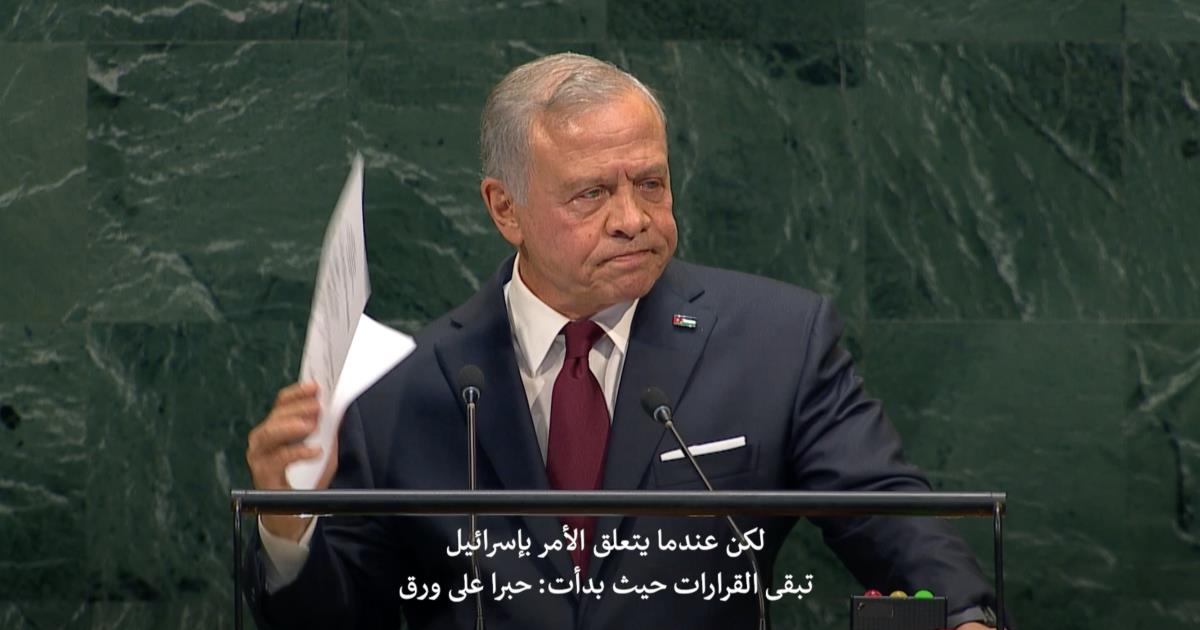
Ink On Paper


The sentence needs little explanation. Anyone who has followed the corridors of the UN for even a decade knows how accurately it captures the reality, perhaps even understating it.
Much of the speech's unusual force lay not in its tone, but in the King's dismantling of the vocabulary itself. When the occupation demolishes Palestinian homes to expand a settlement, it calls that“law enforcement.” When it seizes occupied land, it calls the act“registration.” When it erects checkpoints that choke the daily lives of millions, it describes them as“security infrastructure.”
The King did not simply repeat these terms. He put them back into their actual context. What is happening is not law enforcement, but forced displacement. It is not registration, but de facto annexation. It is not security infrastructure, but a full-fledged system of repression.
This kind of confrontation with language rarely comes from the leader of a state that maintains formal diplomatic relations with Israel, however strained those relations have become. It reveals something deeper than a choice of words.
A significant part of the legitimacy Israel shelters behind internationally is built around a vocabulary designed to soften the impact of actions rather than describe them as they are.
When the King noted that 300 Palestinian children had been killed during the first 300 days of what was described as a ceasefire in Gaza, he was not referring to the casualty figures of a declared war. He was pointing to what happened after the world had officially announced that the fighting had stopped.
That figure alone cuts through the narrative promoted by many Western capitals, the idea of a clear“before” and“after”, as though the period following a ceasefire were necessarily safer.
The King used the number to make a blunt point: what is happening in Gaza can no longer be classified simply as the aftermath of war. It is an ongoing policy whose tools may change while its objective remains fixed.
In one of the speech's most striking moments, the King reclaimed the term used by Israel's far-right government to describe those carrying out settler attacks,“a handful of rioters”, but refused to let it pass unchallenged.
He asked a simple question: when soldiers stand by as attacks take place, sometimes even protecting those who carry them out, block ambulances and target journalists, are we still talking about“a handful”?
The implicit answer in the speech is unmistakable. This is a recurring pattern shielded by state institutions, rather than a deviation from them. That makes the description of an extremist gang operating under official cover closer to the reality presented in the speech than that of a fringe group acting outside the law.
The difference is not merely semantic. It is the difference between holding individuals accountable and holding an entire state policy accountable.
Israel's expansion into southern Syria was no marginal detail in the speech either. It formed part of a broader argument that Israel's ambitions will not remain confined to Gaza, the West Bank and Jerusalem.
The King pointed to repeated incursions into Syria and Lebanon, including those affecting vital water sources, as a warning that should not be taken lightly.
He also pointed to a deeper paradox. The world may choose to look away from what is happening in Syria, just as it has looked away from many other crises, but that indifference has limits. What threatens Jordan's security, borders and water resources cannot be met with the same detachment the world may extend to crises that appear more distant.
The closing point, perhaps the one worth pausing over longest, was that Jordan's commitment to diplomacy should not be mistaken for weakness.
It was a direct response to a common reading, both within the region and beyond it, that sees Jordanian moderation as hesitation or retreat.
The King's message was the opposite: this caution stems from Jordan's direct geographic position on the fault line of the crisis, not from an absence of resolve.
When the speech invoked the Arab Peace Initiative of 2002, still on the table more than two decades later without ever finding an Israeli party willing to accept it, it also redistributed historical responsibility with a clarity rarely expressed so plainly in an international forum.
The Arabs made the offer. Israel rejected it, again and again.
The question left hanging in the hall was what set this speech apart from so much of what is said in that forum year after year.
It did not ask for applause. It demanded an answer to a simple but unforgiving question: is the world's inaction toward Israel the result of a genuine lack of tools, or a repeated choice not to use them?
Jordan answered for its own position without ambiguity.
The remaining question is directed at the international community: will its resolutions concerning Israel remain, once again, nothing more than ink on paper?

Legal Disclaimer:
MENAFN provides the
information “as is” without warranty of any kind. We do not accept any
responsibility or liability for the accuracy, content, images, videos,
licenses, completeness, legality, or reliability of the information
contained in this article. If you have any complaints or copyright issues
related to this article, kindly contact the provider above.
Comments
No comment