

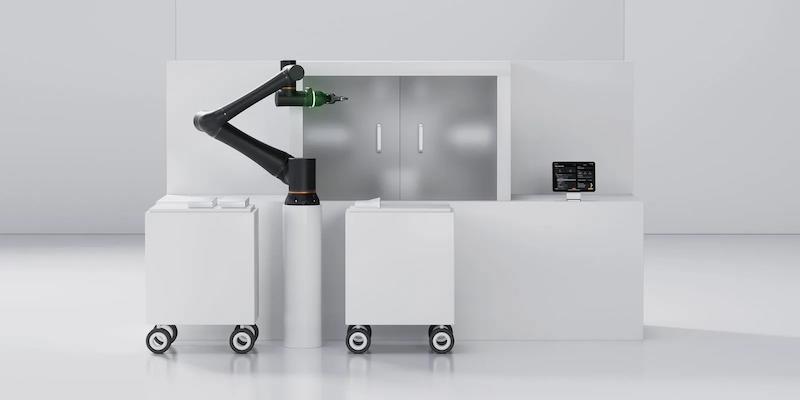
How Quality Management Software Fits Robot Production


The customer audit was in nine days. That's the moment quality stops being paperwork and starts being the reason revenue gets held hostage.
You can't spot-weld discipline into a hundred weldments spread across three shifts using spreadsheets and hope. If your operation is scaling past a handful of robot cells, the fix isn't hiring another quality engineer. It's putting the records somewhere a machine, a supplier, and an auditor can all agree on.
Here's what actually changes when the management software replaces the clipboard stack, where the fails happen, and how to tell if you're ready to move.
What Quality Management Software Actually ReplacesWalk your shop floor and count the places a deviation gets written down. There's a traveler, a maintenance log, an inspection sheet, and someone's phone. Multiply that by every robot cell, every shift, and every supplier who sends you subassemblies. That multiplication is where traceability dies.
The National Institute of Standards and Technology has documented for decades, in its work on manufacturing standards and interoperability, that the failure points in production data cluster around handoffs between systems and people. Every manual re-entry is a place a number can drift.
Quality management software doesn't make your robots more precise. It makes the story about what your robots did verifiable six months later, which is usually the only version anyone with a contract cares about.
Practically, that means one place where a nonconformance, a corrective action, a supplier complaint, and a rework order all reference the same part number and the same timestamp. When a customer calls about a bad batch, you're not reconstructing a week from four sources. You're filtering one.
Where Robot Production Lines Actually Break DownMost quality failures in automated production aren't dramatic. They're quiet. A fixture drifts a fraction of a millimeter, the vision system compensates, and the parts still pass the go/no-go check until they don't. By the time a customer rejects a shipment, the root cause is several weeks upstream in a machine log nobody archived.
A robotic cell is a system of systems, and each system keeps its own version of the truth. That's why software built for real production, like the setups that tie QMS, HACCP, document control, and training records into a single validated workflow, tends to sit at the center rather than the edge of the plant. The value isn't the form. It's the linkage.
Three failure patterns show up again and again in automated manufacturing:
-
Calibration records for a robot's end effector, stored in a maintenance system nobody in quality can query.
Rework decisions made by a shift supervisor, never linked back to the original nonconformance.
Supplier certificates of conformance, filed as PDFs with no connection to the parts they cover.
Each one is survivable on its own. Together, they turn an audit into an excavation.
Why Regulated Industries Have to Care About ThisManufacturers serving medical devices, food processing, chemicals, or aerospace don't get to treat traceability as optional. Their customers audit them. Regulators inspect them. And the standards bodies that govern quality systems expect documented evidence that a process was controlled, not a verbal assurance that it was.
The International Organization for Standardization maintains the quality management framework that most manufacturers build around, and the core requirement hasn't changed in decades: show your work, show who approved it, and show what you did when it went wrong.
Software doesn't make a company compliant. Bad software makes noncompliance invisible until an auditor finds it for you.
Here's my take, and it's blunt. If you're automating production but running quality out of a shared drive, you've automated the part of the business that's easiest to automate and neglected the part that's hardest to defend. That's backwards.
A Practical Readiness Audit Before You Buy AnythingDon't start with a vendor demo. Start with your own records. Spend one afternoon on this checklist and you'll know more about your readiness than any sales call will teach you.
Pick one robot cell and one part number. Try to reconstruct the full build history, from incoming inspection to final test, using only documented records. Time how long it takes. If it's over an hour, you have a data problem, not a staffing problem. Check whether your calibration and maintenance records live in the same system as your quality records. If they don't, note the gap. Find one nonconformance from last quarter and trace it forward. Did the corrective action actually close? Was there evidence? Ask a supplier to send a certificate of conformance for a specific lot. See how long that takes and whether it arrives attached to the right parts. List every place a quality decision gets made without a login. That list is your real scope.If steps one through three take more than a day, don't buy software yet. Fix the process first. Buying a system to fix a process nobody follows is how you end up with expensive digital chaos.
How to Judge a Quality System Without Getting Sold toVendors will show you dashboards. Ignore the dashboards for the first thirty minutes. Ask three harder questions.
First, can the system show you a complete genealogy for a serialized part without a manual search? If the answer involves exporting to a spreadsheet, you've learned enough.
Second, does it handle supplier collaboration natively, or does that live in email? Most real quality events involve an outside party, so a system that stops at your firewall only solves half your problem.
Third, how does it treat change control? If a process change can be made without a linked approval and an impact assessment, your audit trail has a hole in it.
I'd rank supplier collaboration above analytics every time for a company scaling past five robot cells. You can build a report in a week. You can't rebuild trust with a customer who found your gap first.
The Handoff That Decides Whether Any of This WorksSoftware doesn't close the loop. People do, and the handoff between quality and production is where most implementations quietly fail.
The plant manager needs to see value in the first month or they'll route around the system the way they always have, and the way they always have is what got you here.
Give the floor one thing that saves them time this week, not next quarter. Fastest wins I've watched land: capa routing, one-tap nonconformance entry from a tablet at the cell, and automatic flagging when a calibration falls out of date.
The Bureau of Labor Statistics tracks manufacturing employment and productivity trends, and the pattern holds across sectors. Teams adopt tools that remove work. They tolerate tools that add it.
That's the whole test. If your new system adds a step for the person building the robot, it will be abandoned. If it removes three, they'll defend it.
Where This Leaves YouYou don't need a perfect quality system to ship robots. You need records that hold up when someone asks a hard question, and a process the people on your floor will actually use.
Start with the audit checklist above. Pick the one gap that would hurt most in a customer visit and fix that one thing first, whether that's software, a process change, or a conversation with your supplier.
What's in your email folder right now that an auditor would want to see?

Legal Disclaimer:
MENAFN provides the
information “as is” without warranty of any kind. We do not accept any
responsibility or liability for the accuracy, content, images, videos,
licenses, completeness, legality, or reliability of the information
contained in this article. If you have any complaints or copyright issues
related to this article, kindly contact the provider above.
Comments
No comment