

UAE Students Develop AI System To Protect Patient Data Shared Between Hospitals


- By: Nandini Sircar
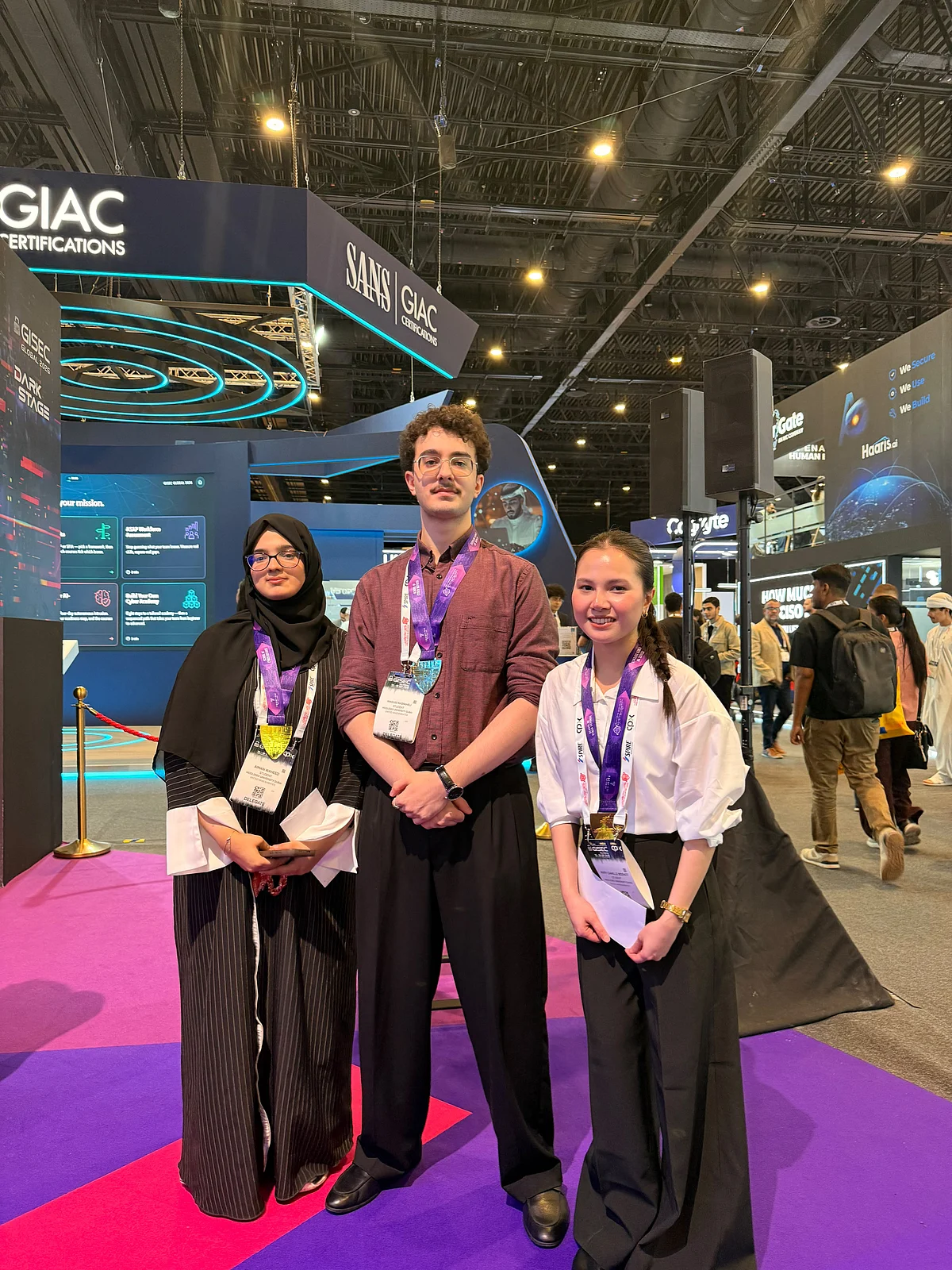
A team of three Middlesex University Dubai students has won a cybersecurity competition hosted by the Dubai Electronic Security Centre (DESC) at GISEC Global 2026, with a project aimed at helping hospitals use medical data without putting patients' personal information at risk.
The students competed against hundreds of participants from universities across the UAE during the competition, which was held during GISEC Global from September 16 to 18 at Dubai Exhibition Centre, Expo City Dubai.
Recommended For YouMore than 400 students took part, with 350 teams progressing to the second stage before seven teams made it to the final. The winning team was led by Aiman Waheed, who worked alongside Mary Camiile Bognot and Nikoloz Khorkheli, all third-year BSc Cybersecurity and Digital Forensics students.
Stay up to date with the latest news. Follow KT on WhatsApp Channels.
The competition theme, 'Privacy-Preserving Analytics on Sensitive Government Data', focused on a challenge at the intersection of artificial intelligence, healthcare and cybersecurity and how hospitals can use patient data to improve healthcare while protecting sensitive personal information.
Students tackle healthcare data privacy challengeAiman Waheed, BSc Honours Cybersecurity and Digital Forensics, Final Year student, Middlesex University, said the team developed the project to address the risks associated with sharing sensitive medical information between hospitals.
“To solve this, we built a project called 'The Model Is The Leak',” she said.
The system was designed around two simulated hospitals, allowing each to train an AI model using its own data without sharing the underlying patient records. The team then tested whether patients whose information had been used to train the model could still be identified.
Aiman Waheed said the privacy safeguards made the model significantly harder to exploit while preserving almost the same level of accuracy.
“We wanted to show that hospitals could still work together and learn from their data without having to share the actual patient records.
We created a system using data from two simulated hospitals, where each hospital could train the model using its own data and only share the necessary information for improving the model. We then tested the system ourselves to see whether someone could still identify patients who had been part of the training data. With our privacy protections in place, the model was much harder to exploit while still maintaining almost the same level of accuracy.”
Mary Camille Bognot explained how the team divided the work according to each member's strengths.
“Our biggest challenge was finding the right balance between protecting personal privacy and keeping the AI useful and accurate. If you add too much protection, the AI becomes unreliable; if you don't add enough, private data can leak.
“We overcame this by dividing the work according to our individual strengths: Aiman handled the legal regulations and problem design, Nikoloz built the AI framework and tested its security, and I measured the mathematical trade-off between privacy and accuracy.”
The students said their testing showed that the privacy protections could be implemented while“costing less than one per cent in overall accuracy”.
'Simple safety steps' are not enoughFor Nikoloz Khorkheli, the competition also highlighted how cybersecurity has moved beyond basic measures such as removing names from datasets.
He also reiterated that attackers can potentially extract hidden information from AI systems, making technical safeguards and evidence of their effectiveness essential.
“Simple safety steps, like the removal of patient names, do not work. Modern attackers can extract hidden data directly from AI tools. True cybersecurity requires technical proof to stop the attacker.
“A team needs absolute trust and specific technical roles to solve complex problems in a short time. I learned how to translate my offensive security findings into clear data to help the project progress.”
The project also gave the students an opportunity to consider how technical solutions would work within government regulations and in real-world healthcare environments.
Khorkheli said one of his key takeaways was that privacy protection could actually become stronger as more hospitals joined an AI network.
“A team needs absolute trust and specific technical roles to solve complex problems in a short time. I learned how to translate my offensive security findings into clear data to help the project progress.
Technical solutions must obey government policies. I also learned a new mathematical concept. When more hospitals join the AI network, the privacy protection actually becomes stronger.”
The experience has also shaped his next steps. He said he plans to focus on a career in offensive security and pursue advanced industry certifications, with the aim of identifying vulnerabilities before they can be exploited by real-world attackers.
“My primary goal is to find and expose critical vulnerabilities before real threat actors can exploit them.”
Meanwhile, Dr Maha Saadeh, founder and head of the MDX CERT Lab under the Centre of Excellence for Foresight and Emerging Technologies at Middlesex University Dubai stressed that what stood out to her was the team's strong performance in the CTF competition and the students' ability to apply their cybersecurity knowledge under pressure.
She said, "This requires students to think critically, investigate unfamiliar problems, identify vulnerabilities, and work effectively as a team within a limited timeframe. Their determination, technical skills, and collaborative approach enabled them to successfully tackle the challenges and ultimately win the competition."
Saadeh also pointed out that students need, "strong foundations in networking, Linux, and programming, together with practical skills in ethical hacking, digital forensics, threat detection, and incident response. They should also develop strong problem-solving and teamwork skills and stay up to date with emerging areas such as AI and quantum computing."
ALSO READ- UAE students build AI tools to cut hospital wait times, prevent unused operating rooms AI may have the right answer but still fail in real-world situations, UAE researchers say UAE cyber threats surge as firms turn to AI to cut response times

Legal Disclaimer:
MENAFN provides the
information “as is” without warranty of any kind. We do not accept any
responsibility or liability for the accuracy, content, images, videos,
licenses, completeness, legality, or reliability of the information
contained in this article. If you have any complaints or copyright issues
related to this article, kindly contact the provider above.
Comments
No comment