

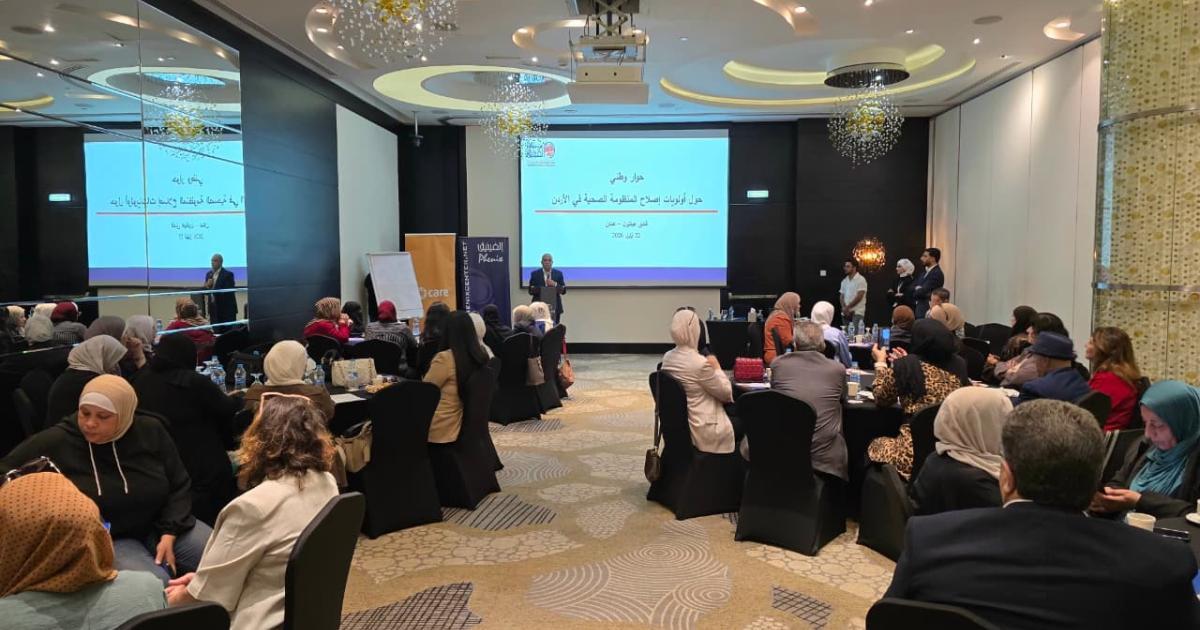
National Dialogue In Amman Moves Toward Establishing Civil Society Network For The Right To Health


The meeting is exploring the establishment of a national civil society network focused on the right to health and equitable access to medicines and healthcare services. The initiative seeks to bring together the diverse expertise and demands of civil society organizations and turn them into a shared agenda that can serve as a basis for dialogue with government institutions and policymakers.
According to the organizers, the initiative is also intended to support the ongoing efforts of Jordan's Ministry of Health by identifying gaps that may not be clearly reflected in official indicators and by conveying the experiences of patients and local communities to the relevant authorities.
Working groups and discussions focused on identifying the most pressing problems within the healthcare system and areas requiring reform at the policy and implementation levels. Participants also discussed mechanisms for collective action and the potential role of an independent civil society network in advocacy, monitoring, and social accountability.
Phenix Center Director Ahmad Awad stressed that ensuring patients receive medicines of the required quality and quantity, at the right time, is an essential part of the right to health and continuity of treatment.
He noted that Jordan has a relatively advanced pharmaceutical system, but said the challenge lies in closing the gap between medicines being available within the system and actually reaching patients. This, he said, requires developing an integrated management system centered on patients' needs.
Aisha Barhouma: Access to healthcare remains unevenAisha Barhouma, project coordinator and researcher at the Phenix Center for Sustainable Development, said the challenges surrounding the right to health in Jordan are not limited to the availability of healthcare services, but also include how easily people can access them, their quality, and their continuity.
She pointed to disparities in people's ability to access certain healthcare services and medicines across different population groups and regions of Jordan.
Barhouma said the Phenix Center organized the national dialogue because it considers health a fundamental human right, rather than simply an issue of providing healthcare services.
Speaking to the news programme, she said the center's research and fieldwork over recent years had identified a range of challenges affecting the ability of some people, particularly more vulnerable groups, to access healthcare and benefit from it on an equitable basis.
She said the national dialogue was intended to bring together different stakeholders, including civil society organizations, government institutions, experts and academics, with the aim of moving beyond simply diagnosing challenges and toward discussing possible solutions, while strengthening dialogue and coordination around improving the right to health and ensuring equitable access to healthcare in Jordan.
Barhouma said the challenges identified by the Phenix Center were not simply about whether services exist, but also about how easily people can access them, as well as their quality and continuity.
She pointed to disparities in access to certain healthcare services among different groups and regions, as well as challenges related to public awareness of health rights and the mechanisms available for obtaining healthcare.
Access to medicines is another part of the problem, she said, both in terms of medicine availability and people's ability to obtain them. She also pointed to challenges surrounding mechanisms for submitting complaints within the healthcare system.
Barhouma said there was a greater need to involve civil society organizations directly in discussions about health policies and services, given their ability to reach local communities and communicate their needs and concerns to policymakers.
The issue, she added, is not only a gap in services, but also gaps in participation, coordination and access to information.
A national network to bring civil society efforts togetherRegarding the Phenix Center's initiative to establish a national network of civil society organizations working on the right to health, Barhouma said the central idea is that collective action can have a greater impact than individual efforts.
Each organization has its own expertise, experience and ability to reach specific groups within society, she explained. Bringing these experiences together within a common framework could provide a more comprehensive picture of healthcare and access to medicines in Jordan.
According to Barhouma, the proposed network could facilitate the exchange of information and expertise, coordinate efforts, identify shared priorities, and support more integrated and comprehensive research.
Another objective would be to communicate civil society recommendations and citizens' concerns to relevant authorities in a more coordinated and structured manner, helping to bring the problems and needs identified at the community level to policymakers.
The network will not replace existing institutionsBarhouma stressed that the proposed network is not intended to replace existing institutions or solve the problems on their behalf. Rather, it would provide a space for cooperation and complementarity among civil society organizations.
Each organization would retain its own role and accumulated expertise while working collectively within a shared framework toward improving the right to health.
She said the Phenix Center views improving the right to health as a shared responsibility, adding that civil society cannot work in isolation from government institutions, official bodies and local communities.
The center hopes the national dialogue and the proposed network will mark a step toward more structured cooperation and a stronger community presence in health-related issues, particularly in monitoring challenges, communicating citizens' needs and strengthening coordination among relevant stakeholders.
Medicines may be available in warehouses, but do they reach patients?Equitable access to medicines and healthcare services is among the central issues being discussed at the dialogue, with particular attention to the potential gap between medicines being available at the central level and actually reaching patients at healthcare facilities.
The discussions are based on the view that the availability of medicines in central warehouses and storage facilities, on its own, is not sufficient to measure the healthcare system's ability to provide treatment. What matters is whether the medicine reaches the patient, in the required quantity and at the right time.
Participants are examining challenges related to distribution chains and the replenishment of healthcare facilities, disparities in access to services across governorates and regions, the financial burdens faced by patients, and the effectiveness of complaint and feedback mechanisms available to them.
The dialogue is also focusing on the needs of groups that face greater barriers to healthcare, including women, persons with disabilities, older people and refugees. Participants have also raised the need for clearer and more transparent information for patients about available services and treatment.
Four areas of discussionThe working groups are addressing four main areas.
The first focuses on identifying priorities for reforming the healthcare system, including gaps in equitable access, continuity of treatment, geographical disparities and the needs of groups at greater risk of exclusion.
The second focuses on turning local experience into a national agenda by drawing on the experience of associations and organizations working directly with citizens and local communities, and translating that experience into policy papers and shared reform demands.
The third concerns the establishment of an independent civil society network, alongside regular channels of dialogue with the Ministry of Health, government institutions, parliament, healthcare unions, universities and the media.
The fourth focuses on defining the proposed network's identity and operating mechanisms, including its name, mission, principles and decision-making processes, while maintaining the independence of participating organizations and ensuring that the network does not become a formal government body.
A national network and advocacy agendaThe dialogue is expected to conclude with the announcement of the establishment of the National Civil Society Network for the Right to Health, alongside agreement on the network's name, mission and areas of work.
A temporary coordination committee is also expected to be formed for an initial period of between three and six months. It would follow up on the dialogue's outcomes, develop a framework for the network and expand membership to organizations and initiatives committed to the principles of the right to health, equity, participation and non-discrimination.
Under the proposed framework, the committee would also develop an initial advocacy agenda covering two or three priority issues. These could include ensuring continuity in access to essential medicines, improving medicine replenishment mechanisms between healthcare facilities, strengthening complaint systems, and reducing the financial burden associated with obtaining treatment.
The proposed approach places access to healthcare within a broader framework than the ability of medical institutions to provide services. It also focuses on the health system's capacity to ensure that patients receive medicines and services in the right place and at the right time, while having effective mechanisms through which they can report problems, follow up on complaints and seek improvements in healthcare delivery.
The organizers hope the dialogue will mark the beginning of a sustained civil society process rather than a series of meetings, leading to concrete policy proposals, follow-up on their implementation, and a more regular relationship between civil society organizations and the institutions responsible for developing and implementing health policies in Jordan.

Legal Disclaimer:
MENAFN provides the
information “as is” without warranty of any kind. We do not accept any
responsibility or liability for the accuracy, content, images, videos,
licenses, completeness, legality, or reliability of the information
contained in this article. If you have any complaints or copyright issues
related to this article, kindly contact the provider above.
Comments
No comment