

Filipinos Revisit Lessons Of Martial Law As Marcos Enters Final 21 Months In Office


His father, the late dictator Ferdinand Marcos Sr, was exactly in the same situation 54 years ago. Barely a year before Marcos Sr was supposed to step down in 1973, he circumvented his two-term limit by declaring martial law on September 21, 1972. He would remain in power for 14 more years until he was deposed by a popular uprising in February 1986.
Recommended For You Vessels trickle through Strait of Hormuz as Middle East tensions persistThe spectre of martial law is not lost among the survivors of“one of the darkest periods in the history of the Philippines ". The present young generation has also learned lessons from the past and vowed to never forget and let the abuses committed during martial law happen again.
Stay up to date with the latest news. Follow KT on WhatsApp Channels.
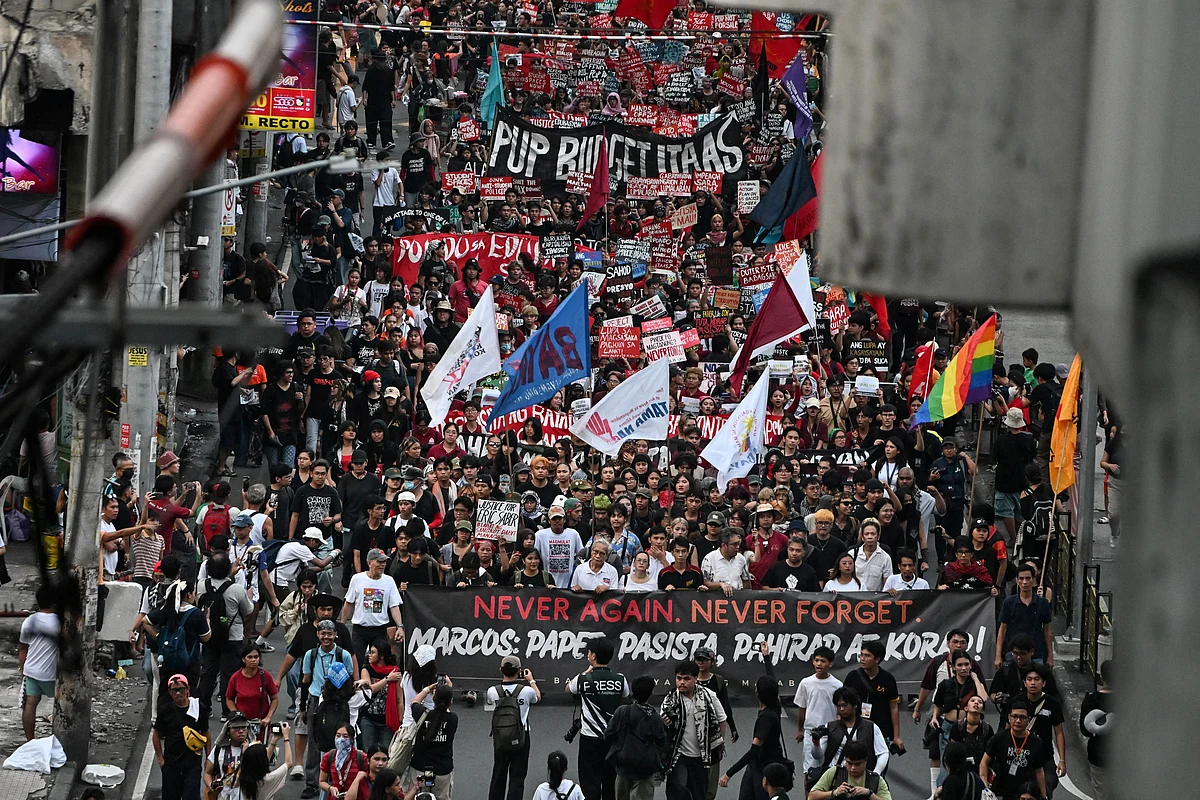
Since last week, thousands of students have walked out of universities, culminating in rallies across the Philippines on Monday, September 21, to mark the 54th anniversary of the declaration of martial law.
Filipinos remembered Marcos Sr.'s authoritarian rule that concentrated power in the presidency, enabling widespread corruption and cronyism. Protesters on Monday, meanwhile, also accused his son, the current president, of massive corruption stemming from the alleged diversion of billions of pesos in public funds to family and associates.
Here are the lessons of martial law and why Filipinos must never forget their history:
What happened during martial law?With absolute power, Marcos Sr was reported to have turned his government into a massive system for stealing public funds. He shut down Congress, silenced the media, and had his political opponents arrested.
Researcher Ricardo Manapat, in his book“Some Are Smarter Than Others,” reported that Marcos Sr gave favourable business rights to a small group of loyal friends and family members called cronies. They, in turn, took over private and public companies, sometimes paying nominal or very low prices for huge commercial empires. Government-owned banks gave massive loans to crony-run businesses with no intention of proper repayment or collateral.
The Marcos family and their associates directly siphoned money from the national treasury, Manapat wrote, including large amounts of foreign economic assistance. United States military aid was diverted into private accounts. Marcos Sr's government also collected heavy commissions and kickbacks from public works contracts and international businesses operating in the country.
At the end of their rule in 1986, Marcos Sr and his wife, Imelda Marcos, stole an estimated $5 billion to $10 billion, described as the biggest kleptocracy in the world at the time according to the official Guinness World Records.
Why did martial law last so long?It wasn't as if the Filipinos simply allowed the naked thievery. Human rights groups such as Amnesty International, Task Force Detainees of the Philippines (TFDP) and similar monitoring groups said the Marcos dictatorship lasted by killing at least 3,257 activists. There were also 35,000 recorded cases of torture, 737 enforced disappearances, and 70,000 incarcerations.
A class suit against Marcos in US revealed that 2,520 of the 3,257 murder victims were tortured and mutilated before their bodies were dumped in various places for the public to discover, a grisly tactic to sow fear among the people.
The US District Court of Hawaii in fact awarded approximately $1.964 billion to the victims in 1995. The funds were taken from amounts given back by the Swiss government to the Philippines and from the sale of Marcos assets sequestered abroad.
After his win, what did Marcos Jr set out to do?Marcos Sr died in exile in Hawaii on September 28, 1989 but his family was allowed to return to the Philippines in October 1991, including his son and now Philippine president.
"We were in exile for six years. We weren't sure if we were coming back at all. My father never made it back. He died in Hawaii. That was a very trying time. Those were dark days for the family and I dare say even for the country,” Marcos Jr said in an interview in January 2023, a few months after being elected president himself.
Cleaning the family was on Marcos Jr's agenda. In his conversation with World Economic Forum president Børge Brende in Davos, Switzerland, Marcos Jr. said:“For us to defend ourselves politically, somebody had to enter politics and be in the political arena so that not only the legacy of my father but even our own survival required that somebody go into politics.”
The issue of widespread corruption, however, also hounded the present Marcos government. An ally-turned-whistleblower, former House of Representatives appropriations committee chairperson Zaldy Co, claimed that he was ordered by Marcos Jr to insert dubious projects into the national budget. Co also claimed to have delivered at least a billion pesos to Marcos Jr's office as kickback.
Activist legislators belonging to Makabayan Coalition said Marcos Jr could not easily wash his hands clean as his was the signature that approved the national budgets. Huge amounts eventually made their way to the pockets of corrupt government officials, including his cousin, former speaker Ferdinand Martin Romualdez, Makabayan noted.
'Never again to martial law'Martial law torture survivor Bonifacio Ilagan spoke at Monday's rally in Manila, denouncing the recent overturning of Imelda Marcos' seven 2018 convictions for graft.“It seems that Marcos Jr's goal is to rehabilitate their tarnished name and reverse history and that is all that he is after,” he said.
Marcos Jr could not just keep away from the family tradition of government corruption, Ilagan added. Surveying the thousands of protesters on the 54th anniversary of the declaration of Martial Law, Ilagan said he is heartened by seeing that the majority are youth and students.
“The youth now know better. There will always be Filipinos fighting against corruption and for a better Philippines,” he concluded.
ALSO READ- Philippine Martial Law survivors outraged as Imelda Marcos' graft conviction overturned Philippines: Massive anti-corruption rallies set to hit Manila on September 21 Philippines' Marcos cousin Romualdez jailed over P7 billion flood control scam, what's next?

Legal Disclaimer:
MENAFN provides the
information “as is” without warranty of any kind. We do not accept any
responsibility or liability for the accuracy, content, images, videos,
licenses, completeness, legality, or reliability of the information
contained in this article. If you have any complaints or copyright issues
related to this article, kindly contact the provider above.
Comments
No comment