

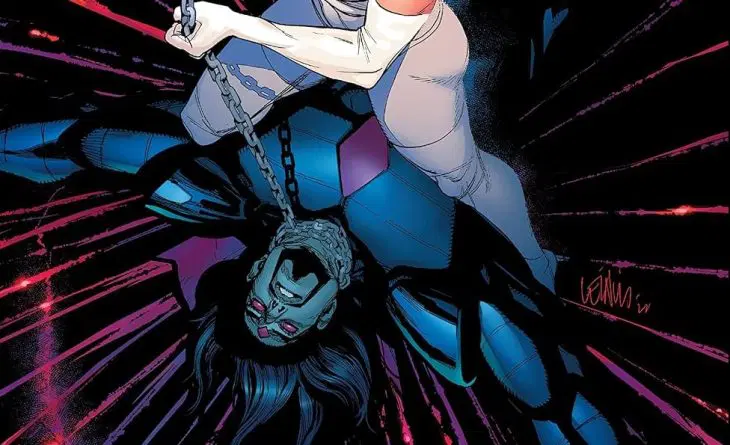
Why Does Being Bad Feel So Good? 9 Immoral And Evil Comic Book Characters We Hate To Love


Comic books thrive on conflict, and sometimes, the villains steal the spotlight. Superheroes are usually defined by their morals and supervillains by their lack of morality. These immoral and evil comic book characters commit atrocities, manipulate heroes, and routinely twist common morality into something unrecognizable. Yet, we as fans can't look away. We root for them, analyze them, and sometimes even sympathize with their pain.
Why?
Thanos was a cultural touchstone for fans and casual fans alike less than a decade ago. The idea of an ideologue willing to cull half of the universe, and sacrifice his own daughter for that cause, was mind-blowing. And he was willing to do it in order to bring balance to the universe, not even for his own benefit. He was a monstrous villain we hated to love.
Scarlet Witch committed unspeakable acts in the MCU and in the comic books. In the comics, Wanda made 98% of mutants disappear with her reality-warping powers. It was genocide, but we still see her as a hero.
Mister Sinister is basically Charles Darwin in supervillain form, performing immoral experiments on living beings for his own curiosity. Doctor Doom once killed his childhood sweetheart and used her flesh to drape mystical armor.
Even when they do awful things, great villains still reveal the uncomfortable truth: darkness is part of the human condition. They are also a mirror of what can happen when good people separate themselves from decency, morality, and accountability.
We love to see our favorite heroes fight the bad guy, but sometimes, we hate to love rooting for the bad guy too.
Let's explore nine immoral icons who make being bad look disturbingly good.
1. Mister SinisterNathaniel Essex, better known as Mr. Sinister, made his debut in Uncanny X-Men #221 in 1987. He has superhuman strength, a healing factor, shapeshifting abilities, control over his body at the molecular level, telepathy, and many other powers.
Essex was a 19th century English biologist and contemporary of Charles Darwin. After a chance meeting with Apocalypse, Essex is given superpowers and becomes almost immortal. He is the ultimate genetic manipulator. Obsessed with evolution and perfection, he treats morality as a failed experiment. His cold intellect and fascination with cloning make him one of the X‐Men's most chilling foes.
Essex has been the secret manipulator behind many X-Men backstories. He would conduct many secret experiments on Jean Grey and Scott Summers as kids. After Jean Grey lost her life as Phoenix, Essex would create a clone, Madelyne Pryor, so Scott would fall in love with her.
Essex's meddling and secret experiments would result in Scott and Madelyne having a child, the time-traveling mutant Cable. He is a scientist who sees humanity as data but still craves recognition. Sinister's arrogance and obsession mirror our own desire to control destiny, making him a villain we love to loathe.
Adam Driver will portray Minister Sinister for the first time in live action in 2028's X-Men.
2. Norman OsbornNorman Osborn made his debut in The Amazing Spider-Man # 37 in 1966. Before he became the Green Goblin, Norman Osborn was a visionary but cold and ruthless industrialist. After the death of his wife, Norman became cold to his son, Harry, and accepts Peter Parker like a spiritual son. After exposure to experimental chemicals, Norman gains super-strength and agility but loses his sanity. He then becomes the Green Goblin.
The crimes of Norman Osborn are too many to list. Norman threw Gwen Stacy, Peter's first love, off a bridge to her death. It was retroactively shown that Norman was having an affair with Gwen before her death: their kids would then grow up to try to kill Peter. Norman once took over S.H.I.E.L.D., took the Iron Patriot armor and made himself leader of the New Avengers.
He recently became Spider-Man temporarily and an ally to Peter. Osborn vacillates often from hero to anti-hero to insane villain in the comics.
3. Red SkullThe Red Skull made his debut in Captain America Comics #1 in 1941. The cover features Captain America punching Hitler in the face. Red Skull is a Hitler stand-in; his organization, H.Y.D.R.A., is just a Nazi analogue. He is pure ideological evil; a Nazi mastermind whose hatred transcends generations.
As Captain America's eternal nemesis, he represents the darkest side of nationalism and fanaticism. Yet his unwavering conviction and strategic genius make him compelling. He is a perennial villain in the comics. Most casual fans know the character through Hugo Weaving and Ross Marquand's portrayals in the MCU.
Readers despise his beliefs but can't ignore his presence; he's the embodiment of what happens when ideology consumes identity. Red Skull's longevity in comics shows that confronting evil head‐on is part of understanding heroism itself.
4. The JokerNo villain captures chaos like the Joker. He's not just Batman's opposite; he's the mirror reflecting humanity's madness. He thinks we're all crazy for following the rules. Every laugh hides trauma, every scheme exposes society's fragility. Fans are horrified yet hypnotized by his unpredictability.
The Joker's appeal lies in his anarchist idea of freedom: he rejects morality entirely, forcing heroes and readers to question their own sanity. He's the clown prince of crime and philosophy, proving that evil can be both terrifying and intoxicating.
Batman refuses to kill the Joker due to his morality. The Joker brazenly kills and commits crimes to illustrate Batman's uselessness in protecting Gotham. Joker also sees Batman as a mirror image and a reason to exist, in an obscene way. Joker made his comic book debut in Batman #1 in 1940.
5. Wilson FiskThe Kingpin of Crime, Wilson Fisk, is a study in ruthless pragmatism. He's not insane; he's methodical, disciplined, and terrifyingly logical. He looks obese and sedentary, but he is a world-class athlete with the deceptive build of a sumo wrestler. His empire runs on intimidation and intelligence, not chaos. Yet his love for his wife Vanessa and his tragic backstory humanizes him to fans.
Fisk's moral complexity makes him irresistible to fans. He's a villain who could have been a hero if not for his obsession with having complete control over everyone and everything. In the world of evil comic book characters, Fisk stands as the businessman of brutality.
In the iconic 1986“Born Again” storyline, Fisk finds out Matt Murdock's identity by supplying his ex-girlfriend, Karen Page, now a porn star and addict, with drugs. The cruel and feral practicality of the character is present in Vincent D'Onofrio's Netflix and MCU characterizations.
The Kingpin, who began as a generic gangster in the Silver Age, made his debut in The Amazing Spider-Man #50 in 1967.
6. DeathstrokeSlade Wilson, the mercenary known as Deathstroke, is the perfect weapon: efficient, emotionless, and unstoppable. He has a healing factor, super strength and reflexes, and is a master assassin and combatant. He is practically an unkillable assassin.
But beneath the armor lies a fractured soul. His loyalty to family and his twisted sense of honor blur the line between villain and antihero. He began as a Teen Titans villain but is now known as a Justice League and Batman adversary as well.
Fans admire his skill and discipline even as they recoil from his cruelty. Killing is no problem for Deathstroke and easier to do than most; living with the consequences of his reputation is another matter. Deathstroke's story is a meditation on morality in warfare: when killing becomes an art form, can redemption still exist?
He made his debut in The New Teen Titans #2 in 1980.
7. Doctor DoomVictor Von Doom is arrogance incarnate; a genius who believes only he can save the world. His intellect rivals Reed Richards, but his pride eclipses his humanity. Doom's mix of nobility and tyranny makes him one of Marvel's most fascinating figures.
In the recent One World Under Doom storyline, a remake of a similar 1987 graphic novel, Emperor Doom, Doctor Doom takes over the world. There is no more hunger, social status, war, or inequality. The price? Everyone must bend the knee and bow to Doom. The Avengers and other heroes must stop Doom from saving the world for selfish means.
In the iconic 1998 Fantastic Four storyline“Unforgivable,” Doom kills his childhood sweetheart, the only woman who ever loved him besides his mother. Demons were going to make him a powerful mystical armor, but this was the sacrifice. Reed Richards does not believe in magic, so Doom burns Johnny Storm with hellfire, traps Franklin in Hell, and torments the scientifically rigid Reed with magic.
He's a ruler, a sorcerer, and a scientist who genuinely thinks his dictatorship is mercy. Fans love him because his evil feels purposeful, a distorted reflection of leadership gone wrong. Doom doesn't just want power; he wants perfection.
Doom made his debut in Fantastic Four #5 in 1962.
8. BrainiacCold, calculating, and cosmic, Brainiac collects civilizations like trophies. Brainiac made his debut in Action Comics #242 in 1958. He is a superintelligent AI in an android body with an obsession; he wants to collect samples of all intelligence in the universe. Brainiac is known to shrink the capital cities of planets, put them in containers, and add them to his growing collection.
His intellect is unmatched, but his empathy is nonexistent. Living things, the opposite of himself, are subjects for study, analysis, and itemization only. Fans are drawn to his paradoxical ideology: a being who seeks understanding but annihilates life to achieve it.
Brainiac's evil is intellectual, not emotional, making him a chilling reminder that logic without compassion leads to extinction.
9. Scarlet WitchWanda Maximoff's descent into darkness is one of comics' most tragic arcs. Once a hero, her grief and power spiral into catastrophe and rewriting reality itself.“No more mutants” wasn't just a line; it was a cry of pain. In the 2005 storyline“House of M,” over 98% of mutants would disappear from Earth after Wanda said those words. It was genocide, but Wanda is still seen as a hero.
In the 2004 storyline“Disassembled,” the precursor to House of M, Scarlet Witch loses her mind and begins killing Avengers. She fell in love with Vision but began to realize he was not human. Her children were projections of magic and were never real. She also felt embarrassment over her living her psychodrama in front of the Avengers.
Whether in comics or Elizabeth Olsen's MCU portrayal, fans were in thrall of Wanda's pain, mental anguish, and emotional turmoil. Fan reception of Wanda after Endgame and WandaVision made it seem like she was a real, relatable person. She held a town hostage in WandaVision for her own selfish goals, but many fans still see her as a hero.
Fans sympathize with her because her evil is born from heartbreak, not malice. Scarlet Witch embodies the danger of unchecked emotion and the beauty of vulnerability. She's proof that even heroes can become villains when love turns to loss.
Wanda made her debut in The X-Men #4 in 1964.
Evil Comic Book CharactersFrom Mr. Sinister's cold ambition to Scarlet Witch's emotional collapse, these evil comic book characters captivate us because they expose the fragile boundary between heroism and corruption. They remind readers that morality isn't binary; it's a spectrum shaped by pain, pride, and purpose.
We hate what they do, but we love what they reveal: that even in fiction, evil is never simple. It's seductive, complex, and profoundly human, which is why being bad, at least in comics, feels so good to experience as fans.

Legal Disclaimer:
MENAFN provides the
information “as is” without warranty of any kind. We do not accept any
responsibility or liability for the accuracy, content, images, videos,
licenses, completeness, legality, or reliability of the information
contained in this article. If you have any complaints or copyright issues
related to this article, kindly contact the provider above.
Comments
No comment