

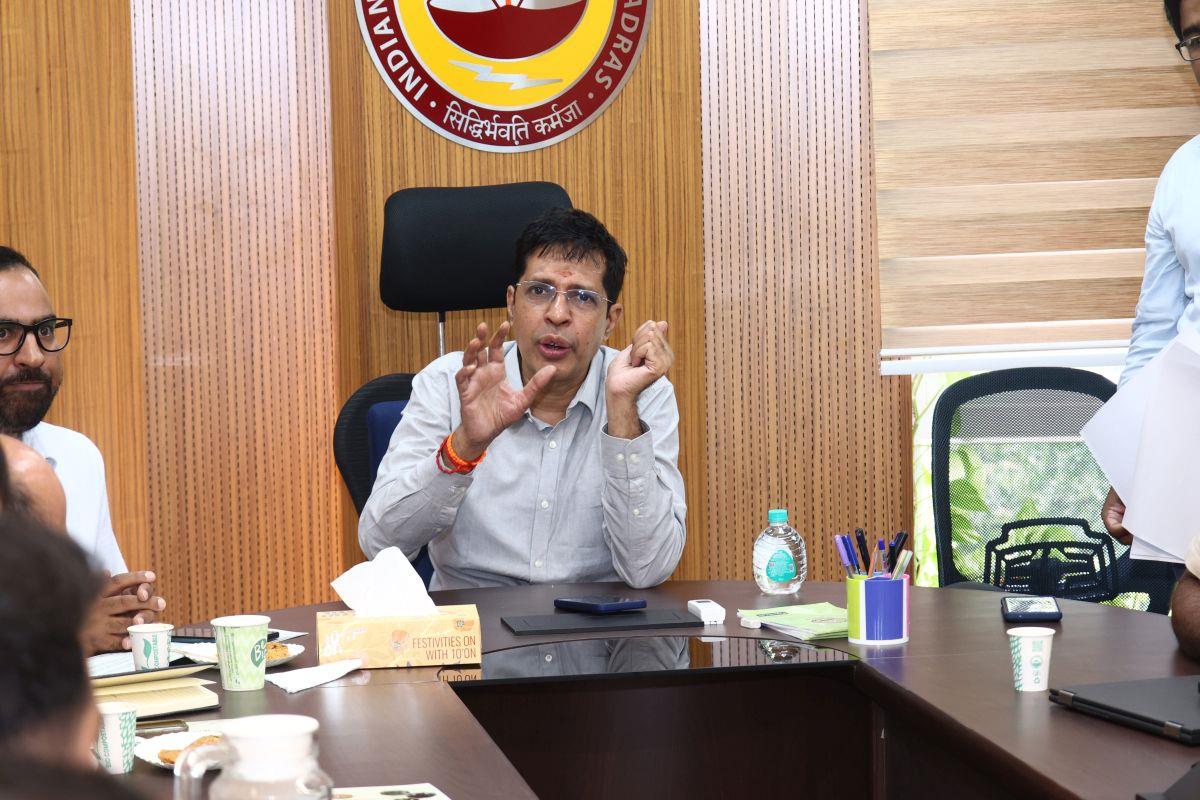
IIT Madras Offers J&K Students BS Entry Without JEE


The IIT Madras BS Degree Programmes are designed to extend IIT-level education beyond the traditional campus model through technology-enabled learning, flexible academic pathways and periodic in-person assessments. IIT Madras Director V Kamakoti described the initiative as an effort to make high-quality technical education more accessible to students irrespective of geography or financial constraints.
For students in Jammu and Kashmir, where moving to a major metropolitan centre for undergraduate education can involve considerable financial and logistical challenges, the model offers an alternative route to an IIT education while allowing learners to remain at home or continue another degree or job.
No JEE required for one admission route
A key feature of the programmes is that candidates do not necessarily need a JEE score for admission, Dr Kamakoti said during an interaction with a media delegation from Srinagar on Tuesday.
According to the IIT brochure, applicants without JEE scores can enter through a structured, self-contained four-week Qualifier Process comprising recorded lectures, live interactive sessions and weekly assignments. Candidates who qualify through this process can secure admission.
ADVERTISEMENTStudents who have qualified for JEE Advanced in the current or previous year are eligible for direct admission, the brochure says.
Admissions are offered three times a year, in January, May and September, providing multiple opportunities for students to begin their IIT journey.
This could be particularly relevant for students from J&K who may otherwise face geographical, financial or coaching-related barriers associated with conventional IIT admissions, officials at IIT Madras said.
Four-year programmes in emerging fields
The IIT, Madras, lists four BS programmes - BS in Data Science and Applications, BS in Electronic Systems, BS in Aeronautics and Space Technology, and BS in Management and Data Science.
The Data Science and Applications programme, launched in 2020, covers areas including full-stack development, data science, artificial intelligence and computing systems. Its curriculum progresses from mathematics, statistics and Python programming at the foundation level to machine learning, databases, deep learning, generative AI, large language models, computer vision, natural language processing, MLOps and advanced algorithms.
The BS in Electronic Systems focuses on electronics, embedded systems, testing, communications, control engineering and system design. Students are exposed to subjects including digital systems, embedded C, signals and systems, sensors, VLSI testing, embedded Linux, FPGA and electronic product design, with electives in areas such as VLSI, IoT and AI/ML.
Two newer programmes, BS in Aeronautics and Space Technology and BS in Management and Data Science, were launched in February 2026.
The Aeronautics and Space Technology programme takes students from engineering mathematics, mechanics and programming to aerodynamics, thermodynamics, flight dynamics, structures, computational fluid dynamics, propulsion, control systems and spacecraft dynamics. Electives include UAV/MAV design and advanced aerospace topics.
The Management and Data Science programme combines business strategy, management and data analytics. Its curriculum includes economics, accounting, organisational behaviour, HR analytics, marketing and finance analytics, operations, supply-chain analytics, Python for data analytics, generative AI for business and digital marketing.
Foundation-to-degree progression
Unlike a conventional four-year programme in which students are required to complete the entire course to obtain a qualification, the IIT Madras model is structured in multiple stages.
The Foundation Level focuses on fundamentals such as mathematics, programming, analytical thinking and core subjects. Students completing it receive a Foundation Certificate from IIT Madras CODE.
The Diploma Level introduces advanced, hands-on courses and individual projects, with project evaluations involving one-to-one vivas by instructors and industry experts. Students can become eligible for internships while continuing their studies.
The final Degree Level builds advanced technical expertise and prepares learners for higher-level industry roles, specialisation and master's programmes. Successful completion leads to a BS degree from IIT Madras.
The structure also provides multiple entry and exit points, allowing learners to earn credentials according to their academic progression.
Online learning, but exams in person
The programmes are not entirely online in the sense of eliminating physical assessments.
According to Prof Andrew Thangaraj of IITM Centre for Outreach and Digital Education, students attend online lectures by IIT faculty, complete assignments, participate in live doubt-clearing sessions and discussion forums, and take quizzes and formal examinations.
Proctored in-person examinations are conducted across India and at select international centres, while project evaluations include one-to-one vivas, he said.
Prof Thangaraj says the programmes are approved by the IIT Madras Senate and follow the same evaluation, approval and recognition framework associated with campus degree programmes. The curriculum is described as industry-aligned and taught by faculty from IITs, IISc and other premium institutions.
Opportunity to pursue another degree simultaneously
Another feature that could appeal to students in J&K is the dual-degree option.
Read Also UGC-NET Results Out; Over 4,000 Qualify for JRF Answer Keys for UGC NET AnnouncedSince much of the coursework is delivered online and exams are scheduled on Sundays, students can pursue an IIT Madras BS degree alongside a conventional on-campus degree, subject to the requirements of the respective institutions.
The flexibility also extends to working professionals and other learners who want to study alongside employment or other commitments.
No age restriction
The brochure states that there is no age restriction for the programmes. Anyone who has completed Standard XII or an equivalent qualification can apply.
This makes the programmes open not only to school-leavers but also to working professionals and lifelong learners. Students can also vary their course load from term to term and progress at their own pace.
Fee support for economically weaker students
Affordability is another major component of the initiative.
The programme follows a pay-per-course model, reducing the upfront financial burden. According to the brochure, students with annual family income below Rs 1 lakh are eligible for 75 per cent fee support, while SC/ST/PwD students and students with annual family income between Rs 1 lakh and Rs 5 lakh are eligible for 50 per cent fee support.
For families in J&K concerned about the cost of relocating a student to another city, the ability to undertake much of the learning remotely could further reduce accommodation and living expenses, although the brochure does not quantify such savings.
Placement and higher education outcomes
The brochure highlights placement and internship outcomes, particularly for the BS in Data Science and Applications.
It states that the programme's placement ecosystem has included 159 companies, with students securing internships and jobs either independently or through the IIT Madras BS Placement Cell.
The reported placement figures include a highest salary package of Rs 20 lakh per annum, an average salary of Rs 7.5 lakh and a median salary of Rs 6 lakh.
The institute also highlights learner achievements, including AIR 1, 7 and 10 in GATE 2025 in Data Science and AI, recognition in international hackathons, national AI and data science competitions, and innovation grants.
Student life beyond the screen
Despite the online component, the programme has developed a substantial student-community ecosystem.
Students are divided into 12 Houses, participate in coding, robotics, drama, entrepreneurship, photography and debate clubs, and take part in hackathons, workshops and competitions.
The programme's annual Paradox campus immersion festival provides another opportunity for online learners to experience IIT Madras physically. More than 5,000 BS students travel to the Chennai campus each year for the five-day student-led event featuring technology competitions, innovation challenges, guest talks, cultural performances and concerts.
For aspiring students in Jammu and Kashmir, the programme therefore represents a different route into the IIT ecosystem - one that places greater emphasis on sustained learning and performance rather than making a single entrance examination the sole gateway.
The institute's stated philosophy is that“talent is everywhere, but opportunity is not”, with the BS programmes intended to remove geographical, financial and entrance-examination barriers while retaining academic rigour.
Legal Disclaimer:
MENAFN provides the
information “as is” without warranty of any kind. We do not accept any
responsibility or liability for the accuracy, content, images, videos,
licenses, completeness, legality, or reliability of the information
contained in this article. If you have any complaints or copyright issues
related to this article, kindly contact the provider above.
Comments
No comment