

Resistance Airbase Hit Heralds A Wider Drone War In Myanmar


Providing a badly needed fillip to sagging opposition morale, both at home and abroad, the September 10 attack on Tada-U airbase, co-located with Mandalay International Airport 35 kilometers south of Myanmarâ€TMs second largest city, was not just payback that deflated the near-total impunity enjoyed by the Myanmar Air Force (MAF).
It was also a first with potentially significant implications for the future of the conflict that relied crucially on fiber-optic first-person view (FPV) technology – guidance by means of a hair-thin wire spooling out from a drone that enables operators to evade electronic jamming measures around key installations.
The pressure on resistance leadership from grassroots Peopleâ€TMs Defense Force (PDF) units across central Myanmar to provide them with the means to replicate the FPV successes demonstrated both at Tadu-U and in recent battles along the Ayeyarwady River waged by their allies of the Kachin Independence Army (KIA) will now inevitably rise sharply. So too will the potential for increased financial donations to opposition coffers from re-energized diaspora and domestic supporters.
But while the technical know-how is now demonstrably in resistance hands, the details of the airbase attack highlighted operational and political questions about how far and how fast fiber-optic drones can impact Myanmarâ€TMs broader battlespace over the coming months and into 2027.
Involving six small quad-copter drones flown from a village to the southwest, the attack unfolded in the late morning and appears to have primarily targeted hangars in the base area at the southern end of the runway, well over two kilometers from the civilian terminal building of the international airport.
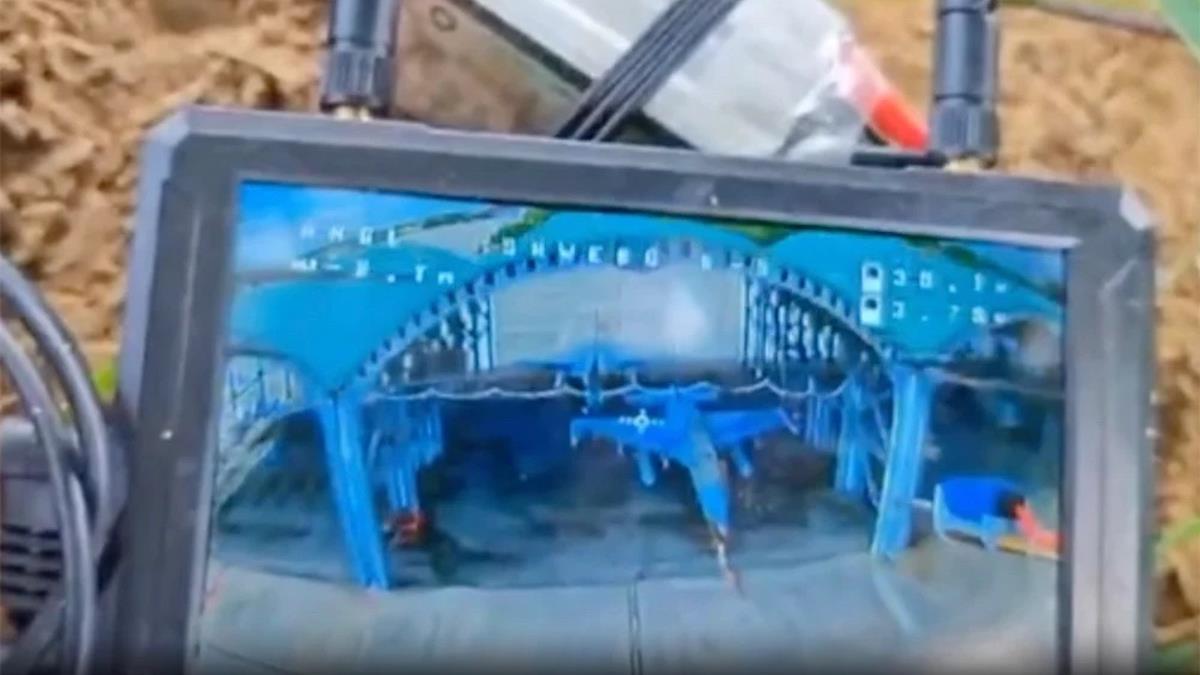
Latest stories Houthis have further tightened their grip on the Red Sea Chinaâ€TMs EVs, LLMs and the stopping power of the real world Fed, battling persistent inflation, ups rates 1st time in 3 yearsVideo footage from cameras mounted on the drones, released the following day by the Myingyan District Drone Strike (MDSS) under the Myingyan District Military Command of the opposition National Unity Government (NUG), showed drones descending toward a row of hangars housing Yakovlev Yak-130 jet-trainer and light attack aircraft.
Whether by happenstance or good planning, the target was well chosen. Before the attack, the MAF is understood to have operated 24 of the heavily armed Russian-built jets, which, since the induction of an initial tranche of six in 2017, have emerged as its most lethally effective ground-attack platform.
The extent of the damage to the jets was impossible to discern from the footage, which blacked out as the drones struck briefly visible protective netting draped across the hangar openings – a defensive measure indicating that the military already took the resistanceâ€TMs drone threat seriously. However, an image later posted on social media showed one of the drones flown in the attack lying unexploded on a nearby taxiway.
In addition to a fiber-optic spool, the quadcopter carried a relatively small explosive device, which one Myanmar military analyst later assessed was comparable to a 60mm mortar bomb, a munition with a lethal radius of around 15 meters. The proximity of the netting where the explosion occurred to the aircraft's nose sections means the drones almost certainly damaged one or more jets. But the available footage does not indicate that the aircraft were destroyed.
A statement later released by the NUG noted that drones accurately targeted areas where the Yak-130 fighters were parked, but notably did not claim that they had been destroyed. And on the regime side of the reporting ledger, the state-run Global New Light of Myanmar daily claimed that the drones had been “successfully intercepted …using counter-drone measures.â€
Beyond the hangars, the raid was harder-hitting. Additional footage released by the MDDS showed one drone descending directly towards ground personnel running for cover across a nearby open area where a vehicle was parked.
A NUG statement later claimed that five MAF personnel had been killed in the operation, including Colonel Myo Hlaing Oo of Air Defense Unit No. 7. It also added that three opposition fighters had also been killed – in a response by security forces that appeared to have unfolded with notable alacrity and precision. Â
The attack was not the first operation in the current civil war using FPV drones to target a MAF airbase. On December 4, 2025, PDF fighters used at least two unmanned combat air systems (UCAS) to attack Toungoo Airbase in eastern Myanmar, apparently targeting the air traffic control tower and an adjacent electronic jammer installation. No MAF aircraft were seen in footage later released by the PDF.
The Tada-U operation was, however, the first evidently well-planned drone attack deploying multiple fiber-optic FPVs to effect and, to this extent, crossed a watershed in opposition capability that, despite the decisive impact of the technology on battlefields in Ukraine and south Lebanon in 2025, has been slow to reach Myanmar.
The challenge now facing resistance forces will be to translate one tactical success into strategic impact capable of disrupting not merely MAF air operations but also critical infrastructure including fuel and ammunition dumps and supply lines countrywide – not all of which can be covered by netting.
Achieving that level of strategic saturation will hinge crucially on the extent to which the opposition alliance, the Steering Council for the Emergence of a Federal Democratic Union (SCEF) – formed earlier this year to include the NUG and major Kachin, Karen and Chin ethnic factions – can prioritize both the sourcing and assembly at scale of component parts required for one or two standardized FPV models and train the personnel needed to pilot them.
Sign up for one of our free newsletters-
The Daily Report
Start your day right with Asia Times' top stories
AT Weekly Report
A weekly roundup of Asia Times' most-read stories
Given the logistical challenges of cross-border supply chains and the SCEFâ€TMs still-untested capacity to translate press statements into real-world operations, this will not be simple. It implies a level of joint planning and coordination that in central Myanmar is still embryonic at best. The good news for the federal opposition is that a template for success is evidently already in operation.
In recent weeks, the KIA has relied heavily on FPV drones in a largely successful effort to block military flotillas sailing over 330 kilometers up the Ayeyarwady from Mandalay to relieve the embattled city of Bhamo near the Chinese border.
In decisive battles from late August into September, KIA drones repeatedly sank and disabled supply barges and the gunboats escorting them through narrow defiles between the river port of Shwegu and Bhamo.
The KIAâ€TMs rainy season Ayeyarwady campaign clearly did not unfold reactively. There can be no doubt it hinged crucially on strategic planning aimed at severing the military regimeâ€TMs riverine lifeline to Bhamo and the north of Kachin State beyond and developing a drone capability commensurate with the mission that notably was not evident last year. That, in turn, implied industrial-scale production and operational distribution that achieved striking results.
Whether part of that KIA distribution reached south to PDFs on the flatlands around Tada-U, an important launchpad for air raids across Kachin State, remains unclear. But against the backdrop of evolving battlefield connectivity across resistance ranks, it is far from impossible. Â
Sign up here to comment on Asia Times stories OrThank you for registering!
-
Share on X (Opens in new window)
Share on LinkedIn (Opens in new window)
LinkedI
Share on Facebook (Opens in new window)
Faceboo
Share on WhatsApp (Opens in new window)
WhatsAp
Share on Reddit (Opens in new window)
Reddi
Email a link to a friend (Opens in new window)
Emai
Print (Opens in new window)
Prin

Legal Disclaimer:
MENAFN provides the
information “as is” without warranty of any kind. We do not accept any
responsibility or liability for the accuracy, content, images, videos,
licenses, completeness, legality, or reliability of the information
contained in this article. If you have any complaints or copyright issues
related to this article, kindly contact the provider above.
Comments
No comment